










Agriculture is adding technology faster than it is adding people who can run it. A competency framework for agriculture & agritech defines what capable looks like in each role, from field operator to farm manager to agronomy lead. But a framework only sets the standard. The organizations that get a return on their agritech spend are the ones that keep verifying, role by role and site by site, that the standard is actually being met.
I. The Farm Is Becoming a Technology Operation
When the drones you bought last season are sitting in a shed, whose problem is that: the vendor’s, the agronomist’s, or the board’s?
Most agricultural businesses can list their technology purchases in minutes. Far fewer can say how many of their people are equipped to run that technology well. The first list is a capital decision. The second is a capability decision, and it decides whether the first ever pays back.
Agritech is no longer an add-on to farming. Precision equipment, sensor networks, farm-management software, drones and remote monitoring now sit inside the daily work of operators, agronomists and farm managers. Each of them is expected to read the data, act on it and answer for the result.
The scale of the people question is large. The World Economic Forum’s Future of Jobs Report 2025 puts farmworkers at the top of the largest-growing jobs by absolute numbers, adding 34 million jobs by 2030 on top of roughly 200 million today. That is tens of millions of roles being created or reshaped in a sector where the tools are changing under the workers’ feet.
The question is the same whether you run farms, a processing operation, an agribusiness supplier or an agritech company selling into the field. Each depends on people who can operate, interpret and support technology, and each carries a gap between the roles it has on paper and the capability it can actually point to.
This is the problem a competency framework for agriculture & agritech exists to solve. It states, role by role, the skills, knowledge and judgment the work now requires. It gives owners, plant heads and HR leaders one language for hiring, training and promotion decisions across farms, processing sites, labs and field teams. Without a competency framework for agriculture & agritech, “skilled” means whatever the last manager thought it meant.
II. Why Agritech Investment Stalls at the People Layer
A. Adoption Barriers Are Capability Barriers
Interest in agritech is not the obstacle. McKinsey’s 2022 survey of 5,500 farmers across Asia, Europe, North America and South America found that 39% were using, or planning to use within two years, at least one agtech product. The hesitation sits elsewhere. Thirty percent of farmers named unclear ROI as a top barrier to adoption, and among European farmers, 32% pointed to complexity in setup and use.
McKinsey frames these as product and pricing problems, and in part they are. There is a second reading worth a CEO’s attention. A tool whose returns are unclear and whose setup is complex is a tool that few people in the organization are equipped to configure, run and read. ROI is not a property of the equipment. It depends on who is operating it, which is exactly what a competency framework for agriculture & agritech is built to define. That reading is ours, not McKinsey’s, but the numbers are consistent with it.
B. What the Gap Costs a CEO or COO
The business cost rarely shows up as a line item called “skills gap”. It shows up as drones that fly twice a season, soil and yield data that is collected and never acted on, and irrigation systems run on the settings the installer left behind. It shows up when the one agronomist who understands the farm-management software goes on leave and nobody else can read the output.
The World Economic Forum’s 2025 jobs report points the same way at a global level. It finds that the skills gap is the most significant barrier to business transformation, cited by 63% of employers, and that employers expect 39% of key skills to change by 2030. In a sector that adds technology every season, the standard a role was hired against two years ago is already out of date.
Sustainability adds a harder edge. McKinsey’s farmer survey also notes that farmers in sustainability programs must verify compliance and keep measuring their impact, with up to 100 data fields recorded across a growing season for some carbon programs. That is a record-keeping capability. If it lives in one diligent person’s habits, the program participation behind it is exposed to that person’s calendar.
For a CEO or COO the consequence is a pattern: capital sitting in underused assets, decisions made on instinct beside data nobody reads, and expansion plans that assume capability exists at the next site because it exists at the first. That is the practical case for a competency framework for agriculture & agritech: it makes the capability behind each investment visible before the investment is made.
C. Where the Knowledge Actually Sits
McKinsey’s farmer survey also asked farmers whom they trust for information on new products. Agronomists came first, followed by neighboring farmers, then sales representatives, with online sources last. Read that as a map of where agricultural know-how lives: in people, built over seasons and shared by proximity.
That is a strength until it becomes a dependency. Knowledge held by a handful of trusted individuals is hard to compare, hard to plan around and hard to replace when they move, retire or are hired away. A competency framework for agriculture & agritech turns that tacit expertise into a defined standard the whole organization can see, which is the first step toward knowing how much of it you actually have.
III. What a Competency Framework for Agriculture & Agritech Must Cover
A framework earns its place when it describes the work, not the job title. A generic “digital skills” line says nothing about reading a soil-moisture alert and deciding whether to irrigate. That is why domain specific competency frameworks outperform generic skill lists: they are written in the language of the actual work. The framework has to serve a wide range of roles: field operators and equipment technicians, agronomists and crop advisers, farm and plant managers, data and systems owners, and the product, sales and support teams inside agritech companies. Three areas of capability recur across all of them, in different proportions.
A. Technical Operation
This area of the competency framework for agriculture & agritech is the ability to run and maintain the technology in field conditions. It covers precision farming equipment, connected devices and sensors, drone operation and upkeep, and smart irrigation, including what to do when something fails mid-season. The test is demonstrated ability under real conditions, not familiarity with the vocabulary. An operator who can describe a variable-rate system and one who can run it on a wet day are not the same hire.
B. Digital Fluency
Technology produces data, and data only matters if someone reads it correctly. This area of the competency framework for agriculture & agritech covers working with farm-management software, mobile tools, cloud platforms, digital record-keeping and remote monitoring. The practical question is whether records are accurate, current and used. A yield map nobody interprets is a cost, not an asset.
C. Sustainable Practice
Resource optimization, environmental impact assessment, climate-smart methods, renewable energy use and waste management are moving from good intentions to reporting obligations. Capability here means being able to act on those practices and to show that they happened. A competency framework for agriculture & agritech that leaves sustainability out will be out of date as soon as the next reporting requirement arrives.
Taken together, the three areas give a leader a practical test for any role: can this person run the technology, read what it produces and stand behind the sustainability claims attached to it? A competency framework for agriculture & agritech that answers those three questions for every critical role is doing its job.
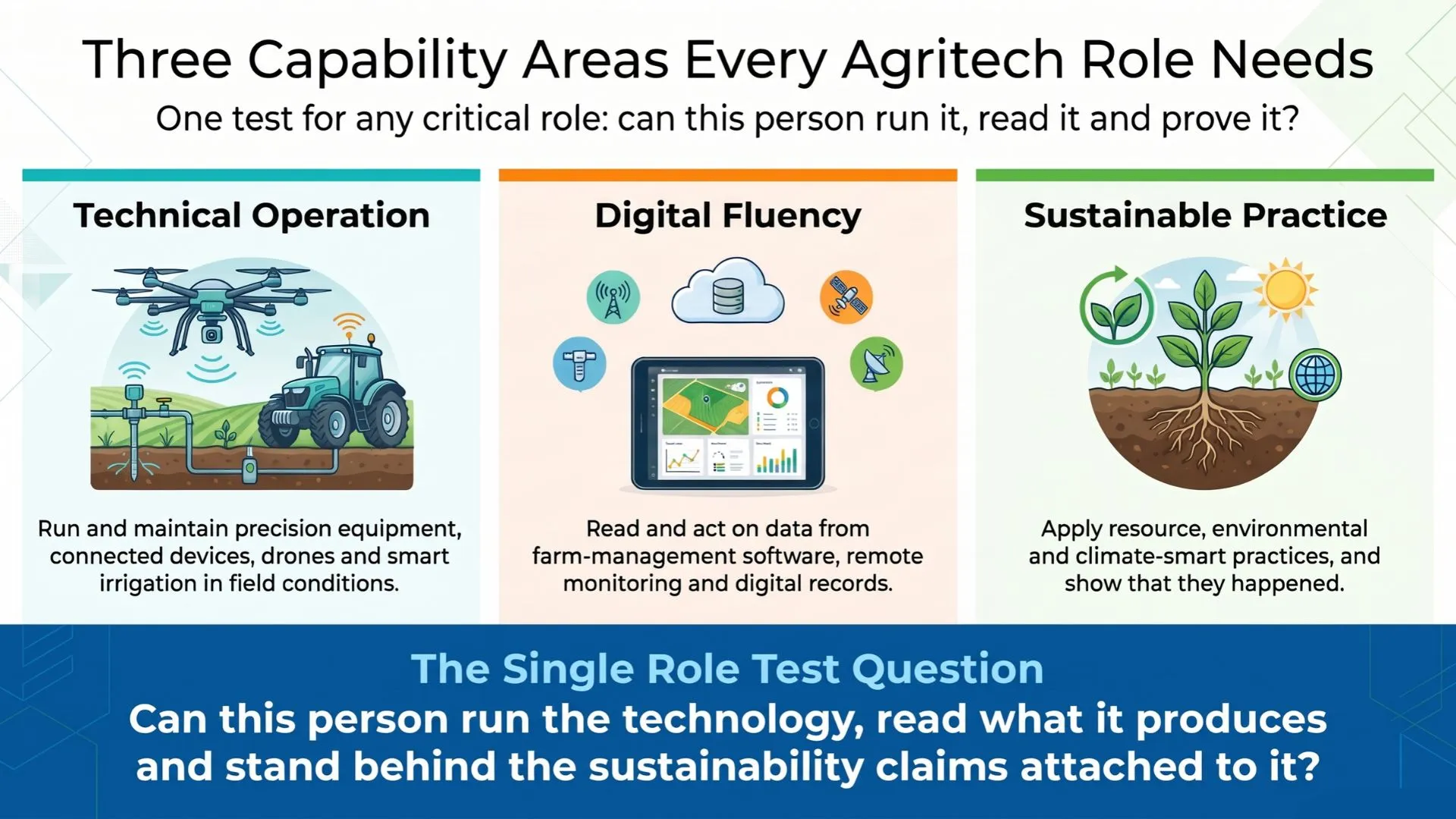
One test for any critical role: can this person run it, read it and prove it?
IV. From Assessing Skills to Assuring Capability
Most agricultural organizations have assessed capability at some point: a training needs review before a new platform rollout, a skills survey after a restructure. Almost none can assure it. Assessment is a photograph. By the time anyone acts on it, the season has turned, the equipment has changed and the person who ran the system has moved on.
Agriculture makes the photograph go stale faster than most sectors. Seasonal hiring, equipment cycles, new reporting rules and a workforce that moves between employers all change the picture between one review and the next. A one-off review against the competency framework for agriculture & agritech tells you only where you stood in the month it was run.
Assurance works more like the way finance treats its numbers: continuously verified, always current, trusted enough to make decisions on. A competency framework for agriculture & agritech supplies the standard. Verification keeps it honest.
Defined standard + continuous verification = capability you can plan around.
This changes the conversation at the top. When a CEO asks whether the precision-farming program can run at the second site, the answer no longer depends on who is in the room. It comes from a current picture of named people measured against a defined standard. Judgment still matters, and it should. What changes is that judgment becomes structured, multi-perspective and anchored to a common standard, so it is comparable across people and sites and revisited over time instead of recalled under pressure.
V. Putting the Framework to Work
Building the standard well is a discipline of its own, and PeopleBlox’s guide to how competency frameworks are built and why most fail covers it. Once the competency framework for agriculture & agritech exists, four moves decide whether it changes anything.
A. Define the Standard by Role, Not by Technology
Write what a capable operator, farm manager or agronomy lead does, in terms a site head would recognize. Tie each role to the outcomes the business needs from it: acres managed to plan, equipment uptime, data quality, compliance records. A standard written around a product dies with the product. A standard written around the work survives the next upgrade. Resist the urge to list every tool on the market. Name the capability the work needs and let the tools change underneath it.
B. Judge Capability Against the Standard, Site by Site
Using the competency framework for agriculture & agritech as the yardstick, look at where capability stands today for each critical role at each location. The point is not a score for its own sake. It is knowing which site is ready for the next rollout, which depends on a single person, and which needs development before it takes on more technology. A shared standard is what makes that comparison fair, and where the same role exists at several sites it also shows whether one location’s practice should become the standard for the others.
C. Connect the Standard to Hiring, Development and Succession
A competency framework for agriculture & agritech that lives in a document changes nothing. Use it to write hiring criteria, to aim training spend at confirmed gaps instead of guesses, and to name who could step into a critical role when the current holder leaves. Recruitment, performance conversations and career paths should all point at the same definition of capable. For a CEO, this is where the framework stops being an HR document and starts touching the budget.
D. Keep the Standard Current
Technology will not wait for the next annual review. The World Economic Forum’s expectation that 39% of key skills will change by 2030 is a reason to revisit role standards when new equipment or software enters the operation, not when the calendar says so. Review triggers should follow the technology: treat each major equipment or software change as a prompt to ask whether the role standard still describes the work.
The agricultural businesses that can say which site is ready for the next rollout are not luckier. They verified capability before they bought the equipment.
VI. How PeopleBlox Helps?
Capability Assurance is the discipline of continuously verifying, not just assessing, that your organization has the capabilities its strategy requires. PeopleBlox is the platform built for it. For an agriculture or agritech business, that means defining the standard for every critical role, verifying people against it, and keeping it current as a standing discipline instead of a one-off project. A competency framework for agriculture & agritech gives that verification something to measure against.
Organizational Capability Assurance applies that verification across the critical roles that carry the operation: the equipment operators, agronomists, site managers and data owners whose capability decides whether your technology investment pays back. Leadership Capability Assurance applies the same discipline to the leaders and successors who will carry the operation through the next expansion or the next leadership transition.
The frameworks behind PeopleBlox are built to a level of structure and detail most organizations never reach, and the platform is built around them. What that gives a leader is narrow and useful. When you ask whether a site is ready to run the next technology rollout, the answer comes back anchored to a defined standard and consistent across every person and location you are comparing, instead of assembled from whoever happened to be in the room.
That picture lands in the Capability Command Center: one place where the readiness of every critical role is visible at once, so the conversation about the next investment starts from a current view instead of a reconstruction.




read next

Capability Mapping for Business Roles: Why Old Role Expectations Create New Execution Risk

Capability Visibility: The Missing Link Between Strategy and Execution