










Aerospace and defense programs stall where a required skill is missing, not where the plan is weak. Most organizations can show who completed training, but few can show who can perform the work the program demands. A competency framework for aerospace & defense closes that gap only when capability is verified against a defined standard and kept current. This guide sets out how CHROs build that discipline and what it lets them answer when the program office asks.
I. When the Skill Gap Reaches the Program
When the program office asks whether you have the people to staff the next phase, how long does the pause last?
Most aerospace and defense organizations can produce a headcount in minutes. A defensible answer about capability takes weeks, and by then the schedule has already absorbed the delay. The gap between those two speeds is where programs lose time, and it is a capability problem long before it becomes a hiring problem.
A. A Shortage Measured in Programs, Not Positions
Deloitte and The Manufacturing Institute project that US manufacturing could need as many as 3.8 million new workers between 2024 and 2033, and that about 1.9 million of those jobs could go unfilled if skills and applicant gaps persist. That figure covers manufacturing as a whole, not aerospace and defense alone. But A&D sits inside it, and it draws on the same limited pool of engineers, technicians, and quality specialists.
Deloitte’s aerospace and defense outlook points the same way: talent attraction and retention challenges that ran through 2024 carried into 2025.
For a CHRO, the practical reading is simple. You will not hire your way out of this. The capability you already employ has to be understood, protected, and grown with more precision than a headcount report allows.
B. Why Headcount Hides the Problem
A filled role is not the same as a capable role. A position can be staffed, reviewed, and rated satisfactory while the person in it lacks the specific technical or regulatory depth the next program phase requires. Nobody sees the gap until a milestone slips, an audit finding lands, or a certified specialist resigns.
The organization then explains the delay in the language of schedule and supply chain. The root cause sits in the workforce, but the workforce data never showed it.
II. What an Unverified Skill Gap Costs
Skill gaps in aerospace and defense do not announce themselves as HR problems. They arrive as rework, deferred milestones, and findings in front of a regulator.
A. The Cost Shows Up Everywhere Except the HR Report
Consider where capability shortfalls land. A test campaign repeats because the team lacked one specialist skill. A design review passes work that a more experienced reviewer would have stopped. A compliance obligation is met on paper by people who have never applied it under pressure. Each of these is an operational event, and none is recorded as a talent event.
In safety-critical work, the stakes extend past cost. Delayed projects and rising expense are the visible results. Compromised safety is the one no leader accepts, and it is the hardest to trace back to a workforce cause after the fact.
So when a CEO asks why a milestone moved, a training completion rate is not an answer. The CHRO needs to show where capability stood against what the work required, and whether anyone knew.
B. The Skills Under Each Role Keep Moving
Deloitte’s same outlook cites a survey in which 81% of aerospace and defense respondents already use or plan to use AI and machine learning. Every one of those deployments changes what a role requires, and the role description rarely changes with it.
The World Economic Forum’s Future of Jobs Report 2025 widens the lens. Employers expect 39% of core skills to change by 2030, and 59 of every 100 workers to need training by then. Even if A&D moves more slowly than the global average, a standard written once will be out of date before the next program phase begins.
III. Why a Competency Framework for Aerospace & Defense Is Not a Skills List
A. What the Framework Defines
A competency framework for aerospace & defense is a structured model of the knowledge, skills, and behaviors each role needs to perform safely and to standard. It answers one question for every critical role: what does good look like here? Without that answer, performance reviews, training budgets, and succession calls rest on each manager’s private definition.
B. The Areas It Must Cover
Aerospace and defense roles draw on five broad areas, and a useful framework covers all of them:
- Technical depth: aerodynamics, avionics, propulsion, cybersecurity, and systems engineering.
- Regulatory and compliance knowledge: the FAA, NASA, and Department of Defense requirements and international standards that govern the work.
- Leadership and management: decision-making, team direction, and judgment under schedule pressure.
- Problem-solving and innovation: critical thinking and the ability to work through novel engineering problems.
- Communication and collaboration: effective work across disciplines, suppliers, and customers.
A skills list names topics. A framework sets the standard against which people in a role are judged on those topics, and that standard has to hold across sites and programs.
C. From Assessed to Assured
Most organizations have assessed capability at some point: a skills audit before a bid, a competency review ahead of a restructure. Almost none can assure it. An assessment is a photograph. By the time anyone acts on it, programs have moved, people have left, and requirements have changed.
Assurance works the way finance treats its numbers. The picture is continuously verified, always current, and trusted enough to make decisions on. Judgment is still human, and it should be. What changes is that it becomes structured, anchored to a common standard, comparable across people and roles, and revisited over time rather than recalled under pressure.
Defined standard + current review = readiness you can defend.
IV. Building and Running the Framework
Five steps turn a competency framework for aerospace & defense from a document into a working control. Each one has to produce something a leader can act on.
A. Start With the Roles the Program Cannot Lose
Begin with an audit, but not of everyone. Identify the roles where a vacancy or a capability shortfall would stop or endanger a program: the lead test engineer, the certification authority, the specialist few others can replace. Map who holds each role today and how much of the capability sits with one person. This narrows the work and focuses the leadership conversation on exposure, not coverage.
B. Define What Good Looks Like for Each Role
Work with engineering leads and regulatory owners to set the standard for each role across technical, regulatory, and leadership work. The standard should be specific enough that two managers at two sites read it the same way. This is the step most organizations shortcut, and every later step depends on it.
C. Tie Development to the Gap, Not the Catalogue
Training catalogues grow because they are easy to add to. Development that closes real gaps starts from the standard and works backward: which gaps matter most for the next program phase, who carries them, and what will close them. Courses, certifications, mentoring, and on-the-job assignments all qualify when they answer a named gap, and none of them qualify when they do not.
D. Review Capability From More Than One Vantage Point
A performance review tells you how someone delivered last year. A capability review tells you how someone stands against the defined standard today. The strongest reviews draw on more than one perspective, because the distance between how people see their own capability and how others see it is itself a signal worth acting on. The conversation then moves from rating people to deciding what happens next.
E. Keep the Standard Current
New platforms, new regulatory requirements, and new tools change what a role demands. Set a review rhythm for the framework itself, triggered by program starts, regulatory changes, and technology adoption, not only by the calendar. A framework that is correct at launch and stale a year later gives leaders false comfort, which is worse than having none.
V. What Your CEO Will Ask
The questions that decide how seriously the business takes HR arrive from the program side, and they are specific:
- Which critical roles are carried by a single person?
- Where is the standard not met today, and by how much?
- Are the gaps closing, or only being discussed?
- If we win the next contract, do we have the depth to staff it?
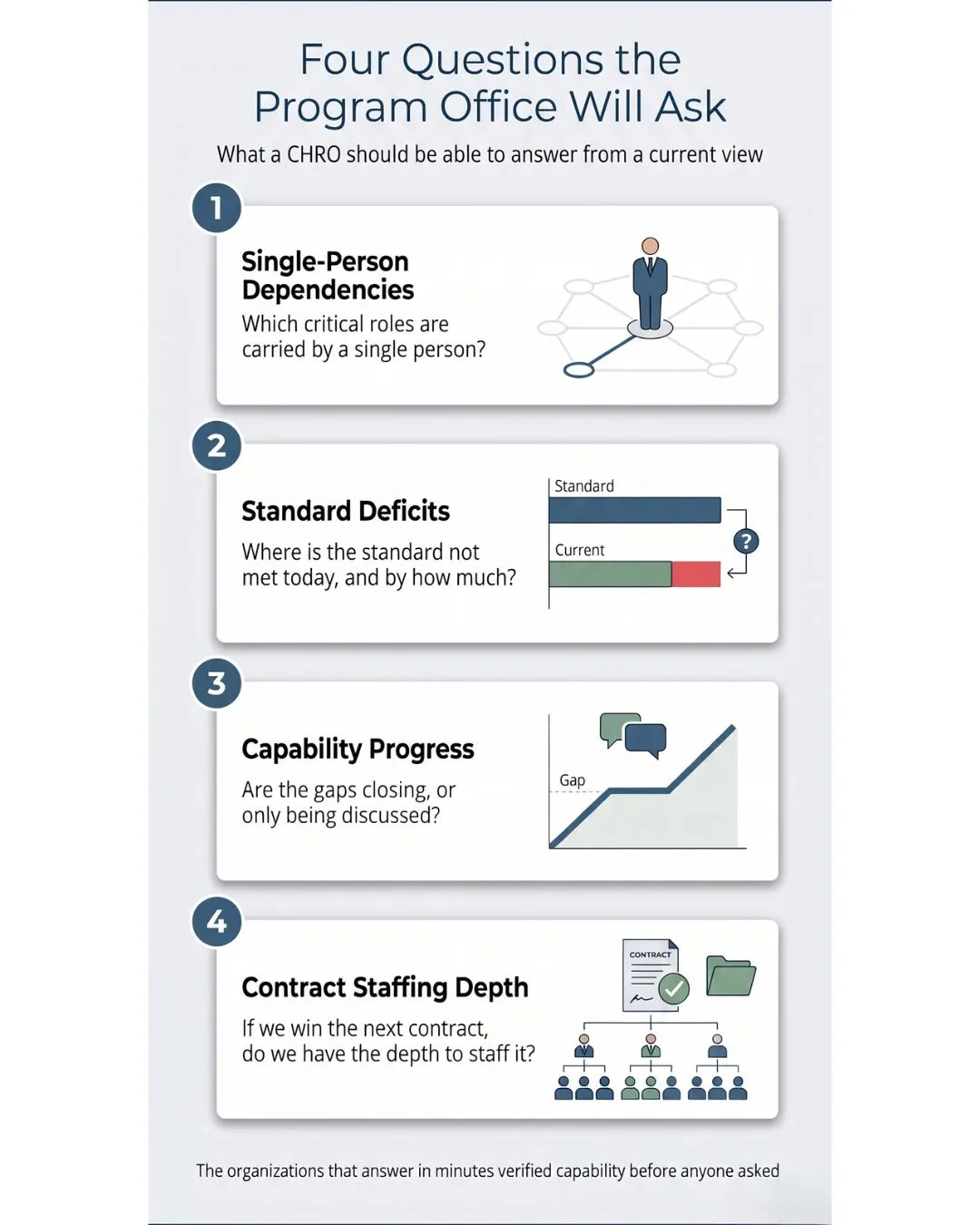
What a CHRO should be able to answer from a current view
A CHRO who answers these from a current view, rather than from a reconstruction assembled that week, changes HR’s standing in the room. The same view supports stronger workforce decisions across hiring, development, and succession, and it shows whether the organization has the expert depth to carry the plan before the plan is committed.
The organizations that answer the program office in minutes did not get lucky; they verified capability before anyone asked.
VI. How PeopleBlox Helps?
The discipline of keeping capability verified rather than assumed has a name: Capability Assurance, the discipline of continuously verifying, not just assessing, that your organization has the capabilities its strategy requires.
For workforce and skills questions like the ones above, this is the work of Organizational Capability Assurance: one view of capability strength, role gaps, and team readiness across the business. It applies the verification to every critical role, so a CHRO can show where readiness is solid, where it is thin, and which gaps could slow a program if left alone. Leadership Capability Assurance applies the same verification to the people expected to lead programs and step into key positions, so succession conversations start from a current picture instead of a reconstruction.
The frameworks behind PeopleBlox are built to a level of structure and detail most organizations never reach, and the platform is built around them. What that buys a CHRO is narrow and useful. When a program asks whether a role is ready, the answer is anchored to a defined standard and consistent across every person being compared, instead of assembled from whoever happened to be in the room.
Where this lands for a leader is the Capability Command Center: one connected view of organizational readiness, strategic exposure, development progress, retention risk, succession, and KPI risk. The readiness conversation moves from anecdote to a shared picture that HR, engineering, and the executive team can all read.




read next

Capability Mapping for Business Roles: Why Old Role Expectations Create New Execution Risk

Capability Visibility: The Missing Link Between Strategy and Execution