










Most businesses track revenue, costs, hiring, performance, and training, yet still cannot see what their people are actually capable of delivering. A Capability Management Platform closes that gap by connecting roles, skills, readiness, development, succession, and workforce risk into one business layer. It moves leaders from reporting activity to proving capability movement, so strategy decisions rest on evidence instead of assumption.
Every business review has a familiar rhythm.
- Revenue is tracked.
- Costs are tracked.
- Hiring numbers are tracked.
- Attrition is tracked.
- Performance ratings are tracked.
- Training completion is tracked.
The dashboards are full. The reports are polished. The leadership meetings are structured.
But one question still remains uncomfortable.
Can the business clearly see what its people are actually capable of delivering?
Not what roles they hold. Not how many years of experience they carry. Not how many courses they completed. Not how they performed last year.
Capability.
That is the missing operating layer in most organizations. And when capability is not visible, leaders end up making critical decisions with incomplete information.
They hire without knowing the real gap. They promote without knowing readiness. They train without knowing priority. They build succession plans without knowing who can actually step up. They approve strategy without knowing whether the organization has the capability to execute it.
This is exactly the gap PeopleBlox is built to solve.
PeopleBlox brings leadership and organizational capability together through a Capability Assurance: a connected way for leaders to map roles, measure capability, identify gaps, build readiness, and make talent decisions with evidence.
I. The Problem Is Not Lack of Data. It Is Lack of Capability Visibility.
Most organizations are not short of HR data.
They have employee data. They have performance data. They have learning data. They have hiring data. They have engagement data. They have succession documents.
But these systems often answer different questions.
The HRMS tells you who exists in the organization. The LMS tells you who completed training. The PMS tells you how people were rated. The ATS tells you who entered the pipeline. The succession sheet tells you who has been nominated.
None of these, by themselves, tell the business what it needs to know most:
- Who is ready for what?
- Where is capability strong?
- Where is it weak?
- Which gaps matter most
- Which roles carry execution risk?
That is why capability cannot stay buried inside spreadsheets, role documents, manager opinions, or annual review cycles.
It needs to become visible. Measurable. Comparable. Actionable.
That is where a Capability Management Platform becomes important. Not as another HR tool. But as a business layer that connects roles, skills, proficiency, readiness, development, succession, and workforce risk.
II. Why This Matters Now?
Capability was always important. But today, the pressure is sharper.
The World Economic Forum’s Future of Jobs Report 2025 finds that employers expect 39% of workers’ core skills to change by 2030.
LinkedIn’s 2025 Workplace Learning Report says 49% of learning and talent professionals agree that their executives are concerned employees do not have the right skills to execute business strategy.
IBM has reported that executives estimate 40% of their workforce will need reskilling because of AI and automation over the next three years.
Deloitte has also found that only 10% of HR executives say they effectively classify and organize skills into a skills taxonomy or framework.
Put these together, and the message is direct.
The business environment is changing faster than most organizations can see capability.
This creates a dangerous gap. Strategy moves ahead. Technology moves ahead. Customer expectations move ahead. Operating models move ahead. But workforce capability often gets reviewed later, after performance slows, execution slips, or leadership gaps become visible.
That delay is expensive.
Capability should not be discovered after the business starts struggling. It should be visible before decisions are made.
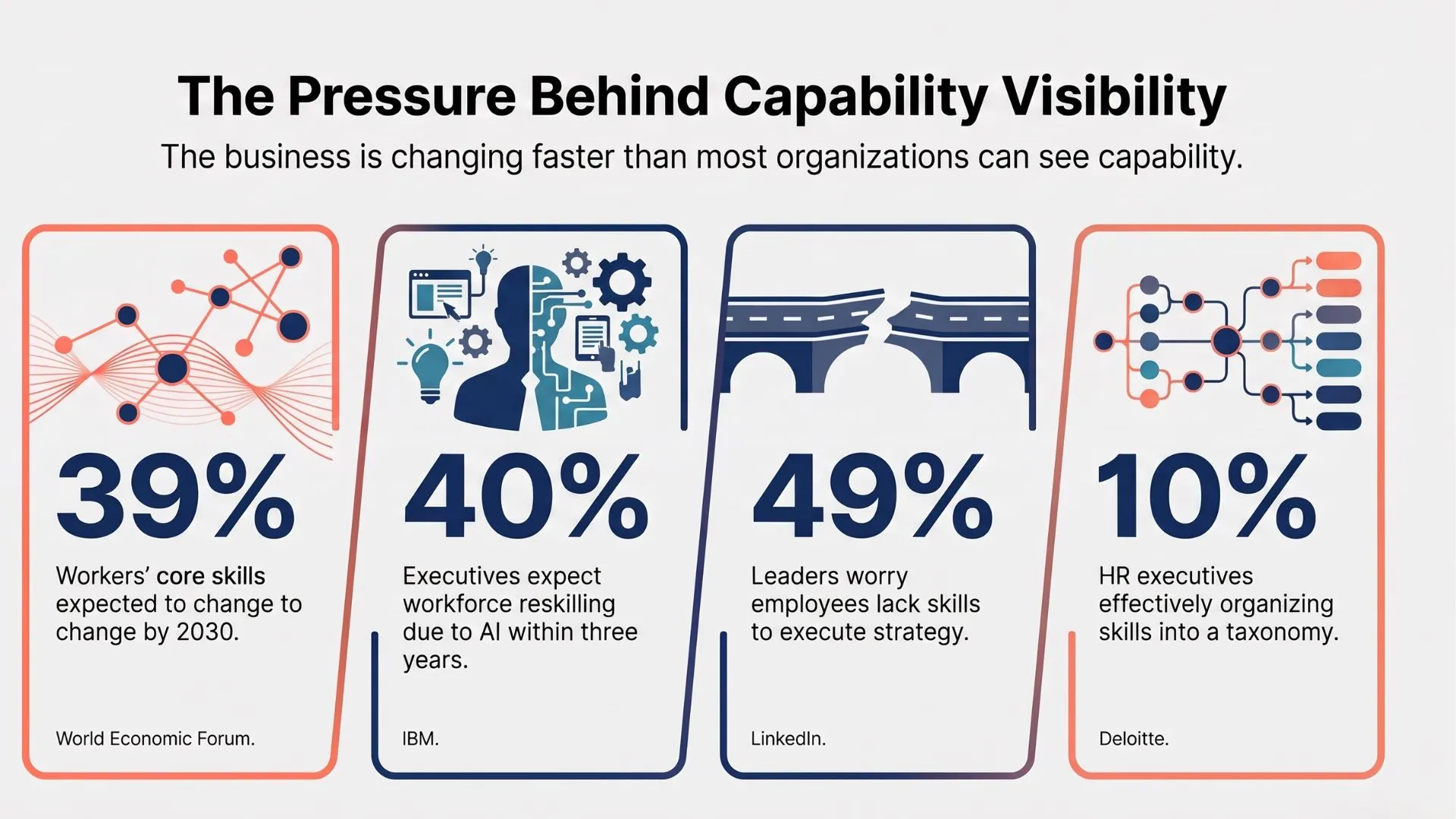
The business is changing faster than most organizations can see capability.
III. The Business Mistake: Confusing Activity with Readiness
Many organizations mistake activity for capability movement.
A hiring drive is not capability building. A training calendar is not capability building. A performance review is not capability building. A succession list is not capability building. A competency framework in a PDF is not capability building.
These are inputs.
The real question is whether capability has moved.
Has the team become stronger? Has the critical gap reduced? Is the person now ready for the role? Can the next leader take charge without business disruption? Can the function execute the next strategy cycle?
This is where most organizations struggle. They know what activity happened. But they cannot always prove what changed.
A Capability Assurance changes the conversation. It helps leaders move from:
“We trained 400 people” to “Capability gaps reduced in these priority roles.”
From: “We have successors identified” to “These successors are ready, nearly ready, or at risk.”
From: “We need to hire more people” to “We need to hire for these specific capability gaps.”
From: “This team is underperforming” to “This team has uneven capability depth across critical role expectations.”
That shift matters. Because business leaders do not need more HR activity. They need better readiness intelligence.
IV. What Leading Companies Are Already Showing Us
Some of the world’s most respected companies have already shown that talent decisions need stronger capability visibility.
A. Microsoft: The Capability Shift Beneath the Transformation
Microsoft’s transformation under Satya Nadella is often discussed as a strategy and culture story. But underneath the transformation was a capability shift. The company had to move from a risk-averse, “know-it-all” culture to a more adaptive, learning-oriented, growth mindset culture. Strategy alone did not change Microsoft. Leadership capability, mindset, and organizational behavior had to move with it.
B. Schneider Electric: Making Internal Capability Movable
Schneider Electric built its Open Talent Market to improve internal mobility at scale. With 135,000 employees across more than 100 countries, Schneider needed a better way to connect people with roles, projects, mentors, and learning opportunities. This was not just an HR experience upgrade. It was a way to make internal capability more visible and movable.
C. Unilever: Assessing Capability More Deliberately in Hiring
Unilever’s AI-led recruitment work showed another side of the same problem. By using digital assessments and AI-supported screening, Unilever reduced around 70,000 person-hours from candidate interviewing and assessment. The larger lesson is not simply automation. It is that hiring improves when organizations assess fit, potential, and capability more deliberately.
D. IBM: Why Reskilling Numbers Are Not Enough
IBM’s research on reskilling shows why this issue is becoming urgent. If 40% of the workforce needs reskilling because of AI and automation, then organizations cannot rely only on learning participation numbers. They need to know which capabilities must shift, in which roles, and how fast.
These examples point to the same truth. The future of workforce management is not just about managing people. It is about managing capability.
V. What a Capability Management Platform Should Actually Do
A strong Capability Management Platform should not simply store competency libraries. It should help the organization answer real business questions.
What does success look like for every critical role? Which capabilities matter most for business execution? What does readiness look like at each level of responsibility? Where does the current workforce stand today? Which gaps are urgent? Which gaps are acceptable? Which gaps create business risk? Which development actions will matter most? Who is ready for larger responsibility? Where is leadership continuity weak?
At PeopleBlox, this is the reason behind the Capability Assurance approach. It connects a defined capability standard for every role with assessment, readiness, development, succession, and business visibility.
The Leadership Capability Assurance helps organizations see leadership readiness, bench strength, successor depth, and critical role risk. The Organizational Capability Assurance helps organizations see capability strength across roles, teams, functions, and business units. Together, they create one connected view of workforce readiness.
Not a static framework. Not a training tracker. Not a succession spreadsheet. Not a generic HR dashboard.
A live capability layer for better business decisions.
That discipline has a name: Capability Assurance, the practice of continuously verifying, not just assessing, that your organization has the capabilities its strategy requires.
VI. Why CEOs and CHROs Need the Same View
Capability cannot remain only an HR conversation.
For CHROs, capability visibility helps prioritize development, succession, mobility, and workforce planning.
For CEOs and business leaders, capability visibility helps answer a sharper question:
Can the organization execute what the business has committed to deliver?
That is where the conversation changes. Capability gaps become business risks. Readiness becomes an execution metric. Succession becomes continuity planning. Development becomes targeted investment. Hiring becomes a gap-closing decision.
This is why PeopleBlox positions capability as an operating layer, not a side process. Because every major business decision has a capability assumption inside it.
Growth assumes capability. Expansion assumes capability. Digital transformation assumes capability. Customer delivery assumes capability. Succession assumes capability. Innovation assumes capability.
When that assumption is wrong, the business feels it later.
VII. The Next Talent Risk Is Already Forming
Most organizations do not fail because they do not have people. They struggle because they cannot clearly see whether the right capability exists in the right place, at the right depth, at the right time.
That blind spot is becoming too large to ignore.
The question is no longer whether capability needs to be measured. The question is how long organizations can afford to operate without seeing it clearly.
PeopleBlox Capability Assurance gives leaders a connected way to move from assumption to evidence. From roles to readiness. From gaps to priorities. From development to measurable movement. From succession names to successor confidence. From scattered HR data to business-ready capability intelligence.
Because the business may already be tracking everything. Except the one thing it will need most. Capability.




read next

Capability Mapping for Business Roles: Why Old Role Expectations Create New Execution Risk

Capability Visibility: The Missing Link Between Strategy and Execution