










I. Introduction
When two VPs are competing for the same regional GM role, what actually goes in front of the board to justify the call?
Most executive teams answer with tenure, a gut read, or a hallway consensus nobody can point to on paper afterward. That’s not a decision process. It’s opinion dressed up as one, and it holds together right until the wrong person gets the job and the cost shows up eighteen months later as a missed target, a stalled expansion, or a costly re-hire.
The gap is common, not rare. SHRM survey data show that just 21 percent of HR professionals report having a formal succession plan in place, while 56 percent report having no plan at all. Most boards are one resignation away from exactly the scramble that creates.
A competency framework exists to close that gap. It puts a name and a working definition on the specific behaviors that separate strong performance from weak performance in a role, so decisions about who leads, who gets promoted, and who is genuinely ready stop being reconstructed from memory in a closed-door meeting.
Most competency frameworks never deliver on that promise. Not because the definitions inside them are wrong, but because a document sitting in a shared drive doesn’t change a single decision on its own. This piece covers what a competency framework actually is, what belongs inside one, why most quietly stop working within a couple of years of launch, and what it takes to turn one from a reference document into something a business actually runs on.
II. What Is a Competency Framework?
A competency framework is a structured model that defines, for a role or role family, the specific behaviors, knowledge, and level of proficiency required to perform well. Not what the job entails on paper, but what good performance actually looks like when someone does the job.
A working framework specifies three things:
- Which behaviors matter for that role, the competencies themselves (things like strategic judgment, stakeholder influence, or technical problem-solving, depending on the role)
- What level of each behavior counts as strong, versus developing, versus not yet ready
- How those expectations shift across role types, an individual contributor, a functional specialist, and a people leader are held to different standards even inside the same competency
Two distinctions are worth getting straight early, because they get blurred constantly in HR conversations.
A. Competence versus competency
Competence describes the output: whether someone can actually do the job. Competency describes the input: the behaviors and judgment that produce that output. A salesperson can be “competent,” they close deals, without anyone being able to say which specific competencies, negotiation, objection handling, relationship building, are doing the work. A framework exists to make that input visible and repeatable.
B. Skill versus competency
A skill is task-level: something concrete and demonstrable, like writing SQL or running a P&L. A competency is broader: the mix of behavior, judgment, and experience that lets someone apply several skills well in a real, messy situation. Skills can be checked off a list. Competencies have to be observed in context, which is exactly why they’re harder to standardize and easier to fake in an interview.
Put together, a competency framework is the tool that turns “we know good performance when we see it” into something a business can actually hire against, promote against, and defend to a board.
III. Why It’s a Business Question, Not Just an HR One
HR typically owns the framework. The business owns what happens when nobody built one.
Every growth plan, every transformation roadmap, every succession slide assumes the people executing it are actually ready. That assumption gets tested constantly and confirmed rarely. The World Economic Forum’s Future of Jobs Report 2025 found that employers expect 39 percent of the skills their workforce relies on today to change by 2030, and 63 percent already name skills gaps as the single biggest barrier to executing their strategy. That’s not a training problem. It’s a visibility problem: most leadership teams cannot say, with any confidence, whether the people in critical roles today can still do the job the strategy needs done tomorrow.
This is why boards increasingly ask a blunter version of the succession question: who could break the business if they walked out tomorrow? A competency framework is the only honest way to answer that. Without one, the answer is a guess dressed up as confidence. With one, at least the standard being measured against is written down and consistent across every candidate in the room.
For regulated industries, BFSI, pharma, anywhere an auditor or regulator can ask how a leadership decision was made, this stops being optional. “We felt he was ready” doesn’t hold up in front of a board risk committee. A documented, role-specific standard does.
And the cost of getting it wrong compounds. A bad promotion isn’t just a performance problem. It’s a re-hiring cost, a morale hit to whoever was passed over unfairly, and a stalled initiative while the wrong person tries to grow into a role they were never actually measured against.
IV. The Building Blocks: What a Competency Framework Actually Contains
Most frameworks fail before they’re even built, because they try to cover everything at once instead of layering competencies with a clear logic. A working framework separates into six layers, each answering a different question.
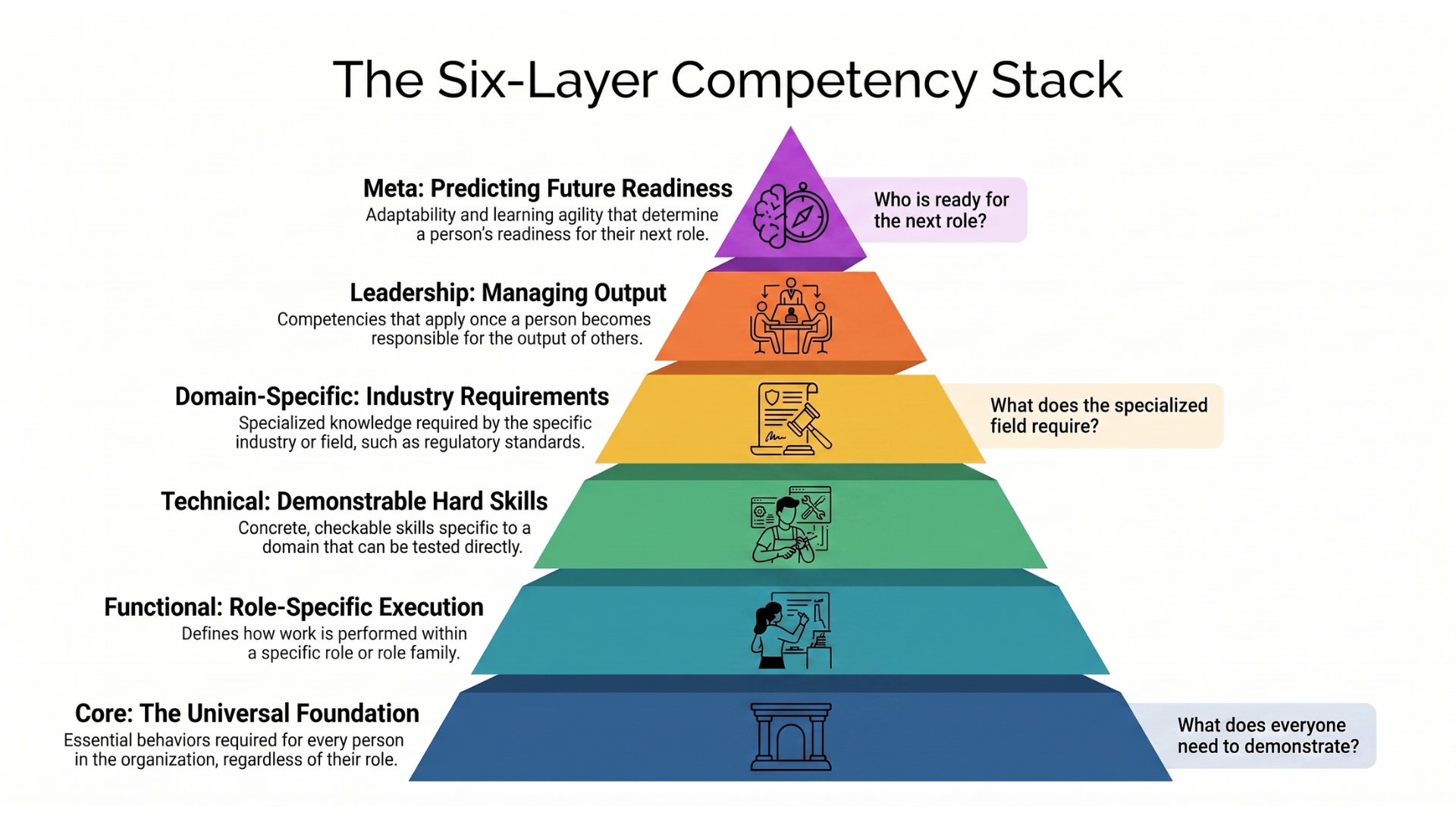
Fig 1: Six Layer Competency Stack
A. Core competencies
What does everyone in the organization need to demonstrate, regardless of role? Usually a small set (communication, judgment, adaptability) tied to how the company actually operates, not generic virtues copied from a template.
B. Functional competencies
What does this specific role or role family need beyond the core, in terms of how the work actually gets done? Stakeholder management for a finance leader looks different from stakeholder management for a sales leader, even though both sit under the same functional heading.
C. Technical competencies
What demonstrable, checkable hard skill does the role require, independent of behavior? A programming language, financial modeling, an engineering standard, these can be tested directly in a way behavior can’t, and they belong in their own layer rather than folded into “functional.”
D. Domain-specific competencies
What does this particular industry or specialized field require, on top of the role itself? BFSI regulatory knowledge, pharma compliance standards, aerospace certifications, these don’t change because someone is good at the underlying function. They’re a separate axis, and frameworks that skip it are exactly where domain specifics get lost once things get generic.
E. Leadership competencies
What changes once someone is responsible for other people’s output, not just their own? Stakeholder influence, delegation, and decision-making under ambiguity belong here, applied on top of every layer below, not instead of them.
F. Meta competencies
What matters regardless of today’s role, because it determines how fast someone can move into tomorrow’s? Learning agility and adaptability sit here. They’re the hardest to assess and the most predictive of who is actually promotable versus who is simply good at their current job.
Layered this way, a framework stops trying to answer one impossible question, “is this person good?”, and starts answering six answerable ones, each at the right altitude.
V. Proficiency Levels: The Part Most Competency Frameworks Skip
A list of competencies without proficiency levels is a vocabulary, not a framework. It tells you what to look for, not what “good” actually looks like at a given level of seniority, or what separates someone who is competent from someone who has genuinely mastered the competency.
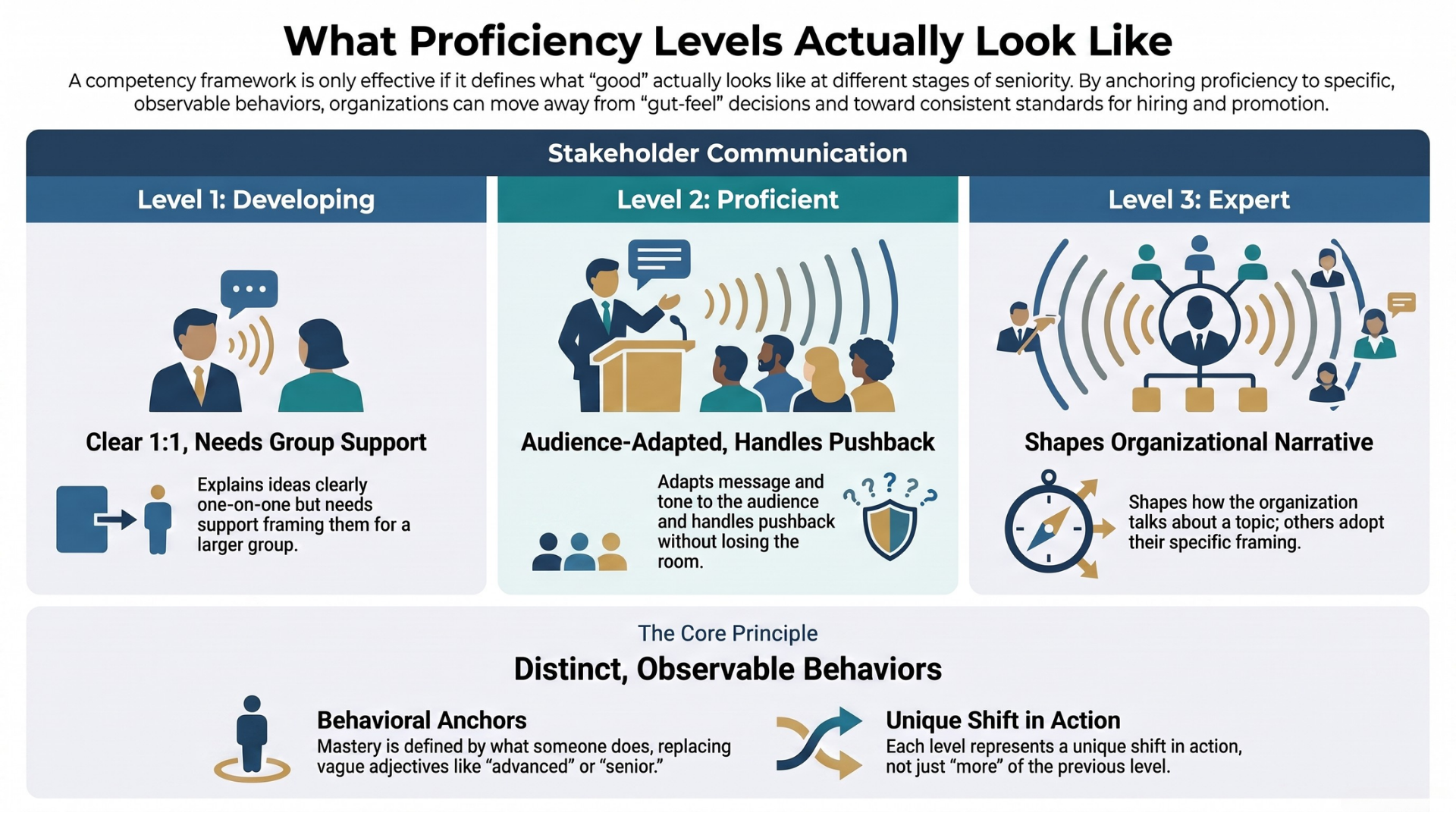
Fig 2: What Proficiency Levels Actually Look Like
The missing piece is usually a leveled structure: the same competency, defined differently depending on the level of mastery expected, each level anchored to specific, observable behavior rather than a vague adjective like “advanced.”
The OECD’s own Core Competency Framework is a useful public example, precisely because it’s public and free of the vendor gloss most competency content carries. It defines three mastery levels, Performing, Inspiring, and Leading, and applies them consistently across every competency in the model. What makes it instructive isn’t the specific labels. It’s the structure underneath them: each level comes with concrete behavioral examples of what strong performance looks like, and, less commonly, examples of what ineffective performance looks like at that same level. That second half matters more than it sounds. Most frameworks describe the target and stop there. Documenting the failure mode alongside it is what actually lets two different managers rate the same person the same way, instead of each applying their own private definition of “strong.”
This is the layer most internal competency frameworks skip, not because it’s unimportant, but because it’s genuinely hard to do well. Writing one clean behavioral description per competency is manageable. Writing three or four distinct levels of it, precise enough that raters converge instead of drift, is a different order of effort entirely. It’s also the layer that decides whether a framework can actually support a promotion decision, or just describes a role.
VI. Measuring It: Where Most Competency Frameworks Lose Credibility
Defining the levels is only half the problem. The other half is deciding how anyone actually gets rated against them, and that’s where most frameworks quietly lose the room.
The two default options both carry real costs. Pure self-assessment is fast and gives an honest first read of how someone sees their own performance, but it drifts toward generosity over time; almost nobody rates themselves below expectation. Pure objective testing, formal exams, certifications, standardized assessments, solves the bias problem but is expensive to build, slow to run, and hard to apply consistently across a fast-moving list of behavioral competencies the way it works for a technical certification. Skills Base’s own analysis of competency measurement lands in a similar place: most organizations end up blending self-assessment with a second, independent perspective, usually a manager, because neither view alone is trustworthy, but together they surface something useful, where the two views disagree.
That disagreement is not a data quality problem to smooth over. It’s often the single most useful signal in the entire exercise. When someone rates themselves strong on a competency and their manager doesn’t, that gap is worth a conversation long before it’s worth a number.
The deeper issue, though, isn’t which method a framework uses. It’s whether the rating, whatever produced it, gets revisited on any real cadence. A rating captured eighteen months ago tells you what was true eighteen months ago. Roles change and people change, and a framework that measures once and moves on is already behind the business it’s supposed to serve.
VII. Building Competency Frameworks: A Step-by-Step Approach
Most competency framework projects go wrong at step one, not step five. They start by trying to write the competencies before anyone has agreed what decisions the framework actually needs to support.
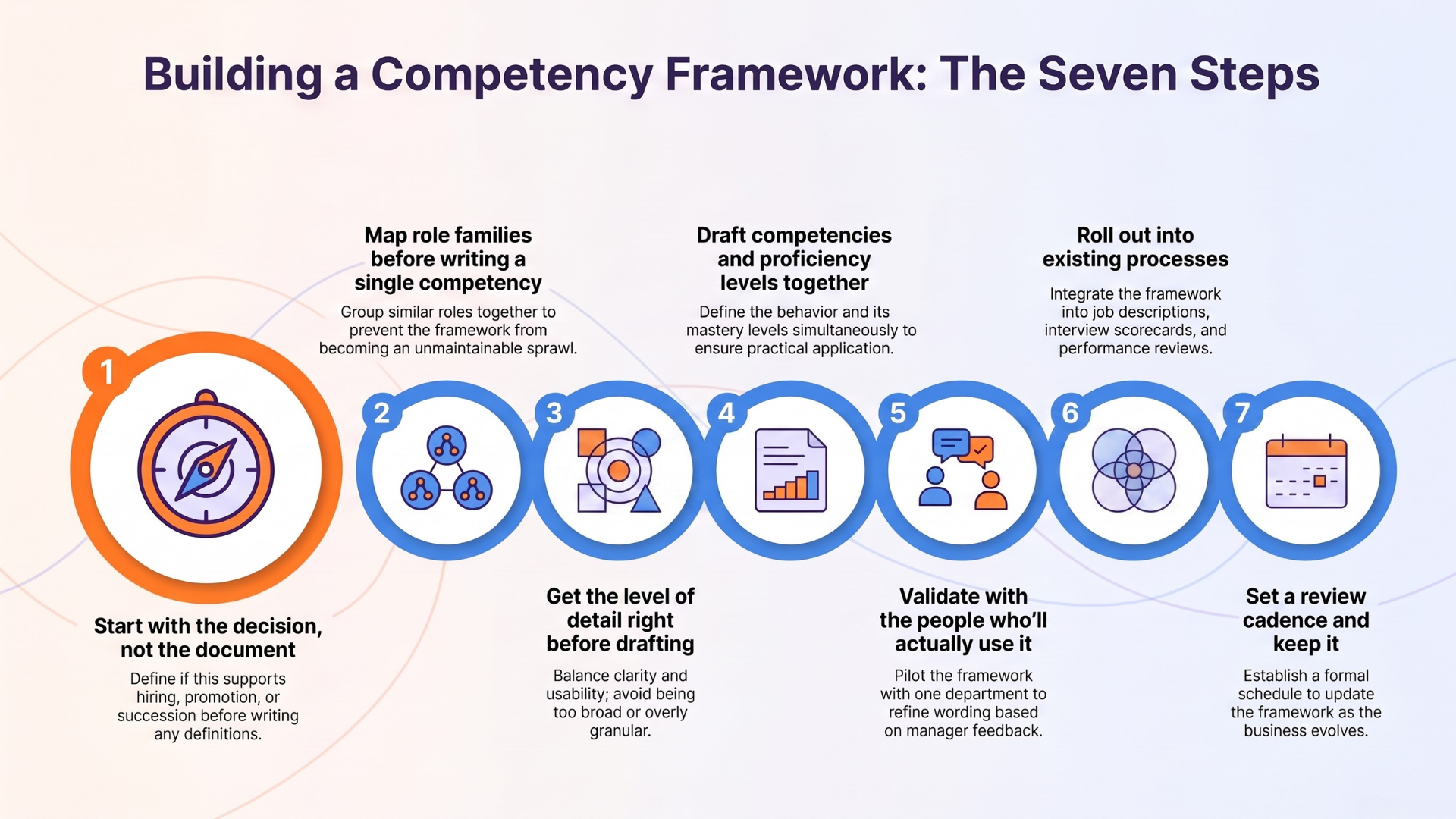
Fig 3: Steps for Competency Frameworks
A. Start with the decision, not the document
Is this for hiring, promotion, succession, or all three? Each answer changes what belongs in the framework and how much detail it needs. A framework built to support hiring decisions can stay lighter than one that has to hold up inside a succession conversation with the board.
B. Map role families before writing a single competency
Grouping similar roles, rather than building one framework per job title, is what keeps the project from becoming an unmaintainable sprawl. Most mid-size companies need a handful of role families to cover an entire org chart, not dozens.
C. Get the level of detail right before drafting
Thomas International’s guidance on this holds up well: go too broad and the framework can’t support a real decision, go too granular and it turns bureaucratic and gets quietly abandoned. Both failure modes end in the same place, a document nobody trusts enough to use.
D. Draft the competencies and the proficiency levels together, not separately
A competency without levels is unusable for the reasons covered above. Draft both in the same pass, using the layered structure, core, functional, technical, domain-specific, leadership, meta, so nothing gets missed and nothing overlaps.
E. Validate with the people who’ll actually use it
Pilot with one department before rolling out company-wide. Expect the wording to change meaningfully once real managers try to rate real people against it; that friction is the framework getting better, not a sign it was built wrong.
F. Roll out into the existing processes
A framework that lives only in a shared drive changes nothing. It has to show up inside job descriptions, interview scorecards, and performance reviews, or it never gets used for anything beyond the launch announcement.
G. Set a review cadence and actually keep it
Annually is a reasonable default, sooner if the business, the roles, or the market shift meaningfully in between.
Most of that work is genuinely doable in-house. The part that quietly breaks down is the last one, keeping it current once the launch excitement fades.
VIII. Advantages of Competency Frameworks
A. Employees know exactly what’s expected of them
Not a job description, a working definition of what strong performance looks like at their level, and what the next level up actually requires. That clarity does more for retention and internal mobility than most engagement initiatives, because people can see the specific gap between where they are and where they want to go.
B. Assessments get fairer and more consistent
Every candidate for a role, whether it’s a promotion or a hire, gets measured against the same defined standard instead of whichever manager happens to be in the room that day. That consistency is what makes a rejection or a pass-over defensible instead of arbitrary.
C. Individual performance connects visibly to organizational results
When competencies are tied to the behaviors that actually drive outcomes in a role, a leadership team can trace a capability gap in one team directly to a stalled initiative, instead of discovering the connection only after the initiative has already slipped.
D. Leadership potential surfaces early, not by accident
Most organizations identify high performers based on who happens to be visible to a senior leader at the right moment. A framework catches capability wherever it’s actually demonstrated, including in roles and teams that rarely get executive attention.
E. Decisions become defensible
To a board, to an auditor, to a manager who feels a promotion decision went against them. “We measured this against a defined standard” survives scrutiny in a way “we felt confident” never does.
IX. Disadvantages of Competency Frameworks
A. They calcify fast when the business moves faster than the framework does
Roles evolve, new skills matter, old ones stop mattering, and a framework locked into a static document can’t keep pace on its own. What was accurate at launch is quietly wrong within a year or two.
B. Over-standardization can flatten out real strengths
A framework built too rigidly rewards people who fit the defined mold and can undervalue someone whose path to strong performance looks different but gets there anyway. The fix isn’t abandoning structure, it’s making sure the structure describes outcomes, not a single acceptable route to them.
C. They’re heavy to build and heavier to maintain without a clear owner
Plenty of frameworks get built with real investment and real stakeholder buy-in, then have no one responsible for keeping them current once the launch excitement fades. Ownership matters more than initial build quality.
D. The hardest failure mode is the quiet one
A framework can be well written and still fail the moment it stays in PDFs, read once at launch and never opened again. Easy to write, much harder to keep evidenced: without ongoing measurement, it stops being a working standard and becomes, at best, a reference document nobody actually checks against reality. Most competency frameworks don’t fail because the definitions were wrong; they fail because nothing kept them alive after launch.
A framework describes what capability should look like. It doesn’t prove what capability actually is, right now, inside your organization. That gap is worth taking seriously.
X. How PeopleBlox Helps?
Most organizations have a competency framework somewhere. Few can say, with confidence, whether it’s still true today.
That gap, between having a framework and being able to trust it in the moment, is what PeopleBlox’s Organization Capability Assurance is built around: continuously verifying, not just assessing once and shelving, that an organization actually has the capabilities its strategy requires, at the level of every role that matters, not only the ones that make it into a board deck. Applied specifically to leadership and succession, the same discipline is Leadership Capability Assurance, keeping the answer to “who’s ready to step up” current instead of reconstructed from memory the moment a board asks.
In practice, that means a business leader can open the Capability Command Center and see the readiness of every critical role at once, current, not from whenever someone last ran a review. A framework tells you what good looks like. A live, continuously verified view tells you where you actually stand against it, today.
The frameworks behind PeopleBlox are built to a level of structure most organizations never get around to building themselves, and the platform runs on structured self-assessment paired with manager assessment, the same dual-perspective judgment covered earlier in this piece, applied consistently and revisited over time instead of once a year.
XI. From Competency Framework to Capability Assurance
Most organizations have assessed capability at some point. A competency review two years ago. A skills audit before the last reorg. Almost none can say with confidence right now whether that assessment is still true.
That’s the real distinction worth naming. Assessment is a photograph. What most organizations actually need is closer to how finance treats its own numbers, continuously verified, always current, trusted enough to make a decision on today, not eighteen months ago.
McKinsey’s research on this gap is striking: 80 percent of business leaders now call capability building extremely or very important to long-term growth, up sharply from 59 percent before the pandemic. But only a third of those same leaders believe their capability-building programs actually succeed at what they set out to do. That gap, high conviction paired with low confidence in execution, is exactly why a well-written framework isn’t enough on its own. A framework can be excellent and still say nothing about whether the organization is living up to it today.
This isn’t a call to build a better one-time framework. A well-designed competency model, reviewed once a year, still leaves eleven months of drift nobody’s watching.
The organizations that can answer the board’s capability question in minutes, not weeks, aren’t lucky. They stopped assessing capability and started assuring it.




read next

Capability Building: From Course Completion to Business Readiness

How Critical Skill Gaps Can Derail AI and Tech Transformation?