










Two EPC projects can run on the same tools, the same technology and the same contract terms, and still finish in very different places. The difference is capability: whether the right people sit in the right roles with the skills those roles demand. A competency framework for EPC industry teams defines what each role requires across engineering, procurement and construction, and gives leaders a standard to check against. This guide covers what it is, why capability breaks on large projects, how to implement one, and what to measure once it is in place.
I. The Project Risk Behind the Competency Framework for EPC Industry
When a project slips by six months, which conversation happens first: the one about the schedule, or the one about who was in the role?
Most EPC post-mortems start with scope changes, supplier delays or design rework. Those causes are real. But they sit on top of a quieter question that rarely reaches the board pack: did the people carrying the work have the capability the work demanded?
McKinsey’s 2022 analysis of more than 500 projects, each worth at least $100 million, found cost overruns averaging at least 79 percent and schedule delays averaging 52 percent. That is a finding about large capital projects in general, not EPC alone, and it does not blame workforce planning. What it does show is how little margin these projects carry for any avoidable weakness. A critical role filled by someone who is almost ready is an avoidable weakness. So is a procurement lead who has never managed suppliers across three jurisdictions, or a site manager promoted for tenure rather than demonstrated safety judgment.
For a CHRO, this is a defensibility problem: can you show the business that the right capability sits behind its most exposed roles? For a CEO or COO, it is a competitive one. Clients awarding EPC work are betting on delivery. Capability is part of what they are buying, whether or not anyone writes it into the tender.
That is the job of a competency framework for EPC industry organizations: to make capability visible before it turns into a project problem.
II. What a Competency Framework for EPC Industry Actually Is
A competency framework for EPC industry roles is a structured statement of what each role needs in order to deliver. It covers the technical knowledge, the functional skills and the behaviors that separate a site engineer who flags a risk early from one who finds it at inspection. If you want the wider concept first, our guide to what a competency framework is and why companies need one covers it across industries.
It is not a job description. A job description lists tasks. A framework describes what good looks like when those tasks are done under pressure, on a live site, with a client waiting.
It answers the questions an EPC leader asks every week:
- What must a project engineer be able to do before running a work package alone?
- What does a procurement lead need in order to manage global suppliers without surprises?
- What does safety and compliance competence look like in someone supervising a crew?
The framework matters because EPC is a chain. Engineering decisions shape procurement, procurement shapes construction, and a capability gap at any link moves downstream. A framework that covers all three phases gives you one standard across the chain instead of three separate conversations held in three separate places. It also gives HR and project leadership a shared language. When a project director says a role is critical and HR says the candidate is qualified, both statements can finally be tested against the same definition.
III. Why Capability Breaks on EPC Projects
A. The labor market is tightening
Deloitte’s 2026 Engineering and Construction Outlook projects a need for nearly 500,000 new workers in the US in 2026, up from 439,000 in 2025, and warns of a possible shortage of more than 2 million skilled craft professionals by 2028. When supply is this tight, close-enough hiring becomes the default. The cost arrives later, as rework and slipped milestones, and it is rarely traced back to the hire that caused it.
B. The skills are changing faster than the job descriptions
Deloitte’s study of the engineering and construction workforce found that demand for people management skills had risen 77 percent and business management skills 41 percent since 2019, alongside growing demand for digital skills. Read that carefully. The skills EPC organizations now need are not only technical. A job description written five years ago does not describe them, and neither does a performance review built on that description.
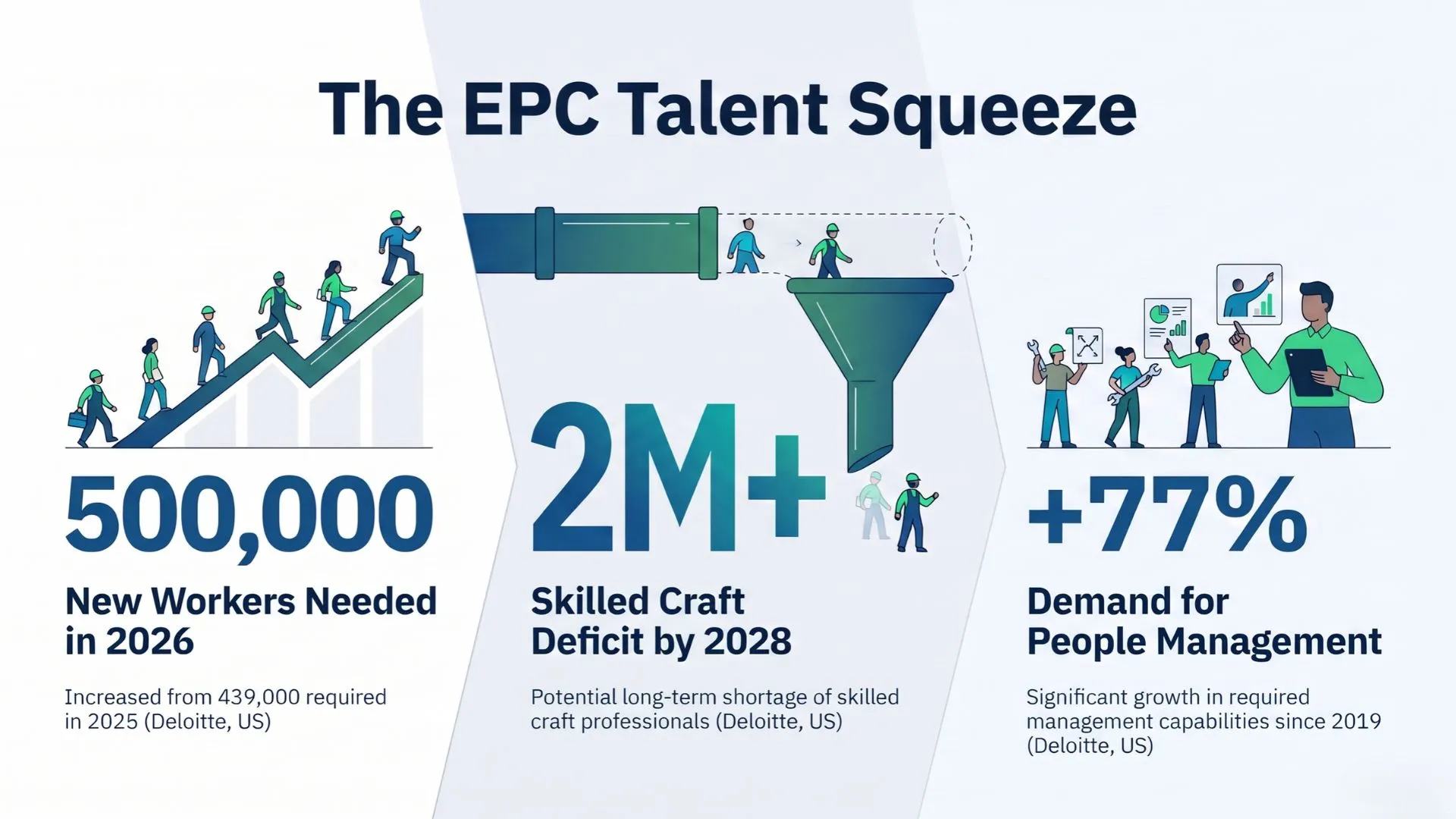
Three signals that capability gaps are structural, not cyclical
C. Capability is judged informally
Many EPC firms still rely on dated job descriptions, annual reviews and the recollection of whoever managed the person last. That holds up until a project needs a critical role staffed in two weeks. Then the question of who is actually ready gets answered by whoever happens to be in the room.
The pattern repeats across the project lifecycle. Early in a bid, the team that wins the work is rarely the team that executes it, and nobody has checked whether the execution team meets the standard the proposal promised. During execution, people are moved to fix problems and the roles they leave behind are backfilled by availability. At handover, the people who held the most knowledge disperse with it.
The consequence is easy to price in CEO terms: a late start on a work package, a rework cycle, a safety incident that triggers a stop-work order. None of them looks like an HR issue when it happens. Any of them can start as one.
IV. From Assessing Capability to Assuring It
Most EPC organizations have assessed capability at some point: a competency review before a major bid, a skills audit after a difficult project. Almost none can assure it. Assessment is a photograph. By the time anyone acts on it, the project has moved, people have rotated and the plan has changed. Assurance is closer to how finance treats its numbers: continuously verified, current enough to decide on, and trusted by the people who have to sign off.
Take a familiar scenario. A lead piping engineer leaves mid-project, and the obvious successor was rated strong in last year’s review. The rating was accurate for the project he worked on then. It says little about the pressure of a different scope, a different client and a compressed schedule. Nobody made a careless call. The evidence was simply out of date.
The distinction matters more in EPC than in most industries because projects are temporary and fast. Teams form around a bid, scale for execution and disperse at handover. A framework checked once a year describes a workforce that has already moved on.
Capability evidence + role clarity = staffing decisions you can defend.
That is the standard any competency framework for EPC industry leaders should be held to. Not a document that says what good looks like, but a live view of whether the people in critical roles meet it.
V. What a Competency Framework for EPC Industry Has to Cover
A. Roles across all three phases
Start with the roles that carry the most delivery risk, from site engineers and project managers to procurement leads and HSE supervisors. Each role needs a defined standard covering technical knowledge, functional skills and behavior, with leadership expectations where the role carries them. A competency framework for EPC industry work should also respect how roles change between phases: the capability a project manager needs during front-end engineering is not identical to what the same role demands during commissioning.
The standard has to be specific to EPC. A generic skill list will describe communication and problem solving perfectly well and still miss what a lead planner must do when a vendor slips. This is the reason domain-specific competency frameworks beat generic skill lists: the demands of the work are in the detail.
B. A standard you can compare across people
A framework earns its keep when it lets you compare people and roles on the same footing. That turns internal mobility, bid staffing and succession conversations from political ones into factual ones.
Judgment still sits with the people doing the assessing. What changes is that the judgment is structured, anchored to a common standard and revisited over time, instead of recalled under pressure by whoever knew the person best.
C. Embedded in how HR already works
A framework that lives in a PDF on a shared drive is decoration. It has to be wired into hiring, performance reviews, development plans and succession, so that a decision made in any of them draws on the same definition of capability. This is the point where most frameworks fail, and it is also where the value is: a single standard feeding every people decision, rather than five systems each holding a different opinion.
VI. How to Implement a Competency Framework for EPC Industry
You do not need to roll this out across the whole organization at once. Start where the exposure is highest, prove that it changes decisions, and then widen the scope. A sequence that works for most EPC companies has five steps.
A. Map the roles that carry delivery risk
Sit down with engineering, procurement and site leaders and agree what success looks like in each function. Begin with the roles where a weak hire or a stalled promotion would hurt a live project most. Resist the urge to map every role in the first pass.
B. Define the standard for each role
Use recognized references such as AACE International, PMI and ISO standards as inputs, then tailor them to your projects, geographies and contract types. External standards describe the profession. Your framework has to describe your work.
C. Find the gaps against that standard
Compare where people stand today with what each role requires, drawing on structured input from more than one perspective. The aim is a clear, comparable view of gaps by role, not a score for its own sake.
D. Build development around real gaps
Direct training spend at the gaps that matter to live and upcoming projects. Learning journeys built on assumptions teach people what they already know and leave the real exposure untouched.
E. Review it against project outcomes
Check the framework against what actually happens on projects: rework, safety incidents, handover quality and attrition in critical roles. Revise the standard when the work changes. A competency framework for EPC industry use is a living standard, not a one-time deliverable.
VII. What to Measure Once It Is in Place
A competency framework for EPC industry teams is worth what it changes. Track a short list tied to project outcomes rather than HR activity.
Start with rework and safety incidents on projects where critical roles were filled against the framework, compared with projects where they were not. Add the time it takes to staff a critical role with a ready candidate, and the share of critical roles that have a named, ready backup. Then watch attrition in the roles where losing someone hurts delivery most.
Keep the list short on purpose. Four or five measures that leadership reviews every quarter will do more than a dashboard of thirty that nobody opens. Review them alongside schedule and cost performance, in the same meeting, so capability is treated as a project variable and not an HR report.
These are numbers a CEO or COO already cares about. They also give HR a way to show the framework earning its place using your own project data, rather than benchmarks borrowed from other companies. If a figure is not moving, that is useful information too: it points to the role, the standard or the project where the framework is not yet doing its job.
The EPC leaders who staff critical roles with confidence did not guess. They verified capability earlier.
VIII. How PeopleBlox Helps?
The gap between assessing capability and assuring it has a name. Capability Assurance is the discipline of continuously verifying, not just assessing, that your organization has the capabilities its strategy requires.
For an EPC company, the first place it applies is Organizational Capability Assurance: the same verification applied to every role that carries delivery risk, from site engineers to procurement leads. The frameworks behind PeopleBlox are built to a level of structure and detail most organizations never reach, and the platform is built around them. What that gives a CHRO is narrow and useful. When you ask whether a person is ready for a role, the answer is anchored to a defined standard and consistent across everyone you are comparing, instead of assembled from whoever was in the room.
At the top of the house, Leadership Capability Assurance applies the same discipline to project directors and the leaders being prepared to follow them, so succession on a major project starts from evidence of readiness rather than reputation.
Where this lands for a CEO or COO is the Capability Command Center: one place where the readiness of critical roles is visible at once, so the conversation about staffing the next project starts from a current picture instead of a reconstruction.
Book a demo before your next kickoff.
IX. Don’t Leave the Next Project to Chance
Picture the next megaproject kickoff with no guesswork about team readiness. Everyone knows their role. Gaps are named and being closed before they become bottlenecks. New hires reach productive work faster because the standard they are held to is clear.
That is what a competency framework for EPC industry teams makes possible. As AI, IoT and digital twins change how EPC work gets done, the standard for readiness will keep moving. A framework that is current tells you where you stand. One that is not tells you where you stood.
You do not need to start with the whole organization. Pick one business unit and the roles that carry the most delivery risk. Define the standard, check where you stand, act on the gaps and measure what changes. The competency framework for EPC industry is not HR jargon. It is a competitive edge, and it only works if you do not let another quarter pass with capability judged by memory.




read next

Capability Mapping for Business Roles: Why Old Role Expectations Create New Execution Risk

Capability Visibility: The Missing Link Between Strategy and Execution