










A competency framework of banking industry defines what capable performance looks like in every role, from the branch counter to the credit committee. Most banks have one on paper. Far fewer can show that their people meet it today. This guide covers what the framework should contain, which competencies matter most, how to implement it, and why verification, not documentation, is where the value sits.
I. Why Banks Have Frameworks but Not Answers
When the board asks whether your credit team can carry the next product launch, how long does it take to answer with evidence rather than reassurance?
Most banks can produce a competency document in minutes. Very few can produce the answer in minutes. The distance between those two speeds is where risk accumulates, and it rarely shows up until a launch slips, an audit finding lands, or a senior manager resigns and nobody knows who is ready to step in.
The pressure on that distance is growing. The World Economic Forum’s Future of Jobs Report 2025 found that 63% of employers see skill gaps as the biggest barrier to transforming their business through 2030, and that nearly 40% of the skills used on the job are expected to change. Banking sits at the sharp end of that shift. Neobanks and fintechs are rewriting customer expectations, supervisors keep tightening requirements, and AI is taking over routine processing.
McKinsey’s banking practice estimates that 43% of working hours in banking activities will be automated. That does not make the workforce question smaller. It changes its shape. When routine processing moves to machines, the work that stays with people leans harder on judgment, client relationships and technical depth, which are the capabilities hardest to read from a job title.
For a CHRO, the consequence is concrete. Product launches stall because nobody knows which teams are ready. Credit and risk decisions rest on tenure instead of demonstrated capability. Development budgets go to the loudest request instead of the most critical gap. A framework that sits in a shared drive does none of the work it was built to do, and the CEO and the board feel that failure long before HR can explain it.
II. What a Competency Framework of Banking Industry Covers
A competency framework of banking industry sets out the knowledge, skills and behaviors that capable performance requires in each role across the bank. It is not a job description. A job description lists tasks. A framework describes what doing those tasks well looks like, in terms specific enough to hire against, develop against and promote against.
That specificity is what makes it useful to a CHRO. Without it, two branch managers with the same title can mean different things by “ready”, and nobody can say which of them is right.
A. The Four Types of Competency
Most banking frameworks group competencies into four families:
- Core competencies: the skills and behaviors expected of everyone in the bank, such as client focus, attention to detail and problem solving.
- Leadership competencies: what managerial roles require, including strategic vision, team leadership and the ability to lead change.
- Technical competencies: role-specific knowledge, such as credit management, risk assessment and financial analysis.
- Behavioral competencies: the personal and interpersonal traits that shape day-to-day effectiveness, such as communication, adaptability and collaboration.
The families matter because they answer different questions. Technical competencies tell you whether someone can do the work. Core and behavioral competencies tell you whether they will do it well under pressure and alongside others. Leadership competencies tell you whether a team will do it consistently when the person at the top changes.
B. Why Banks Need a Shared Standard
Banking is an industry where inconsistency carries a price. A relationship manager who handles a complaint one way in one region and another way elsewhere creates conduct risk. A credit analyst who misses a covenant creates financial risk. A shared standard gives every function the same definition of good, so that regulatory expectations, technology change and customer demands are met by one expectation of capability instead of dozens of local interpretations.
The standard also protects the bank from the quiet drift that follows growth. New branches, acquired teams and fresh hires each bring their own habits. A competency framework of banking industry is how those habits get measured against something fixed.
III. The Competencies Banks Need Most
The useful question for a CHRO is not which competencies are fashionable. It is which ones the bank cannot afford to have thin.
A. The Enduring Core
Five competencies sit underneath most banking roles, from the teller line to the credit committee:
- Client focus: putting the customer’s real need ahead of the product on the shelf, in a business where trust is the product.
- Attention to detail: accuracy in transactions and documentation, where a single missed field becomes a compliance finding.
- Planning and organization: sequencing work and managing competing priorities in functions with hard regulatory deadlines.
- Credit management: judging and managing credit risk, the competency that most directly protects the balance sheet.
- Professionalism: ethical conduct and integrity, which supervisors and customers both treat as a baseline.
None of these is new. What has changed is how expensive it is to assume them instead of confirming them. A bank that assumes attention to detail in a payments team finds out about the gap through an error, not through a review.
B. The Emerging Competencies
As technology takes over routine processing, three competencies move from nice to have toward expected:
- Digital literacy: working confidently with digital tools and understanding how fintech products change the customer’s journey.
- Data analytics: reading data well enough to make and defend a decision, not just to produce a report.
- Cybersecurity awareness: understanding the security practices that protect customer data and the bank’s own systems.
A framework that stops at the enduring core describes the bank of five years ago. A framework that adds the emerging three, role by role, describes the bank you are trying to become. The difference shows up in hiring profiles, in development plans and in who gets considered for the roles that do not exist yet.
IV. From Documenting Capability to Assuring It
Most banks have assessed capability at some point: a competency review before a restructure, a skills survey ahead of a digital program. Almost none can assure it. An assessment is a photograph. By the time anyone acts on it, the roles have changed, people have moved and the regulatory expectation has shifted. Assurance is closer to how finance treats its numbers: continuously verified, always current and trusted enough to make decisions on.
The gap shows up at the top. Deloitte’s survey of nearly 500 board members and executives found that 78% regard skills and talent availability as a major source of risk, yet only 36% believe their board’s workforce discussions are adequate for the organization’s needs. Leaders know the risk is real. They do not have the picture that would let them discuss it with confidence.
That picture comes from a framework used as a standard, not kept as a reference document. Judgment about capability becomes structured and multi-perspective, anchored to a common definition of good, comparable across people and roles, and revisited over time instead of recalled under pressure.
Defined standard + verified capability = a workforce decision you can defend.
The same logic explains why reskilling so often disappoints. McKinsey’s banking research found that three in four executives it polled call reskilling critical to adapting to the digital age. Reskilling without knowing who needs which capability, in which role, is spend without direction. The program runs, the attendance figures look healthy, and the credit team still cannot say whether the gap closed.
V. Implementing the Framework in a Bank
Adopting a competency framework of banking industry works as a cycle with four moves. Skip one and the framework drifts back into a document.
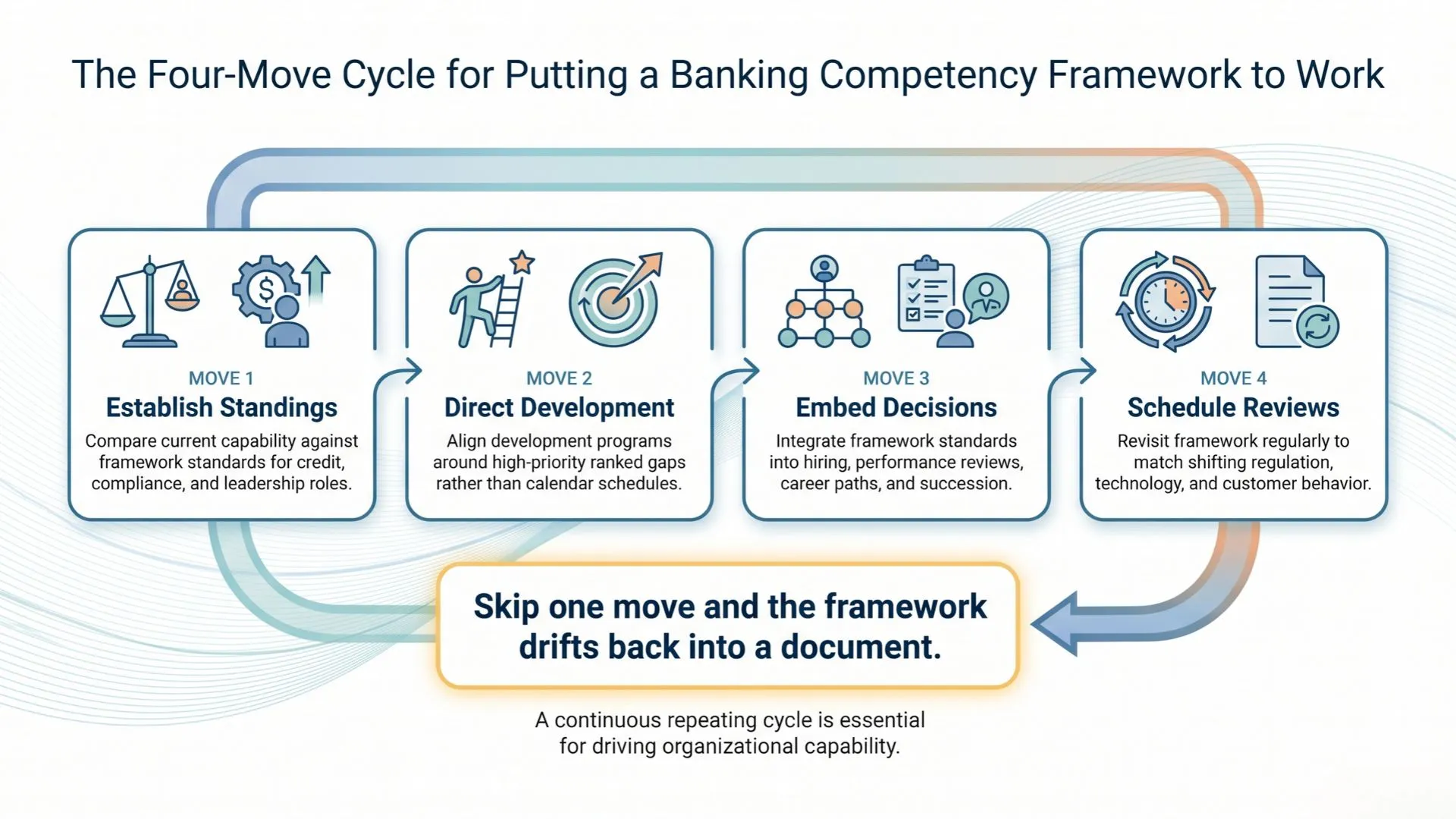
Skip one move and the framework drifts back into a document.
A. Establish Where People Stand
Start by comparing current capability against the framework, role by role, and begin with the roles that carry the most risk: credit, compliance, relationship management and the leaders who run them. The goal is a clear picture of gaps, ranked by how much they matter to the business, not an exhaustive record of every person in every function.
B. Direct Development at the Gaps That Matter
Training should follow the gaps, not the calendar. A development program designed around the ranked list puts effort where a shortfall would hurt most, and it lets the CHRO explain to the CFO why a budget line exists and what it is expected to change.
C. Embed the Framework in Everyday Decisions
The framework earns its place when it shapes hiring profiles, performance conversations, career paths and succession choices. If those processes still run on separate definitions, the framework is decoration. One standard used everywhere is what lets an internal move or a promotion be justified on capability.
D. Review It on a Schedule
Regulation, technology and customer behavior change faster than most documents do. A scheduled review keeps the framework current, so that capability is measured against today’s role and not the role as it was written years ago.
E. What a Verified Framework Gives the Bank
When the cycle runs, four benefits follow:
- Performance: clear definitions of good make individual and team effectiveness easier to improve and to compare.
- Retention: people stay where growth is visible and taken seriously, and a framework makes the path from the current role to the next one explicit.
- Regulatory confidence: a consistent standard gives the bank a defensible basis for showing that people are equipped for the roles they hold.
- Strategic alignment: workforce capability can be tied to the bank’s strategy, so a new product, market or technology comes with a view of who is ready.
VI. Where Implementation Breaks
Frameworks rarely fail on design. They fail on adoption.
A. Resistance to Change
People hear “framework” and expect a new scorecard. Where the purpose is not explained, adoption turns into box-ticking. The fix is to show employees what they gain: clearer expectations, visible development paths and fairer decisions about promotion. When the first conversation is about growth, the second conversation about gaps is easier.
B. Resource Constraints
Building and maintaining a framework costs time and money, and banks rarely have spare capacity in HR. Starting with the highest-risk roles and expanding from there keeps the investment proportionate and produces early evidence that leadership can see.
C. Customization
A framework borrowed wholesale from another institution describes someone else’s strategy and culture. The work is adapting it to your products, your risk appetite and the roles you actually run, which starts with a clear view of what your strategy needs from people. A generic framework tends to go unused, and an unused framework protects nobody.
VII. The Roles That Will Ask for More Next
The next round of change will not arrive as a single event. It will arrive role by role: a credit analyst now expected to interpret model outputs, a relationship manager expected to work from customer data, a compliance officer expected to understand how a new digital channel can be attacked.
The practical move is to review each critical role against the emerging competencies once a year and ask three questions. What has changed in this role? Which of those changes has a competency attached to it? Does the bank know who holds it?
Banks that run this review treat the framework as a living standard, and the answers feed hiring, development and succession at the same time. Banks that skip it discover the gap when a project needs a capability and finds nobody who has it.
The banks that can answer in an afternoon are not lucky. They verified earlier.
VIII. How PeopleBlox Helps?
What this article describes is the work of Organizational Capability Assurance: the discipline of continuously verifying, not just assessing, that your organization has the capabilities its strategy requires. PeopleBlox is built for that discipline. The competency frameworks behind the platform are built to a depth of structure and detail most banks never reach internally, and the platform is organized around them.
What that buys a CHRO is narrow and useful. When the credit committee asks whether a team can take on a new portfolio, the answer comes back anchored to a defined standard, consistent across every person being compared, and revisited over time instead of assembled from whoever happened to be in the room.
The Capability Command Center puts that view in one place: the readiness of every critical role visible at once, so the conversation with the CEO and the board starts from a current picture instead of a reconstruction.
The same verification applies to the people who run the bank. Leadership Capability Assurance holds the leaders and successors expected to carry the strategy to the same evidence standard, so succession choices rest on demonstrated capability and not on tenure.




read next

Capability Mapping for Business Roles: Why Old Role Expectations Create New Execution Risk

Capability Visibility: The Missing Link Between Strategy and Execution