










A skill gap rarely announces itself. It surfaces late, as a missed milestone or a stalled program, when the training response is already behind. AI changes the timing: it can show where gaps are forming and tailor the response to each person. The organizations that get value from it treat AI as a way to keep capability verified, not as another course catalogue.
It is the third-quarter review. The transformation lead tells the CEO the program is two months behind. When the CEO asks why, how many people in the room already knew the skills were not there?
Most organizations learn about a skill gap the same way: after it has cost them something. A product launch slips. A new system goes live and adoption stalls. A manager quietly stops delegating a task because nobody on the team does it well. Each of these gets filed as an execution problem. Underneath, it is a skill gap that sat unseen for months.
I. What an Undetected Skill Gap Costs
A. Skills Are Expiring Faster Than Plans Are Written
The World Economic Forum’s Future of Jobs Report 2025 finds that 63% of employers name skill gaps as the biggest barrier to business transformation between 2025 and 2030. The same report says workers can expect 39% of their existing skill sets to be transformed or outdated over that period. Read the two numbers together. The barrier is the one leaders cite most, and the ground beneath it is moving.
That is why a skill gap is not a fixed list. An inventory built for last year’s roles describes a workforce that has already changed. By the time a one-off audit is compiled, reviewed and presented, some of what it recorded has aged out and some of what the business now needs was never on it.
B. Leaders Are Worried, Often Without Evidence
LinkedIn’s 2025 Workplace Learning Report finds that 49% of L&D professionals say their executives are concerned that employees do not have the skills to execute business strategy. That concern is reasonable. It is also not evidence.
A CEO who suspects a skill gap and a CHRO who cannot say where it sits are holding a conversation without data. The CEO hears hesitation. The CHRO hears pressure. Neither can move, because the one thing both need, a current and specific picture of where capability falls short of what strategy requires, is missing.
II. Why Reactive Training Keeps Losing
A. Gaps Are Found After the Damage
Reactive training follows a familiar loop. A gap appears. A course is commissioned. By the time it is built, approved and delivered, the business has moved on and a different skill gap has opened somewhere else. This is the game of whack-a-mole, and the person holding the mallet is always one step late.
The delay is not a failure of effort. It is a failure of timing. When the only signal is a missed target, the training response begins after the cost has landed, and it can only repair, never prevent.
B. Spend Follows Noise, Not Criticality
Without a clear view of which gaps matter most, learning budgets drift toward the loudest request. The team with the most persuasive manager gets the program. The role that quietly carries a critical process gets nothing, because nobody flagged it.
Training activity measures effort. It does not tell you whether capability moved.
A completed course is a fact about attendance. Whether the skill gap behind it narrowed is a separate question, and most reporting never asks it. The result is a learning function that looks busy and a leadership team that still cannot answer whether the organization is more capable than it was a year ago.
III. From Assessing Capability to Assuring It
Most organizations have assessed capability at some point: a competency review two years ago, a skills audit before the last restructure. Almost none can say, today, that the capability their strategy depends on is actually there. Assessment is a photograph. By the time anyone acts on it, the organization has moved.
Assurance works differently. It is closer to how finance treats its numbers: kept current, trusted enough to make decisions on, and checked as conditions change. A leader asking whether a critical team can deliver next year’s plan should get an answer anchored to a defined standard, not a recollection of who impressed whom in a review cycle.
A clear standard + a current picture = a skill gap you can act on.
This is the shift that makes the rest of the conversation useful. Treat a skill gap as a one-time finding and every response will be late. Treat it as something continuously watched against a standard, and the response can start while the gap is still small. That second approach was impractical for most teams until recently, because keeping a picture current across thousands of people costs more time than most HR functions have. This is where AI enters.
IV. What AI Changes About the Skill Gap
LinkedIn’s report also finds that 71% of L&D professionals are already exploring, experimenting with or integrating AI into their work. Exploring is not the same as getting value. The value comes from being specific about what AI actually changes, and there are four things worth naming.
A. Seeing the Gap Before It Becomes a Roadblock
AI can work through large volumes of workforce information, such as role requirements, learning records and project signals, and point to where deficiencies exist now and where they are likely to appear next. That moves the work from reacting to a missed target toward spotting the weak point while there is still time to act.
A structured skill gap analysis still sets the foundation, because AI needs a clear definition of what each role requires before it can say who falls short. The forward-looking part matters just as much. Knowing how to forecast where the next talent gap will hit is what separates planning from firefighting.
B. Matching the Response to the Person
One-size-fits-all training spends time on people who already have the skill and misses the people who need it most. AI can tailor recommendations to an individual’s strengths, weaknesses and career goals, so that each employee is pointed toward the learning most relevant to them. The practical effect is less wasted time and a clearer link between a person’s development and the gap the business is trying to close. For concrete ways to do this, see these personalized learning solutions.
C. Learning That Fits the Working Day
Long programs are hard to schedule and easy to abandon. AI-supported platforms can break a complex topic into short modules that fit between meetings, which makes continuous learning possible without pulling people out of their work for days at a time.
This has limits. Short modules suit knowledge and routine skills well. Skills that depend on judgment, such as handling a difficult conversation or making a call under uncertainty, still need practice and feedback from people who have done the work.
D. Support Between Formal Sessions
AI can provide prompts, guidance and reminders in the gaps between courses and manager conversations. Used well, that keeps development moving when nobody has time to schedule a session. It does not replace a manager or a mentor, and the quality of the support depends on how the organization uses it.
The same World Economic Forum report finds that 85% of employers plan to prioritize upskilling between 2025 and 2030. More money and attention are about to flow into learning. That raises the stakes on whether the spending lands on the gaps that matter.
V. Three Moves to Close Your Skill Gap with AI
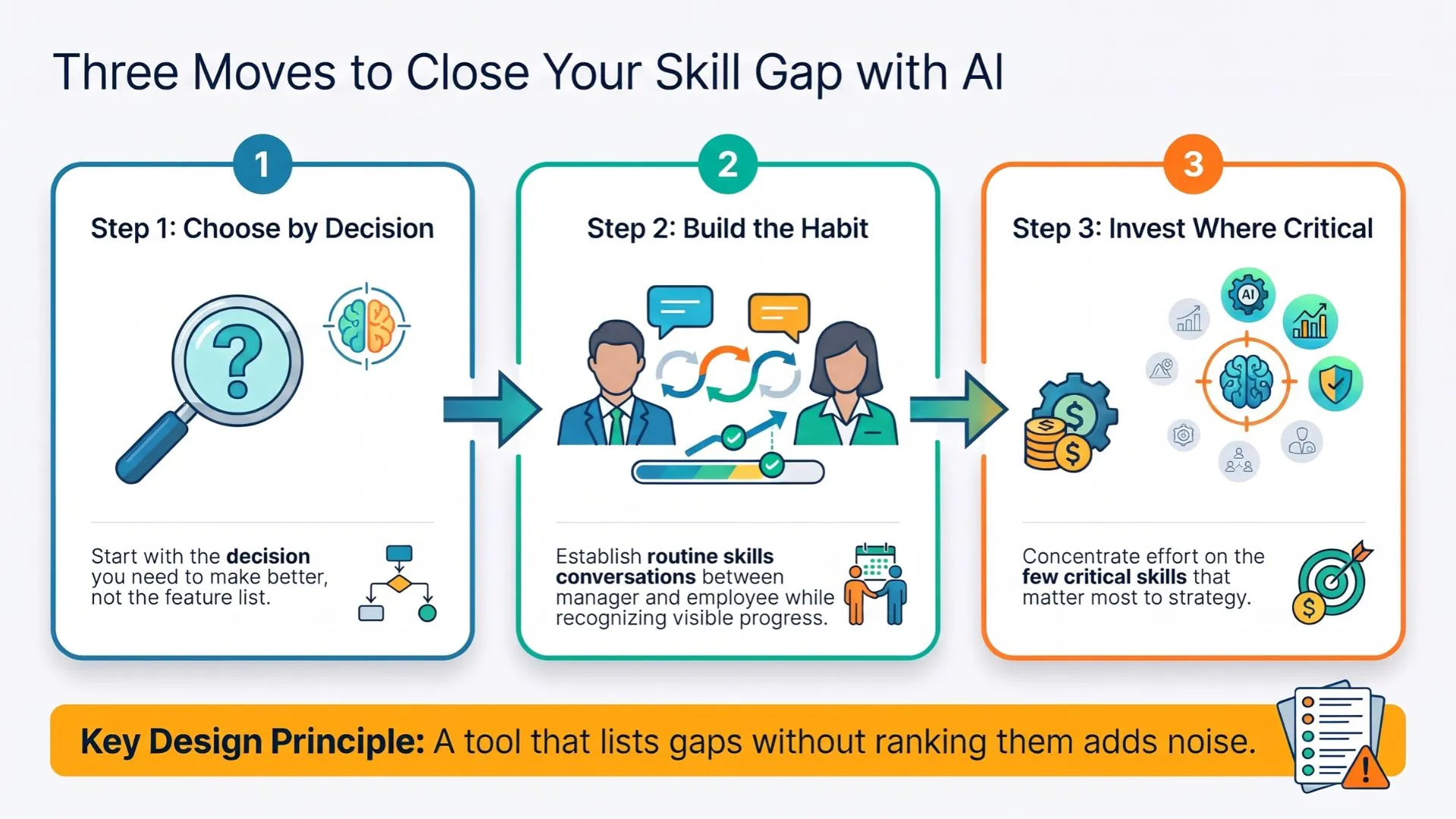
Start with the decision, build the habit, invest where it is critical
A. Choose the Tool by the Decision It Supports
Most evaluations begin with a feature list. A better starting point is the decision you need to make better. Do you need to know where to invest next quarter? Whether a team can deliver a new strategy? Which gaps are critical and which are merely visible?
Ask any vendor, including us, the same questions. Does it start from a defined standard for each role? Does it separate critical gaps from minor ones? Can a CEO and a CHRO look at the same picture and agree on what it says? A tool that produces a long list of gaps without a way to rank them creates a new version of the same noise.
B. Build the Habit Around It
Technology does not create a learning culture. Managers and employees do. The habit worth building is a routine conversation about skills: what the role needs, where the person stands, and what the next step is. When that conversation happens regularly, AI has something useful to work with, and employees treat the output as part of their own development, not as surveillance.
Recognize visible progress. When someone closes a meaningful gap, say so in front of their team. People repeat what gets noticed.
C. Invest Where the Gap Is Critical
Investing in people works best when it is concentrated. Spreading learning budget evenly across every gap guarantees that the critical ones are under-served. The better discipline is to focus on the few critical skills that matter most and treat the rest as lower priority until those are secure.
The stakes extend past HR. A critical skill gap can also stall AI and technology programs that the business has already paid for. An organization that has funded the technology but not the capability to use it has bought the cost without the return.
VI. What AI Cannot Settle for You
AI can show you a pattern. It cannot decide whether the pattern is right, and it should not be asked to. The picture it produces is only as good as the definition of what each role requires and the information that goes in.
The stronger approach keeps human judgment in the loop and makes it structured: more than one perspective, one shared standard, and a regular return to the question as conditions change. That is different from replacing opinion with a score. A leader still has to decide what a skill gap means for a person, a team or a plan. What changes is that the decision rests on a consistent picture instead of whoever spoke last in the room.
Be wary of any claim that AI removes the need for that judgment. A CHRO will spot the overclaim immediately, and so will the CEO who has to act on it.
VII. A Skill Gap You Can Answer For
The move from reactive to proactive is not a technology upgrade. It is a change in what leaders expect to know and when. A board that asks whether the organization can deliver its strategy wants an answer in minutes, backed by something more current than last year’s review.
That answer depends on three things working together: a defined standard for what each critical role needs, a current view of where people stand against it, and a response aimed at the gaps that carry the most risk. AI makes the second of those affordable at scale. The first and third still depend on leaders being specific about what they are asking for.
The leaders who can name their skill gaps in the first quarter are not luckier. They looked sooner.
VIII. How PeopleBlox Helps?
Watching capability continuously against a defined standard is a discipline, and it has a name. Organizational Capability Assurance is the discipline of continuously verifying, not just assessing, that your organization has the capabilities its strategy requires. It is the shift from a photograph taken once to a picture kept current.
Organizational Capability Assurance at PeopleBlox gives a CHRO one view of capability strength, role gaps and team readiness across the business. The frameworks behind it are built to a level of structure and detail most organizations never get to, and the platform is built around them. What that buys a leader is narrow and useful: when you ask whether a team is ready for the work ahead, the answer is anchored to a defined standard and consistent across every group you are comparing, instead of assembled from whoever happened to be in the room.
Where this lands for a CEO is the Capability Command Center: one place where the readiness of critical capabilities is visible at once, so the conversation about a skill gap starts from a current picture instead of a reconstruction. For the learning function, the same view puts the most critical gaps at the front of the queue and shows whether critical gaps are actually closing, so development spend follows risk and not volume.
The same verification applies at the top of the house. Leadership Capability Assurance is the discipline applied to the people expected to carry the strategy, and it sits inside the wider practice of Organizational Capability Assurance.
PeopleBlox runs on structured, multi-perspective judgment assessed against a defined standard. The mechanics are best seen live, and a demo is the quickest way to see what your own picture would look like.




read next
Competency Frameworks: What They Are, How They’re Built, and Why Most Fail in Practice

Capability Building: From Course Completion to Business Readiness