










Org redesign fails when structure changes before capability does. Roles get renamed and reporting lines shift, but if competency management starts only after the org chart is finalized, frameworks end up documenting the chart instead of guiding it. Starting competency management early, through Talent Architecture, Talent Identification, and Talent Process Re-Engineering, turns redesign into something executable instead of another round of rework.
Need of competency management becomes painfully obvious the moment you attempt org redesign. You can move boxes on an org chart overnight. But you can’t move capability, accountability, and decision clarity that fast. And that’s why so many org redesign efforts create “busier people” instead of “better outcomes.” Roles get renamed, reporting lines change, budgets shift, yet work still flows through the same informal heroes, the same bottlenecks, and the same hidden dependencies.
Here’s the hard truth: org redesign fails when it’s done on structure first and capability later. That’s exactly why competency management needs to start early, before you hire, reshuffle, or scale. If you redesign org structure without redesigning skills and role capability, you’re only rearranging confusion.
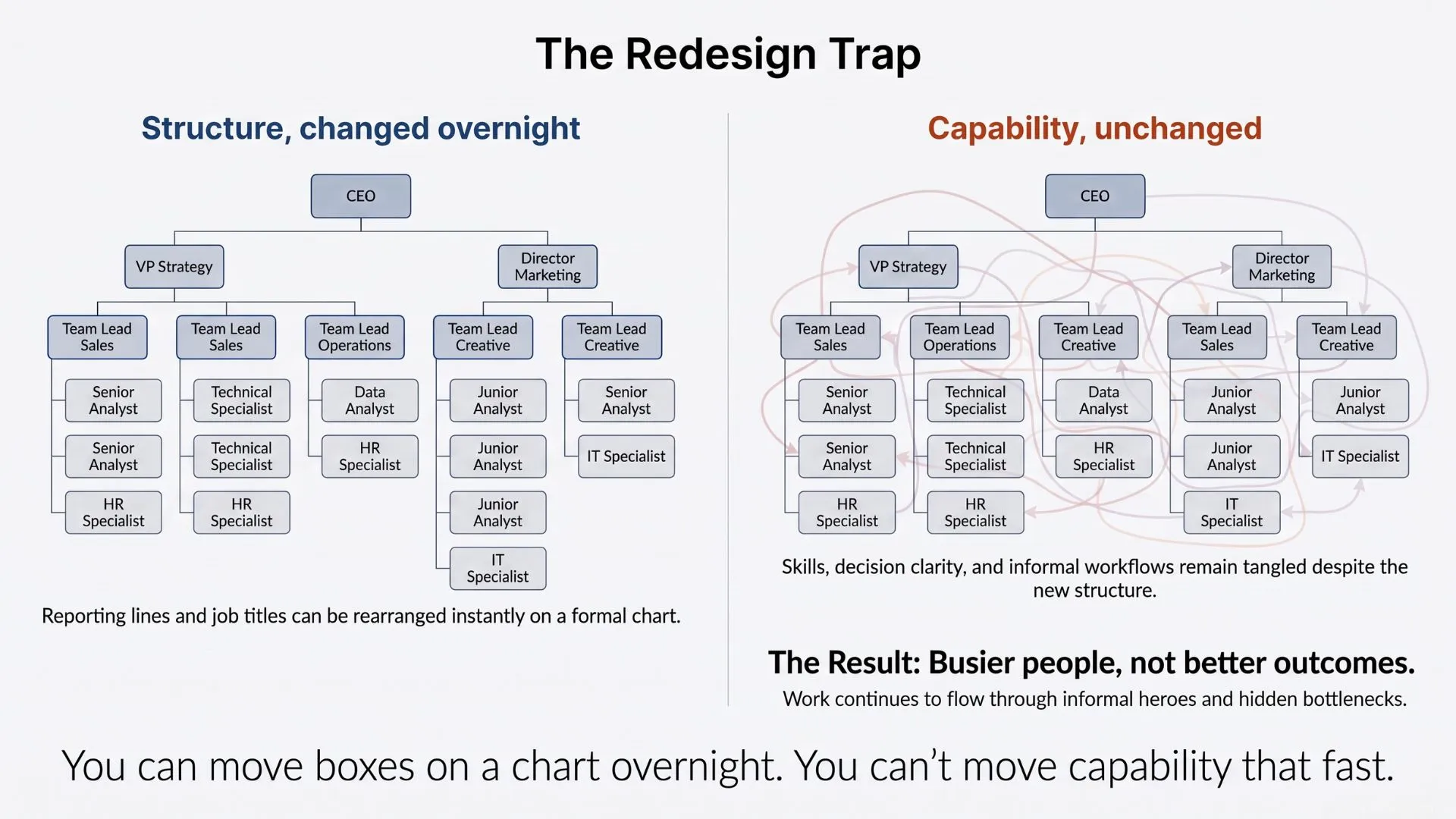
Structure moves overnight. Capability doesn’t.
I. Why Org Redesign Collapses Without Role Clarity
Org redesign typically starts with questions like: “Do we need a new function?” “Should this team report elsewhere?” “What should we centralize vs. decentralize?” But the real org redesign questions are: “What outcomes must this role own?” “What decisions must this role make?” “What skills and behaviors make that possible?”
Without competency management, your redesign ends up relying on job titles and assumptions exactly when work has already moved beyond job descriptions. Deloitte’s research highlights how work increasingly happens outside formal job boundaries: 71% of workers report doing work outside their job description, and executives note that work crosses functional lines more than ever.
So when you redesign “roles” without redesigning “capability,” you create unclear ownership, duplicated effort, slow decisions, escalations for basic calls, and a quiet spike in attrition from high performers who get stuck doing everyone else’s work. Org redesign works only when roles are defined by capability, not titles.
II. The Hidden Cost of “Late” Competency Work
Most organizations treat competency management as a later-stage HR project: “Let’s finalize the org structure first. Then we’ll define competencies.” That sequencing is the trap. Once structure is set, leaders defend their span of control, teams resist role changes, hiring begins on half-baked JDs, internal moves become political rather than evidence-based, and competency frameworks become paperwork created to “fit” the org chart, not guide it.
Meanwhile, transformation odds aren’t great when people-side clarity is missing. McKinsey notes that transformation efforts fail about 70% of the time, and one of the biggest reasons is that organizations struggle to change day-to-day behaviors at scale. Doing competency management late turns it into documentation. Doing it early turns it into direction.
III. Why “Early” Matters Even More in a Skills-Shifting World
Org redesign used to be occasional, every few years. Now, it’s continuous. WEF’s Future of Jobs Report 2025 indicates employers expect 39% of workers’ core skills to change by 2030. So if skills are shifting this fast, competency management can’t be a static framework living in PDFs. It has to be an operating layer that helps you answer: What capabilities do we need now? What capabilities are emerging? Which roles will carry tomorrow’s work? Where do we have gaps, risk, or misfit? When skills evolve continuously, competency management must start early and stay alive.
IV. The PeopleBlox Way to Make Org Redesign Actually Stick
When you use the PeopleBlox solution approach, Talent Architecture → Talent Identification → Talent Process Re-Engineering, you’re not just building a framework, you’re building a system that makes org redesign executable.
This piece is about sequencing, getting roles clarified before you redesign, not about how a competency framework itself gets built. For that deeper breakdown, see The Need of Competency Framework.
A. Talent Architecture: Define Roles as Capability, Not Hierarchy
This step establishes clear role outcomes (what “good” looks like), techno-functional and behavioral competencies (what “ready” looks like), and role-level expectations (what “senior” truly means here). Most importantly, it creates a shared language between HR and business, so instead of debating titles, you debate capability. Talent Architecture makes org redesign measurable, not subjective.
B. Talent Identification: Map Real People to Real Role Demands
Once role expectations are clear, Talent Identification helps you see who is ready now, who can grow into it, where the critical gaps are, and where risk is silently building. This is where org redesign stops being a structure exercise and becomes a talent decision. Talent Identification turns org redesign into a “who can deliver” map, not a “who reports where” map.
C. Talent Process Re-Engineering: Make the New Org Run Differently
This is where most org redesigns fail, because processes don’t change. You need redesigned talent processes such as competency-based internal mobility, role-fit hiring (even for internal moves), IDPs linked to role outcomes, and governance for role clarity, decision rights, and capability tracking. In short, your org redesign becomes sustainable. Process Re-Engineering makes the new org real in day-to-day execution.
V. A Client Story
One of our clients, a growing mid-sized enterprise, entered a high-pressure org redesign after a rapid expansion. They did what most leaders do first: restructured functions, created new layers, moved reporting lines. Within weeks, they hit the predictable wall: “This role is unclear.” “Two teams own the same thing.” “We’re hiring, but we don’t know what good looks like.” “Internal moves are stalling because managers don’t want to ‘lose’ people.”
They reset the approach and started early competency management the right way: Talent Architecture (role outcomes and a competency blueprint for critical roles), Talent Identification (assessed current leaders and mapped readiness and gaps), and Process Re-Engineering (rebuilt mobility, IDPs, and role clarity governance).
What changed wasn’t just HR documentation. What changed was execution: faster decision-making, fewer escalations, cleaner accountability, and better internal placements because role fit became visible. The org redesign finally started behaving like a system, not a chart.
VI. Need of Competency Management Is Org Redesign Insurance
Early need of competency management doesn’t slow org redesign. It prevents redesign rework. If you see these symptoms, competency management should start immediately:
- You’re redesigning teams but still unsure who owns outcomes
- Managers keep saying “it depends on the person”
- Hiring panels disagree on what “good” looks like
- Internal mobility feels political
- Key work runs through a few individuals, not roles
- You’re scaling, but capability feels fragile
Org redesign is not just a structural change. It’s a capability commitment. And that’s exactly why need of competency management must be addressed early, before structure hardens, before hiring accelerates, and before the informal org becomes the real org again.
This is the discipline PeopleBlox calls Capability Assurance: continuously verifying, not just assessing, that your organization has the capabilities its strategy requires.
If you want your redesign to stick, start with Talent Architecture → Talent Identification → Talent Process Re-Engineering. If you’re planning an org redesign, or you’re already in one, book a demo and we’ll show you how competency management can become your operating layer, not another document repository.




read next

Capability Mapping for Business Roles: Why Old Role Expectations Create New Execution Risk

Capability Visibility: The Missing Link Between Strategy and Execution