










Most pharmaceutical competency frameworks document roles. Few prove that the people in those roles can do the regulated work in front of them. This guide sets out what a framework must show a CEO and a board, what third-party evidence says about doing it well, and how HR leaders can move from documenting capability to verifying it.
I. The Question Most Pharma Frameworks Cannot Answer
Your CEO asks who, by name, is ready to run the new biologics line, and how you know. How long does the silence last?
Most pharma HR teams can produce a competency framework in minutes. Role profiles, skill lists, behavior statements. The answer to the CEO’s question takes weeks. The framework describes what good looks like. It says nothing about who has reached it. That is the weakness in many competency frameworks for pharmaceuticals today.
That gap costs more in pharmaceuticals than almost anywhere else. The work is regulated, documented and unforgiving. A batch is released or it is not. A safety case is handled correctly or it is not. Competency frameworks for pharmaceuticals exist to put the right people in those roles, and a framework that only describes roles cannot do that job.
A. Documented Is Not the Same as Demonstrated
A training record shows that someone attended a session. A job description shows what a role requires. Neither shows whether the person in the role can do the work today.
Leaders fill that gap with tenure, reputation and the opinion of whoever happens to be in the room. In an industry built on evidence, that is an odd way to run capability.
B. What a Framework Is Actually For
A competency framework is a structured description of the skills, knowledge and behaviors a role requires. The World Health Organization’s Global Competency Framework for Regulators of Medicines is a useful reference point: it sets out an internationally accepted set of organizational and role-specific competencies, built to harmonize workforce development.
That is a standard. A pharma competency framework earns its keep only when you can measure people against it, and most pharmaceutical organizations stop one step short of that.
II. What a Weak Framework Costs a Pharmaceutical Business
The cost rarely arrives labeled as a competency problem. It shows up as a new site staffed on assumption instead of evidence. It shows up as a regulatory affairs lead who leaves and takes years of undocumented judgment with them. It shows up as a succession call made on tenure, because nothing better was on the table.
A. Skills Are Moving Faster Than Role Profiles
The World Economic Forum’s Future of Jobs survey found that 63% of employers cite skills gaps as the main barrier to business transformation. The same survey finds employers expect 39% of workers’ core skills to change by 2030.
Apply that to pharma. A role profile written before the current wave of AI and data work in drug development describes yesterday’s job. The people in the role are being asked to do tomorrow’s.
B. HR Often Cannot See the Gaps
Gartner surveyed 339 HR leaders in July 2021 and found that 47% did not know what skills gaps their current employees had. The survey is several years old, but the pattern it describes is familiar.
Read that plainly. Nearly half of the people responsible for workforce capability could not say where it was thin. In a regulated sector, “we think we are covered” is a weak answer to give a board.
C. Why This Lands on the CEO’s Desk
HR can treat a capability gap as a development item. A CEO sees it differently. A gap in a critical quality, regulatory or manufacturing role is a launch timeline at risk, an inspection that goes harder than it should, or a growth plan that quietly depends on three people nobody has mapped.
That is why competency frameworks for pharmaceuticals belong in the executive conversation, not only the HR one. The framework is the first place the business can see whether its strategy has the people it needs. If the framework cannot answer that, the strategy is being run on faith.
III. From Documenting Roles to Verifying Capability
Most organizations have assessed capability at some point: a competency review before the last restructure, a skills audit ahead of a site expansion. Almost none can assure it.
Assessment is a photograph. By the time anyone acts on it, the organization has moved: people have changed roles, a new product has changed what a role needs, and the framework behind the photograph has aged. Assurance works the way finance treats its numbers. The picture is continuously verified, always current, and trusted enough to make decisions on.
A. Why the Distinction Matters in a Regulated Industry
Pharmaceutical leaders already live by this logic everywhere except people. Nobody accepts a quality result checked once three years ago. Yet capability, the thing that produces every result, is often checked once and filed.
The honest version of the fix is not removing human judgment. It is making that judgment structured, anchored to a defined standard, comparable across people and roles, and revisited over time instead of recalled under pressure.
B. The Test Worth Applying
A defined standard + current evidence of capability = a workforce decision you can defend.
If your framework supplies only the first half, it is a reference document. If it supplies both, it is a decision tool.
IV. What Strong Pharma Competency Frameworks Do in Practice
Building a framework is not the hard part. Building competency frameworks for pharmaceuticals that stay useful is. Capable organizations tend to share five habits.
A. Start From the Regulated Work, Not the Job Title
A title tells you where someone sits. It does not tell you what they must be able to do on a given day. Begin with the regulated tasks and outcomes that carry risk: release decisions, safety reporting, protocol compliance, quality investigations. Then define the capability each one demands. Roles inherit their standards from the work, not the other way round.
In practice, this means sitting down with a quality head and asking which five decisions in the role carry the most risk, then writing the capability standard around those decisions first. The result is shorter and sharper than a generic skills list, and far easier for a manager to use.
B. Build It With the People Who Do the Work
A pharma competency framework written only by HR describes a job the way HR imagines it. Consult senior scientists, quality leads, plant heads and regulatory managers. They know which capabilities separate someone who is merely trained from someone who can be trusted with the work. They are also the managers who will have to use the framework, so their buy-in decides whether it lives or dies.
C. Tie It to the Strategy the Business Is Funding
A pharma competency framework should follow the portfolio. If the company is building a position in biologics, the capability standards for biopharmaceutical manufacturing and its quality oversight need to be sharper than the rest. Capability investment then becomes a strategic choice, visible to the CEO, not a general HR preference.
D. Aim Development at the Gaps That Matter
Training catalogs grow by request. Capability gaps do not. Once you can see which gaps could slow a launch or expose a critical role, development spend can follow risk instead of volume. The test of a training program is not completions. It is whether a critical gap closed.
A simple workflow helps. Pick one critical function, such as quality assurance. Define the standard with the people who run it. Compare the current team against that standard. Name the two or three gaps that carry the most risk. Then fund development against those gaps only. One function done properly teaches an organization more than ten done lightly.
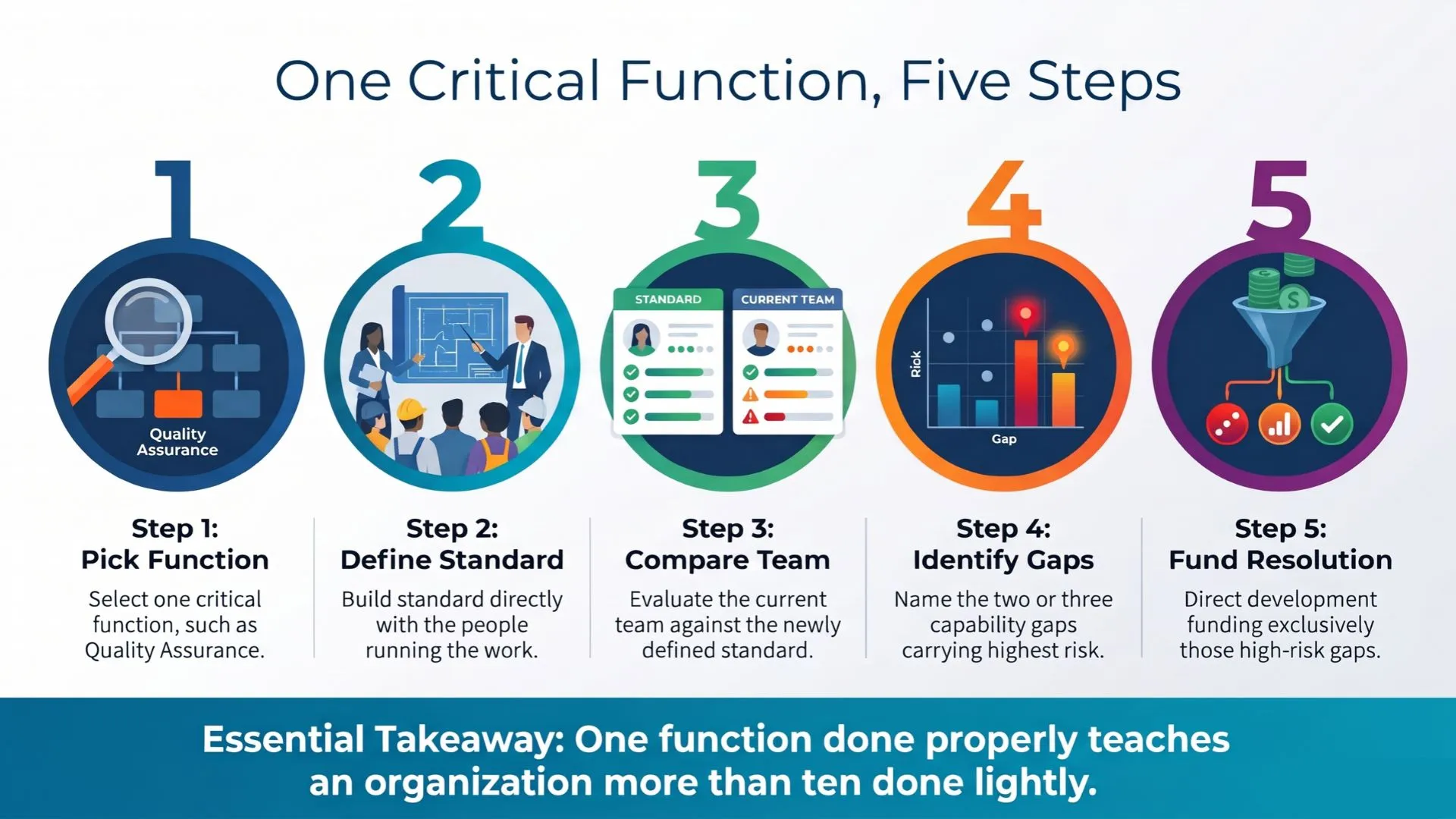
How to turn a competency framework into a capability decision
E. Review It on the Industry’s Clock
Regulations, technologies and therapies change on their own schedule. A framework reviewed only at the annual planning cycle is always behind. Set review triggers tied to events, such as a new regulation, a new modality or a new site, as well as a calendar date.
V. What Evidence Shows
Two independent, published examples carry the proof here. Each has limits worth stating, and neither is a PeopleBlox client.
A. The WHO Pilot With Medicine Regulators
WHO-affiliated authors writing in Frontiers in Medicine report that fewer than 30% of countries have regulatory systems at the maturity level WHO treats as stable and well functioning. They point to a shortage of adequately skilled people as a central cause, and they note that in some cases training stays focused on acquiring knowledge without applying it in the workplace.
Their response was a competency-based approach, piloted using the WHO framework, designed so that learning transfers into real practice. The subjects are regulators, not manufacturers. The lesson carries over directly: counting training delivered is not the same as confirming capability applied.
B. Industry Pharmacists in Lebanon
A validation and pilot study of a specialized competency framework for industry pharmacists, published in the Journal of Pharmaceutical Policy and Practice in 2023, tested seven domains with ten pharmacists working in Lebanese pharmaceutical plants. Confidence was lowest in research and development, and some domains, including industrial development and emergency preparedness, diverged from the rest.
The sample is small and the setting is one country, so treat it as a signal, not a benchmark. The signal is still useful. A structured framework surfaced uneven confidence across domains that a job description would never have shown, and the authors turned that into specific recommendations for education and training.
C. What the Two Examples Share
Both examples start from a defined standard and then check people against it. Neither treats attendance at training as proof of capability. Both found that capability was uneven in places the organization had not expected, and both turned that finding into a specific action.
That is the pattern worth copying. The framework is the starting point. The value comes from using it to see where people stand and what to do next.
VI. Where Pharma Frameworks Break Down
Most failures of competency frameworks in pharma are not technical. They are failures of use.
A. Frameworks Treated as Paperwork
Employees read a new framework as extra bureaucracy, and managers read it as an HR exercise. Both reactions are earned when the framework is used once a year at review time and never in a coaching conversation or a staffing decision. Resistance falls when the framework visibly changes something: who gets developed, who gets promoted, who gets a critical role.
B. Frameworks That Go Stale
Building one takes real time and effort, and the temptation is to treat the finished version as permanent. In a sector where therapies and regulations move quickly, a framework that stops being maintained quietly turns back into a reference document.
Leaders who can answer the board’s question in minutes did not get lucky. They verified earlier.
VII. How PeopleBlox Helps?
The discipline this article describes has a name: Capability Assurance, the discipline of continuously verifying, not just assessing, that your organization has the capabilities its strategy requires. PeopleBlox is built around it.
A. Organizational Capability Assurance
For a pharmaceutical workforce, the starting point is Organizational Capability Assurance: one view of capability strength, role gaps and team readiness across the business. It lets a CHRO say where capability is strong, where it is uneven and where a gap could slow delivery, against a defined standard for each role, with judgment that is structured instead of recalled under pressure.
The frameworks behind PeopleBlox are built to a level of structure and detail most organizations never reach, and the platform is built around them. What that buys a leader is narrow and useful. When you ask whether a team is ready for a new product, the answer comes back consistent across every team you compare, instead of assembled from whoever was in the room.
B. Leadership Capability Assurance
The same verification applies at the top. Leadership Capability Assurance addresses succession and leadership readiness, so the question of who could run a critical function, a plant or a regulatory team starts from a current picture.
Where this lands for a CEO is the Capability Command Center: one place where the readiness of critical roles is visible at once. For roles where one departure would hurt, Critical Employee De-risking shows where that dependency sits before it becomes a vacancy.
Book a demo for your pharma workforce.
VIII. What the Next Five Years Will Ask of Your People
The direction is clear even where the details are not. AI, automation and data analytics are becoming part of drug development. Advanced and personalized therapies, including genomics-led approaches, are creating demand for new skill sets. Regulators and industry bodies keep pushing toward shared, internationally recognized competency models, as the WHO framework shows.
The World Economic Forum’s expectation that 39% of core skills will change by 2030 is a general figure, not a pharma one. For a sector with this much specialization, the pressure is unlikely to be lighter.
There is also a talent dimension. Pharmaceutical organizations compete for scarce regulatory, quality and data skills. People stay where they can see a clear path and a fair standard for advancing. A framework that makes expectations and growth routes visible helps the organization keep the people it can least afford to lose.
Leaders who treat the framework as a living standard will find those shifts manageable. Leaders who treat it as a document will find out about each gap after it has already cost them something. For anyone building competency frameworks for pharmaceuticals now, the practical move is to start from the regulated work, verify capability against it, and keep it current as the work changes.




read next

Capability Mapping for Business Roles: Why Old Role Expectations Create New Execution Risk

Capability Visibility: The Missing Link Between Strategy and Execution