










Most competency framework models fail because of the order they are built in, not because of what they say. They start with every role at once, skip the managers who see the work, and launch as a document instead of a decision tool. The build that holds begins with business-critical roles, describes good performance in observable terms, ties each competency to a real decision before launch, and gets reviewed on a fixed cycle. This guide walks a CHRO through that sequence.
I. Why Most Competency Framework Models Fail Before They Launch
When your CEO asks which business-critical roles are ready for next year’s strategy, how many of them have a written standard for what good looks like?
For most CHROs, the honest answer is a few. The org chart is current. The role definitions are not. Somewhere on a shared drive sits a competency framework model built two or three years ago by a project team, approved in a steering meeting, and opened by almost nobody since.
The pattern repeats across enterprises, and it is rarely a content problem. The competencies themselves are usually sensible. The failure sits in how the model was built: every role at once, drafted by HR in isolation, launched as a document rather than a decision tool. The framework ends up describing the organization instead of running it.
Ask three questions of your own framework today. Who used it last quarter? Which decision did it inform? When was it last revised? If the answers are nobody, none, and not sure, you do not have a framework. You have an archive.
The blind spot is measurable. McKinsey’s State of Organizations 2023 research found that 46% of the leaders it asked about critical roles have no, little, or only some clarity on which roles create the most value. Nearly half cannot name the roles that matter most. A framework spread evenly across every role is spending most of its effort in the wrong places.
The common failure patterns are covered in why competency frameworks fail. The sequence that avoids them starts with the roles, not the document.
II. What an Unused Competency Framework Model Costs
An unused framework looks harmless. It costs little to keep and nothing to ignore. The expense shows up elsewhere, in decisions made without a standard.
Hiring panels interview for different ideas of the same role. Promotions drift toward tenure and visibility. Learning budgets follow the loudest request instead of the most damaging gap. When the board asks who is ready for a critical seat, the answer is assembled over weeks from whoever remembers the most. Each of these is small on its own. Together they are why a capable organization keeps being surprised by its own bench.
The concentration of risk makes this worse. McKinsey reports that most large organizations draw disproportionate value from just 25 to 50 roles, and that in many organizations between 20 and 30% of critical roles are not filled by the most appropriate person. A small number of seats carries most of the value, and without a defined standard nobody can say how many of those seats are well matched.
The ground is also moving. The World Economic Forum’s Future of Jobs Report 2025 expects workers’ existing skill sets to be 39% transformed or outdated over 2025 to 2030, and 63% of surveyed employers see skill gaps as a major barrier to business transformation, the biggest of any they cited. A competency framework model that is not kept current ends up describing roles as they were, not as the strategy now needs them.
III. From Assessing Capability to Assuring It
Most organizations have assessed capability at some point. A competency review before the last restructure. A skills audit that fed one budget cycle. Very few can assure it, and that difference decides whether a framework survives.
Assessment is a photograph. It is accurate on the day it is taken and starts aging the next morning. Assurance works the way finance treats its numbers: checked continuously, current enough to act on, trusted enough that a board will make decisions from it. A competency framework model built as a one-off project produces a photograph. One built as a living reference produces something a CHRO can stand behind in the room.
That shift changes how the model is built. The standard has to be defined once, in terms people recognize. Judgment about who meets it has to come from people who see the work, from more than one vantage point. And the whole thing has to be revisited on a schedule, not rediscovered when something breaks.
A defined standard + judgment from people who see the work = decisions you can defend.
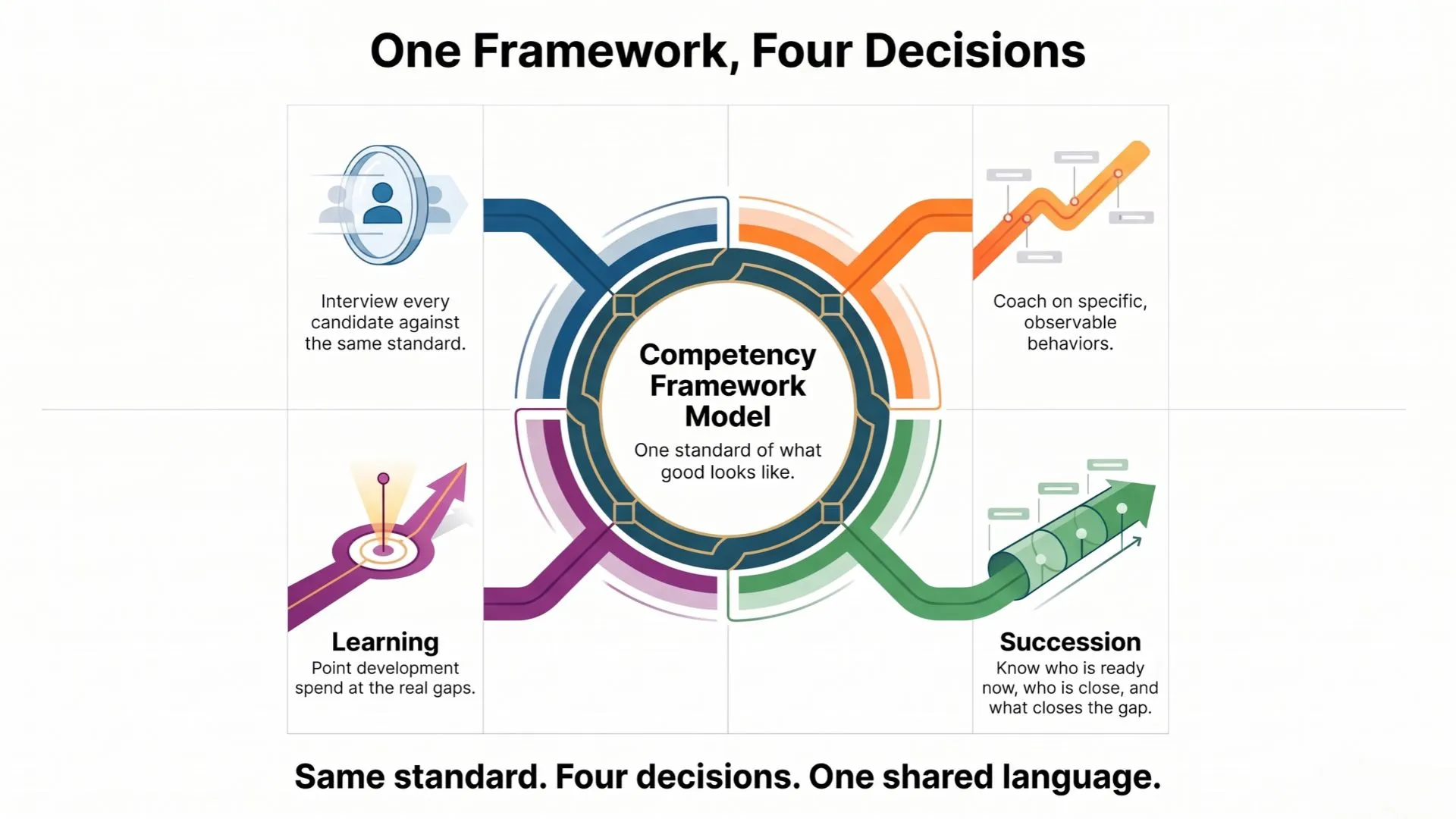
A single standard of what good looks like feeds every talent decision
IV. How to Build a Competency Framework Model That Holds Up
Listing skills is not building a framework. The work needs structure, scale, and the support of the people who will use it. Five moves, in this order, carry most of the weight.
A. Start With the Roles the Business Cannot Afford to Get Wrong
Resist the instinct to cover the whole organization. Begin with the roles where a wrong call costs most: the ones tied to revenue, to risk, or to a strategy the board has already approved. In a large organization that is a few dozen seats at most, and it is where a defined standard changes decisions fastest.
In practice the list is shorter than leadership expects. Ask each business head to name the three roles whose vacancy or underperformance would show up in results within a quarter. The overlap between those lists is your starting group. Building here first also gives you a working model to show skeptics, which is worth more than a complete model nobody has seen. How the model grows beyond that first group is covered in the guide on how to scale with a competency framework.
B. Build With the Managers Who See the Work
Managers watch behavior in action. They know the difference between someone who holds the title and someone who delivers the outcome. Their input makes the standard credible, and their involvement is what makes them use it afterwards. A framework drafted without them gets politely ignored. Run working sessions per critical role, and bring in strong performers from that role, not only their bosses.
C. Describe Good Performance in Observable Terms
Competency language fails when it describes temperament instead of conduct. “Strategic mindset” means five different things to five managers. Write what a person does: chooses the option with the better three-year outcome even when it costs the quarter.
Write it so a line manager could use the sentence in a one-to-one tomorrow. If it needs a glossary, it will not survive contact with real conversations. Plain, behavioral language is also what stops two managers from judging the same behavior differently.
D. Tie Every Competency to a Decision Before Launch
Ask of each competency: which decision does this inform? Hiring, promotion, a development plan, a succession call. If it informs none, cut it. A model connected to decisions gets used because people need it. A model connected to nothing gets admired once and filed.
This is also where a wider competency-based talent approach starts to pay off. A hiring panel that uses the competency language in its interview guide, and a succession review that uses the same language, are working from one definition of the role. That consistency is the real return, because what one decision reveals can inform the next.
E. Keep It Current on a Fixed Cycle
Review the model at least once a year, and again whenever strategy shifts, a function restructures, or a role changes materially. Name an owner. Frameworks without owners drift, and a drifting framework is worse than none, because people still trust it. Keeping the model in a system that managers and employees open as part of normal work, rather than in a document someone must remember to update, is what holds the cycle in place.
V. Where a Competency Framework Model Earns Its Keep Across the Talent Lifecycle
A well-built model touches every phase of the talent lifecycle. It becomes the common language between HR, managers, and employees, and the backbone behind each decision it informs.
A. Hiring the Right People
Stop relying on CV keywords and instinct. A competency-driven job description evaluates candidates on the behaviors, skills, and potential the role needs. Panels interview against the same standard, so a comparison between two candidates means something.
B. Performance and Development
Managers cannot manage what they cannot describe. With a clear model, performance conversations reference specific competencies and coaching becomes concrete. A manager who can name the behaviors a person already shows, and the ones still missing, has a coaching conversation. One who cannot is left with a general impression.
C. Learning That Matters
Generic training wastes budget. Competency gaps show where capability is thin, so learning spend follows need instead of request, and L&D investment becomes sharper and more personal.
D. Succession Planning and Readiness
Succession built on past performance alone misses the question that matters: whether someone is ready for what the role will demand next. A competency framework model lets you assess future potential against a defined standard, so you know who is ready for what, and roughly when. For a CHRO, the board’s question becomes a routine review: for each critical seat, who is ready now, who is close, and what would close the gap.
The difference shows up across the whole talent agenda:
Talent Area | Challenge Without a Framework | Impact With a Competency Framework Model |
Hiring | Subjective screening, inconsistent role definitions | Role-fit hiring with structured assessments and defined expectations |
Performance Management | Generic goals, unclear expectations | Behavior-anchored evaluations and coaching clarity |
L&D / Training | One-size-fits-all programs | Targeted learning paths based on actual skill gaps |
Succession Planning | Guesswork in the leadership pipeline | Predictive readiness mapping and risk mitigation |
Internal Mobility | Lack of visibility on transferable skills | Transparent, skill-based career pathways |
Engagement and Retention | Misalignment between capability and role fit | Higher engagement through growth clarity and purpose |
VI. Rolling Out at Scale Without Losing Adoption
Pilot first. Run the first group of critical roles through real hiring, performance, and development cycles before expanding, and note where the language confuses people. Fix it there, while the cost of fixing is small. Then expand function by function, with each new group building on the shared language already in use rather than starting from a blank page.
Communicate the purpose before the content. Employees and managers should hear which decisions the model will inform and, just as important, which it will not. Silence on that point is where resistance grows.
Set governance early: who owns the competency framework model, who approves changes, and how often it is reviewed. Scale amplifies whatever is loose. A model with unclear ownership at ten roles becomes unmanageable at a thousand.
Measure adoption, not completion. The useful numbers are how many hiring decisions, development plans, and succession reviews in the pilot group referenced the model, not how many documents were published. Falling usage is the early signal that the language needs revising.
The CHROs who answer “which critical roles are ready?” in a meeting, not in a month, did not get lucky. They defined the standard first and kept it live.
VII. How PeopleBlox Helps?
Building a framework that stays in use is a discipline: continuously verifying, not just assessing, that your organization has the capabilities its strategy requires. That discipline is Capability Assurance, and PeopleBlox is built around it.
For workforce and skills questions like these, the relevant discipline is Organizational Capability Assurance: one view of capability strength, role gaps, and team readiness across the business, anchored to a defined standard for each role. It sits alongside Leadership Capability Assurance, the same verification applied to the leaders and successors your strategy depends on.
The frameworks behind PeopleBlox are built to a level of structure and detail most organizations never get to, and the platform is built around them. What that gives a CHRO is narrow and useful. When you ask whether a critical role is covered, the answer is anchored to a defined standard and consistent across every person and team you compare, instead of assembled from whoever happened to be in the room. Judgment stays human. It becomes structured, comes from more than one perspective, and is revisited over time.
Where this lands for a CHRO is the Capability Command Center: one place where readiness across critical roles is visible at once, so the conversation with the CEO starts from a current picture, not a reconstruction.
IX. A Framework Is Only as Good as the Decisions It Runs
A competency framework model is not a grid to be completed. It is a working reference that hiring, performance, learning, and succession decisions run from. When it works, HR stops reconciling private versions of a role and starts answering questions the business actually asks. That is what earns HR a seat at the strategic table: the conversation moves from process to readiness.
Start small, tie the model to decisions from the first week, and expand once people are using it. The right framework builds trust, clarity, and capability across the organization, but only for as long as it stays alive.




read next

Capability Mapping for Business Roles: Why Old Role Expectations Create New Execution Risk

Capability Visibility: The Missing Link Between Strategy and Execution