











Talent Risk Management often begins with a deceptively simple question in the boardroom: “Who can break us if they exit?” It’s not asked casually. It usually surfaces when a company is scaling, restructuring, or entering a critical growth phase. And when the question appears, something uncomfortable often follows. No one has a confident answer. Not because leaders don’t understand their people, but because most organizations lack real visibility into talent risk. At the center of that blind spot sits a specific pattern: capability concentration, what governance conversations often call key-person risk, where too much of the organization’s execution depends on too few individuals. The reality is this: companies track financial risk. They track operational risk. They track compliance risk. But talent risk remains mostly invisible. Let’s unpack why.
I. The Myth of Talent Stability in Talent Risk Management
There is a persistent assumption inside many organizations: “Our leadership bench is strong. If someone leaves, we will manage.” This belief is comforting. But it’s also dangerous. In reality, most organizations operate with hidden talent dependencies. These dependencies often sit in roles like: critical technical experts, long-tenured operations leaders, client relationship owners, product architects, and transformation program leads.
If one of these individuals exits suddenly, the organization doesn’t just lose a person. It loses decision velocity, institutional knowledge, client continuity, and execution stability. And yet, most companies discover these dependencies only after someone leaves. Talent Risk Management begins by acknowledging that stability is often an illusion.
A. Why Talent Risk Management Rarely Shows Up on Leadership Dashboards
Ironically, the absence of talent risk data isn’t because leaders don’t care. It’s because talent risk is incredibly hard to measure with traditional HR tools. Most HR systems track headcount, attrition rates, performance ratings, and engagement scores. But these metrics don’t answer the real risk questions leaders care about: which roles have single-point dependency risk, where succession depth is dangerously thin, which teams are operating with capability gaps that threaten strategy execution, and where the organization is over-reliant on a handful of experts.
Without structured capability data, these risks remain invisible. Organizations rely on manager intuition instead of evidence. And intuition, while valuable, does not scale. Talent Risk Management fails when leadership decisions rely only on intuition instead of capability intelligence.
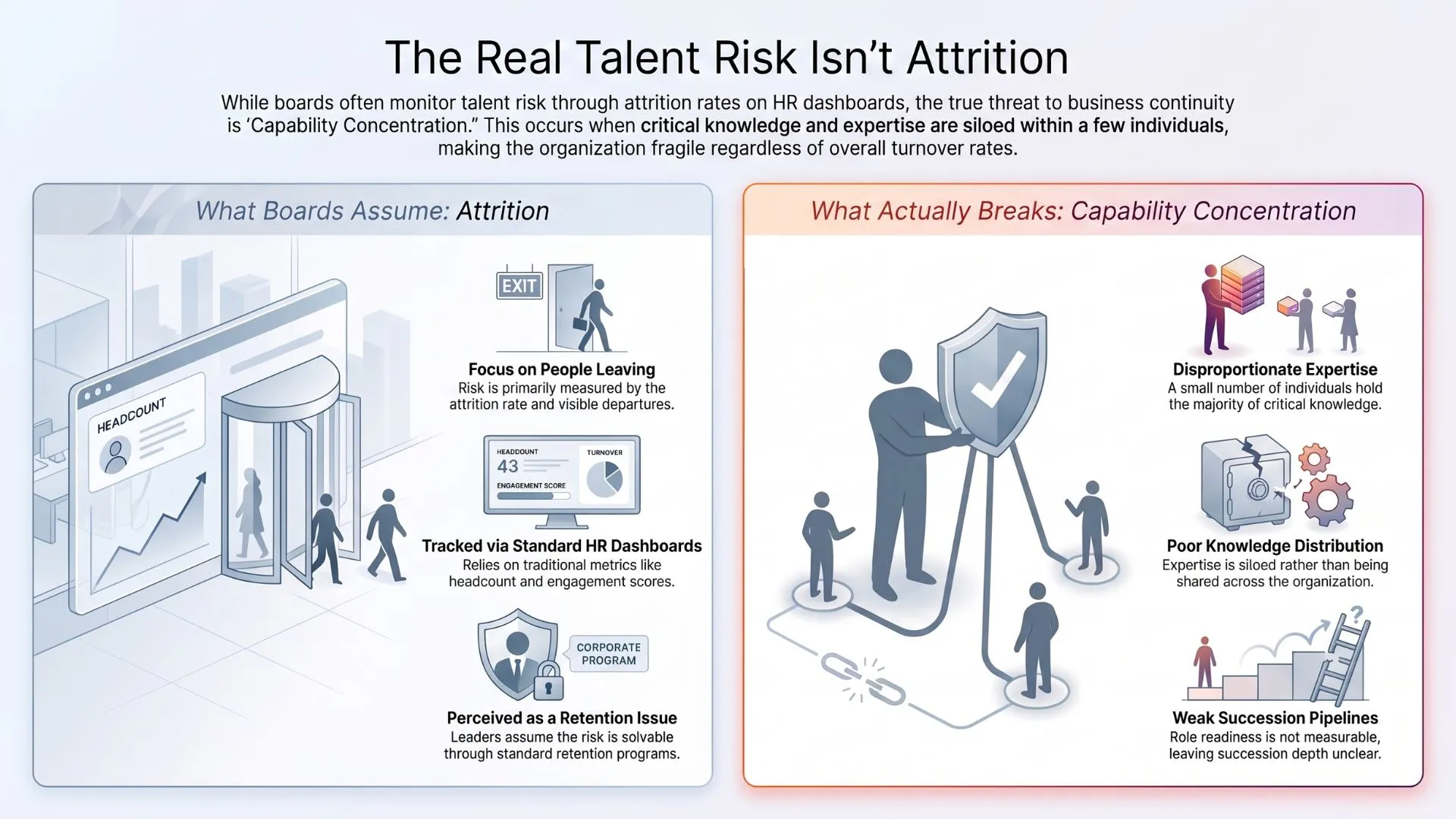
What boards assume vs. what actually breaks execution
II. The Real Talent Risk: Capability Concentration
When boards ask about talent risk, they often assume the risk lies in attrition, a framing explored further in Talent Risk in 2025: The Silent Killer of Strategy. But attrition is not the real problem. The real problem is capability concentration.
Capability concentration happens when a small number of individuals hold disproportionate expertise, knowledge is not distributed across the organization, succession pipelines are weak or unclear, and role readiness is not measurable. This creates fragile organizations. On paper, everything appears stable. But under the surface, execution depends on a few irreplaceable individuals. This is sometimes called Key Person Risk in governance discussions. Yet most organizations do not have a systematic way to measure it. Talent Risk is rarely about attrition rates. It is about invisible capability concentration.
III. Talent Risk Management Requires Capability Visibility
To truly address talent risk, organizations must shift from people tracking to capability visibility. This requires answering three fundamental questions.
A. What Capabilities Does Each Role Require?
Not job descriptions. Actual competency architecture. This includes functional competencies, domain expertise, and behavioral capabilities. Without this structure, risk cannot be measured. According to a Deloitte Global Human Capital Trends report, organizations increasingly recognize workforce capability as a strategic risk rather than just an HR metric.
B. What Capability Depth Exists in the Organization?
Once competencies are defined, leaders can see who possesses critical skills, where expertise is concentrated, and where capability gaps exist. This creates the foundation for evidence-based talent decisions.
C. What Happens If Key Individuals Exit?
With capability data in place, leaders can simulate real scenarios: What if this expert leaves? Do we have ready successors? How quickly could someone step in? This is where Talent Risk Management becomes strategic rather than reactive. Talent risk becomes manageable only when capability data becomes visible.
IV. Why Boards Are Starting to Ask About Talent Risk Management
Over the last few years, leadership conversations have changed. Boards are no longer asking only about revenue forecasts or cost structures. They are asking about organizational capability. Because strategy execution ultimately depends on people.
In boardrooms around the world, new questions are emerging: Do we know which roles are mission-critical? Do we know where our talent dependencies are? How strong is our succession depth? Can we quantify leadership readiness? These questions signal an important shift. Talent is no longer seen as just an HR topic. It is increasingly recognized as a strategic risk category. The future of governance will include Talent Risk Management alongside financial and operational risk.
V. The Shift Toward Data-Driven Talent Risk Management
Forward-thinking organizations are beginning to treat talent risk with the same rigor as other enterprise risks, part of what it actually means to transform talent risk management rather than simply monitor it. This requires two capabilities.
A. Talent Risk Detection
Identifying critical role dependencies, capability gaps, succession weaknesses, and knowledge concentration.
B. Talent Risk Analytics
Understanding capability trends across teams, readiness pipelines, emerging leadership gaps, and workforce capability shifts.
Together, these capabilities provide leadership with something they rarely had before: clear visibility into organizational resilience.
VI. The Leadership Question That Changes Everything
Eventually, every leadership team reaches a moment when they ask: “If one or two key people left tomorrow, what would break?” For many organizations, the answer is unclear. Not because leaders lack insight. But because the organization lacks structured talent intelligence. And that is exactly what Talent Risk Management aims to solve. Research from PwC’s CEO Survey shows that many CEOs see talent shortages and capability gaps as one of the biggest threats to growth.
VII. Where PeopleBlox Fits In
PeopleBlox helps organizations move from assumptions about talent to evidence about capability, the foundation of what we call Capability Assurance. Using competency frameworks, talent analytics, and risk signals, organizations can detect hidden talent dependencies, identify critical capability gaps, understand succession depth, and monitor workforce readiness. Instead of reacting to talent disruptions, leaders can anticipate them. Because in modern organizations, talent risk is not hypothetical. It is simply invisible until measured.
Most organizations already manage financial risk and operational risk. But the companies that will outperform in the future are the ones that master Talent Risk Management. Because strategy execution ultimately depends on one thing: the right capabilities being in the right place at the right time. And that requires visibility.
The organizations that can answer the board’s question in minutes are not lucky. They made talent risk visible before it became urgent.
See PeopleBlox in action, request a demo.



read next
The Talent You Can’t See Is the Risk You Can’t Manage
The Talent Visibility Gap: Why HR Data Alone Cannot Show True Capability