










Succession risk is not a staffing gap. It is the exposure created when a board cannot see, in real time, which critical roles depend on one person, which named successors are actually ready, and where a departure would stall the strategy the CEO is accountable for. Most organizations still manage this with an annual review and a chart of names, which is exactly why the exposure stays invisible until a resignation makes it visible the hard way. This piece reframes succession risk as a continuous, business-continuity signal rather than a once-a-year talent exercise, and shows what boards and CEOs need to see in order to act before the gap becomes a headline.
I. Why Succession Risk Stays Hidden Until It Costs You
When a board member asks who could step into your COO’s chair tomorrow, how long does the pause last before someone answers?
Most executive teams can produce a name in seconds. Far fewer can produce evidence. That gap, between having a name and having confidence in it, is what succession risk actually is. It is the exposure created when critical roles depend too heavily on one person, when bench strength is thinner than the org chart suggests, when role-to-person fit is unclear, and when leaders do not have an honest, current view of readiness across the business.
This is a harder problem than most succession conversations admit. The standard questions, who could replace whom, who is high-potential, who might be ready in twelve or twenty-four months, are not wrong. They are just incomplete. They describe a plan. They do not describe the risk sitting underneath it.
That risk is growing faster than most organizations’ visibility into it. SHRM’s research on talent management executives found that 42% cite building a succession strategy as a top priority, yet only 22% of HR leaders report having a formal succession plan in place. Read that gap again: the majority of leaders who call succession urgent still cannot produce a plan when asked. At the same time, Deloitte’s 2026 Global Human Capital Trends survey found that seven in ten business leaders now see speed and adaptability as their primary competitive strategy over the next three years. Put those two findings together and the problem is plain: the pressure on continuity is rising faster than most organizations’ ability to see where they are exposed.
Succession risk usually hides behind healthy-looking language. A leadership pipeline exists. Successors have been identified. Development plans are on file. Look closer and the picture changes. A named successor may not be genuinely ready. Every listed successor may sit in the same function, the same geography, the same manager’s orbit, an illusion of depth with none of the substance. And sometimes the real dependency is not a title at all. It is a specialist, a team lead, a single expert whose capability the business quietly runs on.
This is where succession stops being a talent conversation and becomes a board-level risk question. Not “who is next,” but where are we exposed right now. Succession risk becomes visible only when leaders stop looking at names and start looking at dependency, fit, and readiness.
II. What Succession Risk Really Looks Like Inside the Business
Succession risk is rarely dramatic at first. It is quiet. It shows up as a handful of recurring patterns, and once a CEO learns to recognize them, they are hard to unsee.
“We know who our strong people are, but we’re not sure where the real risk sits.”
“We have succession names, but I’m not convinced we have real bench depth.”
“If two or three people moved at once, we’d feel it immediately.”
These are not failure statements. They are reality statements, and they describe four distinct patterns worth naming separately, because each one demands a different fix.
A. Single-Point-of-Failure Roles
The clearest form of succession risk is concentration: one role carrying too much decision authority, one leader holding too much institutional knowledge, one team with no ready-now backup. This is the pattern most people mean when they say succession risk, and it is the easiest to describe and the hardest to feel the cost of, until the person in that role actually leaves. A resignation in a single-point-of-failure role does not just create a vacancy. It stalls whatever decisions, relationships, or execution depended on that one person, at whatever moment they happened to walk out.
B. Successors Who Look Ready but Aren’t
A name in a succession box is not the same as a capable successor. McKinsey’s research on matching talent to value found that when companies rigorously assess incumbents against the actual requirements of value-critical roles, they typically discover that 20% to 30% of people in those roles are not well matched. Apply the same lens to successors, and the number gets uncomfortable fast: a candidate can look ready on paper, tenure, title, a strong performance history, and still lack the specific capability the role will demand next. Readiness has to be evidence-based. A name is not evidence.
C. Successor Slates That All Look the Same
A less visible but equally corrosive pattern is conformity. When succession candidates are chosen informally, senior leaders naming who comes to mind, the resulting slate tends to cluster: same function, same geography, same manager’s orbit, often the same profile as the leader doing the choosing. That is not depth. It is a narrow bet dressed up as a bench, and it quietly limits the range of judgment, experience, and perspective available the moment a critical role opens.
D. Plans Built for Yesterday’s Org Chart
The fourth pattern is the most structural: succession plans built around what a role requires today, not what the business will need from it next. A successor can be well matched to the job as it currently exists and still be the wrong bet for the job as it will exist in eighteen months, after a restructure, a market shift, or a strategic pivot. This is where succession planning as a document starts to break down, and it is the subject of the next section.
Each of these patterns is a visibility problem before it becomes a talent crisis. None of them show up in an annual succession review that only asks who is next.
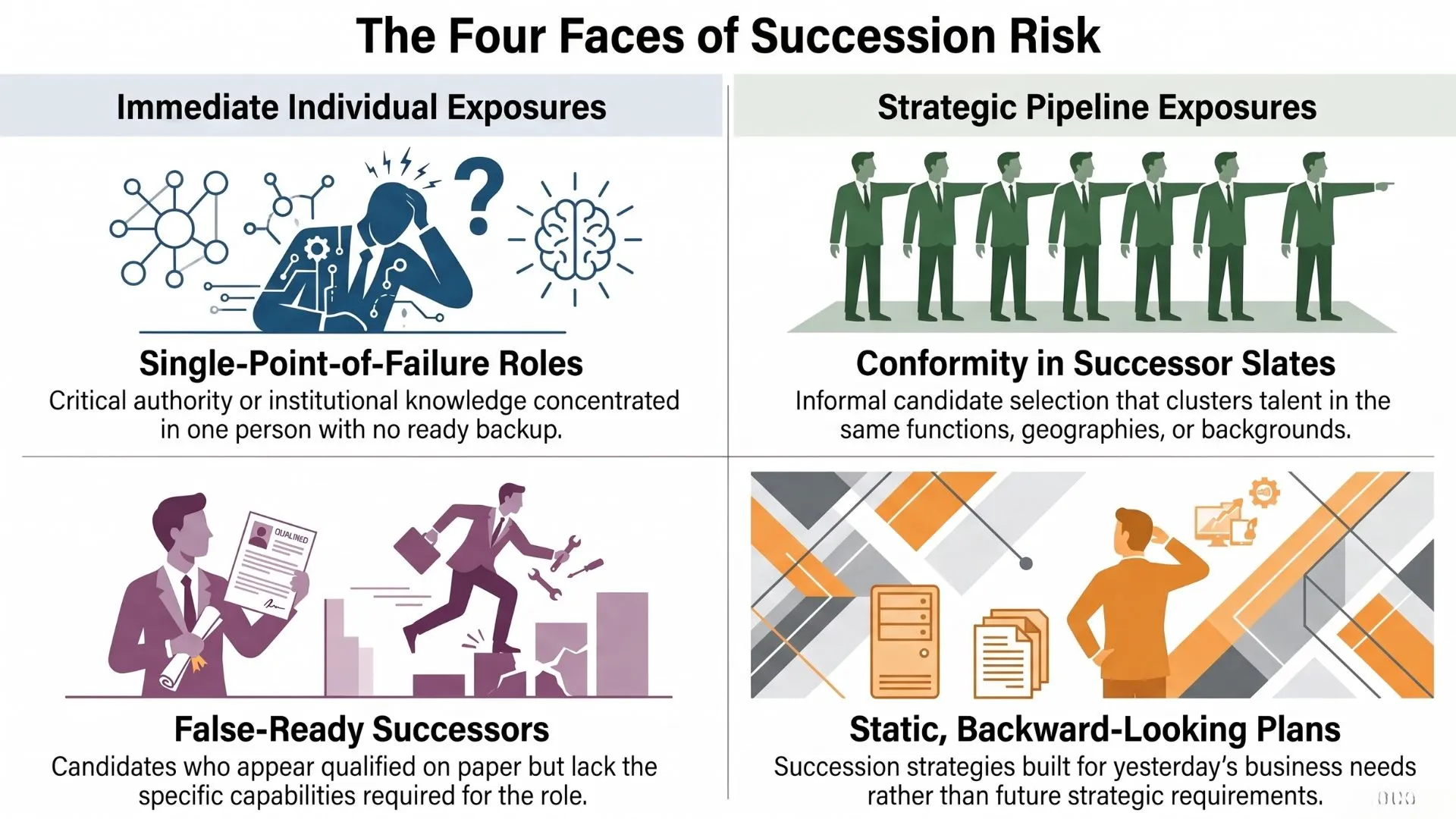
The four succession risk patterns
III. Why Succession Risk Needs a Live View, Not a Static Plan
A succession plan is a document. Succession risk is a moving target, and treating the first as a proxy for the second is where most organizations go wrong.
People change roles. Teams get restructured. Critical skills become scarce faster than anyone updates the spreadsheet. A successor who looked ready six months ago may no longer be the strongest option, not because they got worse, but because the role changed under them. A role that looked stable can become fragile overnight because of new complexity, a departure two levels down, or a shift in what the business now needs from it. None of that shows up in a document that was accurate the day it was written and has been quietly decaying ever since.
This is the deeper issue with treating succession as an annual exercise. Most organizations have assessed succession at some point: a talent review last year, a round of nine-box calibration before the last reorg. Far fewer can say they are assuring it. An assessment is a photograph. By the time anyone acts on it, the organization has already moved past what it shows. Assurance is closer to how finance treats its own numbers: continuously verified, always current, trusted enough to make a real decision on without checking twice. Succession deserves the same standard. A board that would never accept a photograph in place of a current balance sheet should not accept one in place of a current view of leadership exposure either.
That distinction changes what the right question is. Not “do we have a succession plan,” but “can we see succession risk right now, today, without waiting for the next scheduled review.” A formal plan answers the first question and says nothing about the second.
A live view of readiness beats a static list of names.
When the business is moving faster, succession cannot remain a once-a-year talent review. It has to become a continuous risk conversation, monitored the way any other business exposure is monitored: not reviewed periodically and hoped to still be accurate, but watched.
IV. How Capable Boards and CEOs Reduce Succession Risk
The best succession risk conversations are not abstract. They are operational, and they start with sharper questions than “who is next.”
A. Five Questions Worth Asking Before the Next Departure
- Which roles are truly value-critical, not just senior? McKinsey’s talent-to-value research is useful here: the roles that matter most are not always the highest-ranking ones. Some are pivotal because they carry revenue, customer continuity, transformation, compliance, or execution speed, regardless of title.
- Where does a single resignation, retirement, or internal move slow the business down? That is single-point-of-failure risk, and it is measurable if anyone bothers to look.
- Do we know the difference between a named successor and a ready one? A name in a box is not bench strength. Readiness has to be evidence, not assumption.
- Where are the capability gaps in the roles that matter most? If a role is critical and the likely successor has a visible deficit, that is not a future problem. It is a current one.
- Are we discussing succession as an HR process, or as a business continuity issue? The framing changes who pays attention. Succession gets board-level urgency when it is tied to continuity and execution confidence, not when it is filed under talent management.
B. Why This Discipline Keeps Breaking Down
Even organizations that ask these questions well often stop short of acting on the answers. One recurring failure is treating succession planning as a document to be filed rather than a discipline to be run, an idea covered in more depth in Succession Planning for Leaders Is Not a Spreadsheet. Another is confusing a list of named successors with real bench depth, the exact gap explored in why organizations keep missing succession-ready leaders. And when the real constraint is leadership depth itself rather than a process failure, the fix looks different again, closer to what’s covered in de-risking succession planning when depth is the real constraint.
You reduce succession risk by treating it like a business exposure map, not a talent spreadsheet. That shift, from occasional review to continuous exposure management, is what makes the next question answerable: not “do we have successors,” but “can we see, right now, where we are exposed.”
The organizations that answer the board’s question in minutes are not lucky. They measured earlier.
V. How PeopleBlox Helps
Seeing succession risk clearly is not a data problem in the way most dashboards treat it. It is a standards problem: most organizations have never defined, in writing, what “ready” actually means for a given critical role, so every succession conversation ends up assembled from whoever is in the room that day.
PeopleBlox positions its Talent Risk capability as an early warning system built for exactly this gap: real-time visibility into critical role exposure, readiness, and where dependency has quietly concentrated in one person or team. Rather than asking a CHRO to reconstruct the picture from memory, manager sentiment, and last year’s nine-box slide, it surfaces the signals that actually matter: which roles carry the most concentration risk, where a named successor’s readiness has not been evidenced, which teams show rising retention or capability risk, and where an intervention now would reduce exposure fastest.
One place this shows up concretely is Critical Employee De-risking, which gives a CEO or board a direct answer to the question that actually keeps them up at night: not “do we have a plan,” but “where are we exposed if a specific, business-critical person left tomorrow, and what would we do about it before that happens.” That is a sharper conversation than a generic succession review, and it is the one boards are increasingly asking for.
This is the discipline of Leadership Capability Assurance: continuously verifying, not just assessing, that the people expected to carry your strategy actually can, at the standard the role requires, on an ongoing basis rather than as a once-a-year snapshot. It sits inside the wider discipline of Organizational Capability Assurance, the same standard of continuous verification applied to every critical role in the business, not only the ones at the top of the chart. Capability Assurance is the difference between having assessed your leadership bench at some point and being able to assure, right now, that it holds.
None of this replaces judgment. PeopleBlox’s view of readiness draws on structured input from the people closest to the role, self-assessment and manager assessment together, so the picture reflects more than one perspective. What changes is that the judgment becomes visible, comparable across roles, and current, instead of recalled under pressure the week a resignation letter lands.
Succession should never be reduced to replacement planning. It is part of how a business protects momentum, preserves capability, and avoids disruption it did not need to absorb.
VI. The Question Boards Should Actually Be Asking
Most leadership teams are comfortable answering “do we have a succession plan.” Far fewer are comfortable answering “where are we exposed right now, and how do we know.”
That second question is the harder one, and it is the one that actually protects the business. The organizations that handle continuity best are rarely the ones with the most elaborate succession binders. They are the ones with the clearest, most current view of role criticality, readiness, and dependency, checked continuously rather than recalled under pressure.
Where is your organization more exposed than you think?
See your succession risk clearly. Request a demo.




read next

Strategic Talent Risk Management: A Smarter Way to Improve Retention

Performance Management and Development Plans That Actually Move Readiness