










A competency framework defines the skills, behaviors and knowledge each role requires, so hiring, development, promotion and succession decisions rest on one shared standard. Most organizations already have one on paper. Few can say whether it reflects what their people can actually do today. This guide covers what a competency framework contains, what it improves, why so many stall after launch, and how to build one that stays in use.
I. What Is a Competency Framework?
When two of your managers describe the same role, do they list the same requirements?
Usually they do not. One describes the tasks. Another describes the kind of person who tends to succeed. A third describes whoever held the role last. Every one of them believes the description is obvious, and every one of them is working from a different standard.
A competency framework is a structured model that defines the skills, behaviors and knowledge required for each role in an organization. It turns a loose idea of “good in this role” into a written standard that managers, recruiters and employees can read the same way.
The word that matters is standard. A job description lists duties and is written for candidates. A competency framework states what capable performance looks like and is written for the decisions the organization makes about people: who to hire, who to develop, who to promote, who to name as a successor. Because the same standard runs across roles, two people in different jobs can still be compared fairly.
That is the real purpose of a competency framework. It is not documentation. It is the reference every people decision is checked against.
II. The Four Types of Competencies
Most frameworks group competencies into four families. Each family answers a different question about a role.
A. Functional Competencies
Functional competencies are the technical, job-specific capabilities a role needs: sales strategy, coding, financial modeling, demand planning. They answer a plain question: can this person do the work? They also change fastest when technology shifts, which is why a framework written five years ago often describes a role that no longer exists in that form.
B. Behavioral Competencies
Behavioral competencies describe how work gets done: communication, adaptability, critical thinking, collaboration. They answer a different question: how does this person operate? Gaps here often explain why a technically strong hire struggles. They are also the hardest to judge in an interview, because a candidate can describe a behavior without having shown it. A framework gives managers specific behaviors to look for instead of a general impression.
C. Leadership Competencies
Leadership competencies cover vision, stakeholder influence, decision-making under uncertainty and the ability to build teams. They answer the question that matters most for succession: can this person carry more responsibility? Without them defined, promotion tends to reward the best individual contributor, which is a familiar way to lose a strong specialist and gain a struggling manager.
D. Domain-Specific Competencies
Domain-specific competencies are tied to an industry or regulatory setting: healthcare regulations, cloud security, aviation safety, banking compliance. They answer whether a person understands the context the organization operates in. A generic skills list misses them completely, which is why domain-specific competency frameworks hold up better than one-size-fits-all grids in regulated or technical industries.
III. What a Missing Competency Framework Costs
Your CEO asks who is ready for the next regional head role. How many different answers would you hear?
The cost of unclear standards rarely appears as a line item. It appears inside decisions: a hire who looked right and was not, a succession slate built on tenure, a learning budget spent on courses nobody can connect to a gap.
The scale of the underlying problem is well documented. The World Economic Forum’s Future of Jobs Report 2025 finds that skill gaps are the biggest barrier to business transformation, cited by 63% of surveyed employers. The same report expects 39% of workers’ existing skills to be transformed or become outdated by 2030, and 85% of employers plan to prioritize upskilling in response. An organization cannot upskill toward a standard it has never defined.
The view from the boardroom is similar. LinkedIn’s Workplace Learning Report 2025 found that 49% of learning and talent professionals say their executives worry that employees lack the skills to execute business strategy. That worry is a capability question, and it lands on HR.
The pattern also compounds as a company grows. Growth exposes uneven hiring standards and capability gaps between teams, and every new location or business unit adds one more private definition of what good looks like. A competency framework is the cheapest way to make those definitions converge.
IV. Six Decisions a Competency Framework Improves
A well-built competency framework does not sit beside people decisions. It sits inside them. Six decisions change first.
A. Hiring
Hiring on gut feel or years of experience produces hires that fit the résumé and miss the role. A competency framework defines what success looks like first, then screens against it. Deloitte’s 2025 Global Human Capital Trends recommends moving from rigid experience requirements to skills- and potential-based hiring. That shift only works when “potential” has a definition a recruiter can screen for. The wider logic is covered in our guide to a competency-based talent approach.
B. Development
Learning budgets are easier to defend when they are tied to named gaps instead of a course catalog. With a competency framework, a manager can point to the capability a person needs for the next role, and L&D can report which gaps closed. Development stops being a menu and becomes a plan.
C. Internal Mobility
Employees often cannot see how to move, and managers often cannot see who is ready to move. A shared standard fixes both. People see the capabilities a target role requires, and managers match internal talent to openings on readiness rather than familiarity.
D. Succession
Knowing who is next should not be a mystery. Competency data shows which leaders are close to ready for a critical role and which capabilities each still needs to build. The conversation shifts from “who do we like for this” to “who can do this, and what is the gap.”
E. Evaluation
Reviews carry more credibility when they rest on agreed behaviors and skills instead of the rater’s impression of the year. A competency framework gives managers and employees the same reference, which makes difficult feedback easier to give and easier to accept.
F. Alignment Between HR and the Business
HR business partners, functional heads and the COO often use different words for the same capability. A competency framework gives them one vocabulary. People decisions stop being translated between HR language and business language, which removes a quiet source of delay and disagreement.
V. Why Most Frameworks Stall After Launch
A. A Document Is Not a Capability
Most organizations have assessed capability at some point: a competency review two years ago, a skills audit before the last restructure. Very few can assure it. Assessment is a photograph. By the time anyone acts on it, the organization has moved, people have changed roles, and the strategy has shifted.
Assurance works more like the way finance treats its numbers. The picture is kept current, checked against a defined standard, and trusted enough to decide on. A framework without that ongoing check becomes a well-formatted PDF that leadership reviewed once and nobody opens when a real decision arrives. This is the pattern behind why frameworks stall after rollout: the design work is done, and the adoption never follows.
A framework defines the standard. Verification tells you whether you meet it.
B. An Illustrative Scenario
A manufacturer with 2,000 employees, two years ago it built a competency framework and circulated it as a PDF. Now the head of plant operations announces retirement, and three internal candidates are in contention.
Each candidate’s manager makes the case from memory. One talks about a turnaround the candidate led. Another talks about tenure. The third talks about potential. The framework exists, but nobody can say how any candidate stands against it today, so the discussion drifts toward whoever is best known.
We changed one thing. The company holds a current, comparable view of how each candidate stands against the capabilities the role needs. The first question is no longer who is liked. It becomes which candidate has shown the capabilities required, and what gap would need closing in the first six months. The framework is the same. What changed is that it is being used.
VI. How to Build a Competency Framework That Gets Used
You do not need to start from scratch.
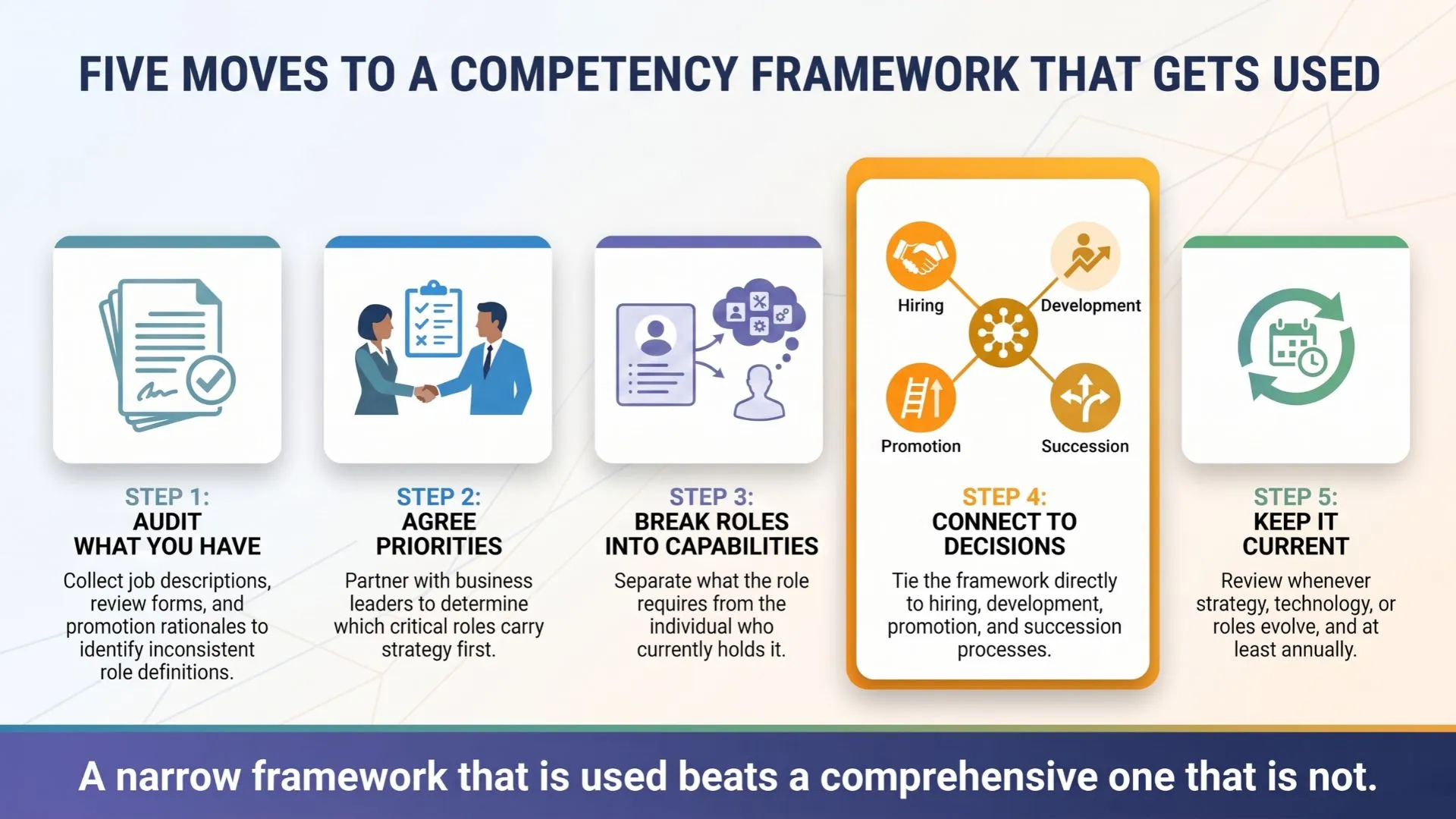
From draft to working standard
Five moves get a competency framework from draft to working standard.
A. Audit What You Already Have
Collect job descriptions, review forms, past promotion rationales and any older competency documents. Look for conflicts: the same role described three ways, or expectations that differ between locations. Those conflicts show where a shared standard will matter most.
B. Agree Priorities With Business Leaders
A competency framework built by HR alone tends to describe HR’s view of the organization. Sit with the business leaders who own outcomes and decide which roles carry strategy first. Start there. A narrow framework that is used beats a comprehensive one that is not.
C. Break Roles Into Capabilities
For each priority role, separate what the role requires from who currently holds it. Role deconstruction is the discipline of breaking jobs into the skills and capabilities underneath them, so the framework describes the work and not the incumbent.
D. Connect the Framework to Decisions
Wire the competency framework into hiring scorecards, development plans, promotion reviews and succession discussions. If none of those processes refers to it, it will not be used, however well it is written.
E. Keep It Current
Review the framework whenever strategy, technology or a role itself changes, and on a fixed schedule at least once a year. Watch for the common framework mistakes, such as copying a template without adapting it or launching without manager buy-in. As the business grows, scaling a framework as you grow becomes its own task, since every new unit adds roles the original did not cover.
VII. Custom, Off-the-Shelf and Industry-Specific Frameworks
A. Custom or Off-the-Shelf
A custom competency framework is built around your strategy, culture and role structure. It fits closely and takes longer, because it needs workshops, leadership input and internal agreement. An off-the-shelf framework is faster to deploy and consistent across locations, but it can read as generic and may need adjustment for your roles. The question is not which is better. It is where talent is a differentiator for you, and how much time you can give the work. Reviewing competency framework models and competency framework examples is a practical way to see which structure suits your organization.
B. Industry Context
The same four families look different in a bank, a pharmaceutical plant or an engineering contractor. Our industry guides cover the IT, banking, pharmaceutical, automotive, aerospace and defense, agriculture and EPC sectors.
The organizations that can name their next plant head in a single meeting did not guess better. They verified earlier.
VIII. How PeopleBlox Helps?
The gap between a framework on paper and a framework in daily use is the gap between assessing capability and assuring it. Capability Assurance is the discipline of continuously verifying, not just assessing, that your organization has the capabilities its strategy requires.
PeopleBlox is built around that discipline. Organizational Capability Assurance applies it to the critical roles across the workforce, so a leader can see whether the capability behind each part of the strategy is actually there. Leadership Capability Assurance applies the same verification to the people expected to carry the organization forward, so succession conversations start from a current picture instead of a reconstruction.
The competency frameworks behind PeopleBlox are built to a level of structure and detail most organizations never reach, and the platform is built around them. What that gives a leader is narrow and useful. When you ask whether someone is ready for a role, the answer is anchored to a defined standard, judged from more than one perspective, and consistent across every person you are comparing.
Where this lands for a CHRO is the Capability Command Center: one place where the readiness of critical roles is visible at once, so the conversation with the CEO and the board begins with a current view. You can explore PeopleBlox’s competency frameworks to see how that standard is organized for your industry.




read next

Capability Mapping for Business Roles: Why Old Role Expectations Create New Execution Risk

Capability Visibility: The Missing Link Between Strategy and Execution