










Most succession planning documents record names, not capability. Gartner finds that 72% of HR leaders struggle to close successor capability gaps, and HBR research puts the market value lost to badly managed leadership transitions in the S&P 1500 at close to $1 trillion a year. The fix is not a longer list of successors. It is a plan that verifies, role by role, that the people named can do the job when the vacancy arrives.
I. When Your Best Performer Walks Out
When your top commercial leader gives notice on Friday, who does the board call on Monday?
Picture the person who brings in the biggest accounts and holds the hardest projects together. They announce their retirement. Panic starts in the first meeting. Their judgment, their client relationships and their authority in the room feel irreplaceable.
Often they are not. But only when the organization did the work before the announcement.
Succession planning is the proactive practice of identifying, developing and preparing people to step into future leadership roles. It anticipates departures, planned or sudden, so that a vacancy does not turn into a crisis. Retirement is the tidy case. Illness, a competitor’s offer, a relocation and a resignation with two weeks’ notice are the common ones.
The difference between organizations that absorb the exit and organizations that scramble is rarely the quality of their intentions. Nearly every enterprise has a succession plan of some kind. The difference is whether the plan names people or proves them. That distinction decides what the exit costs.
Done well, succession planning also does quieter work long before anyone leaves. It forces the organization to look beyond current titles, and that is where hidden talent surfaces: the regional manager running the hardest operation, the engineer other teams already go to for decisions. It also tells ambitious people the company has a place for their growth. Succession planning is a retention signal as much as a continuity tool.
II. Why Most Succession Plans Fail When Tested
A succession plan is tested exactly once: on the day a critical role opens. Most are written for the review meeting, not for that day.
In many enterprises, succession is still a spreadsheet exercise: names in rows, color codes, a grid pasted into a deck. Each name carries a label such as high potential or ready soon. Nobody has checked those labels against what the role will demand next year, and the labels were often assigned by whoever spoke most confidently in the room.
Gartner’s research on succession planning shows how common this is. It finds that 72% of HR leaders struggle to close successor capability gaps. Gartner’s same analysis reports that only 35% of organizations select successors aligned with future needs, which means most plans are built around the role as it exists today, not the one the strategy will require. And 61% of HR leaders say their succession plans lean too heavily toward senior positions, which leaves the roles one layer down, where much of the daily operating risk sits, without cover.
Read those figures together. The plans exist. The names exist. The capability behind the names is unverified, aimed at yesterday’s job and concentrated at the top of the house.
A narrow bench is the second failure. A plan that names one successor per role has a single point of failure. If that person resigns, is promoted elsewhere or turns out not to be ready, the plan is empty and nobody notices until it matters. Gartner’s same analysis warns that short successor lists make plans obsolete the moment one candidate leaves.
The third failure is ownership. Succession planning is run as an HR process, reviewed once a year and handed to the business for comment. Business leaders treat it as a form to approve, not a risk to manage. Gartner reports that 40% of HR leaders struggle to get leaders to commit to development follow-through once the plan is written. A plan nobody acts on is a document, not a safeguard.
III. What a Weak Bench Costs the Business
For a CEO or COO, the cost of a thin bench does not appear in an HR report. It appears in a stalled launch, a delayed integration, a key client who quietly moves their account, and an external search that runs for months and costs more than anyone budgeted.
The aggregate numbers are large. Research published in Harvard Business Review estimates that the market value wiped out by badly managed CEO and C-suite transitions in the S&P 1500 alone comes to close to $1 trillion a year. The authors trace the loss to three causes: external hires who underperform the insiders they replace, intellectual capital walking out of the companies that lose executives, and internally promoted successors who were never properly prepared. Notice the third. Promoting from within does not protect you if the person promoted was never verified as ready.
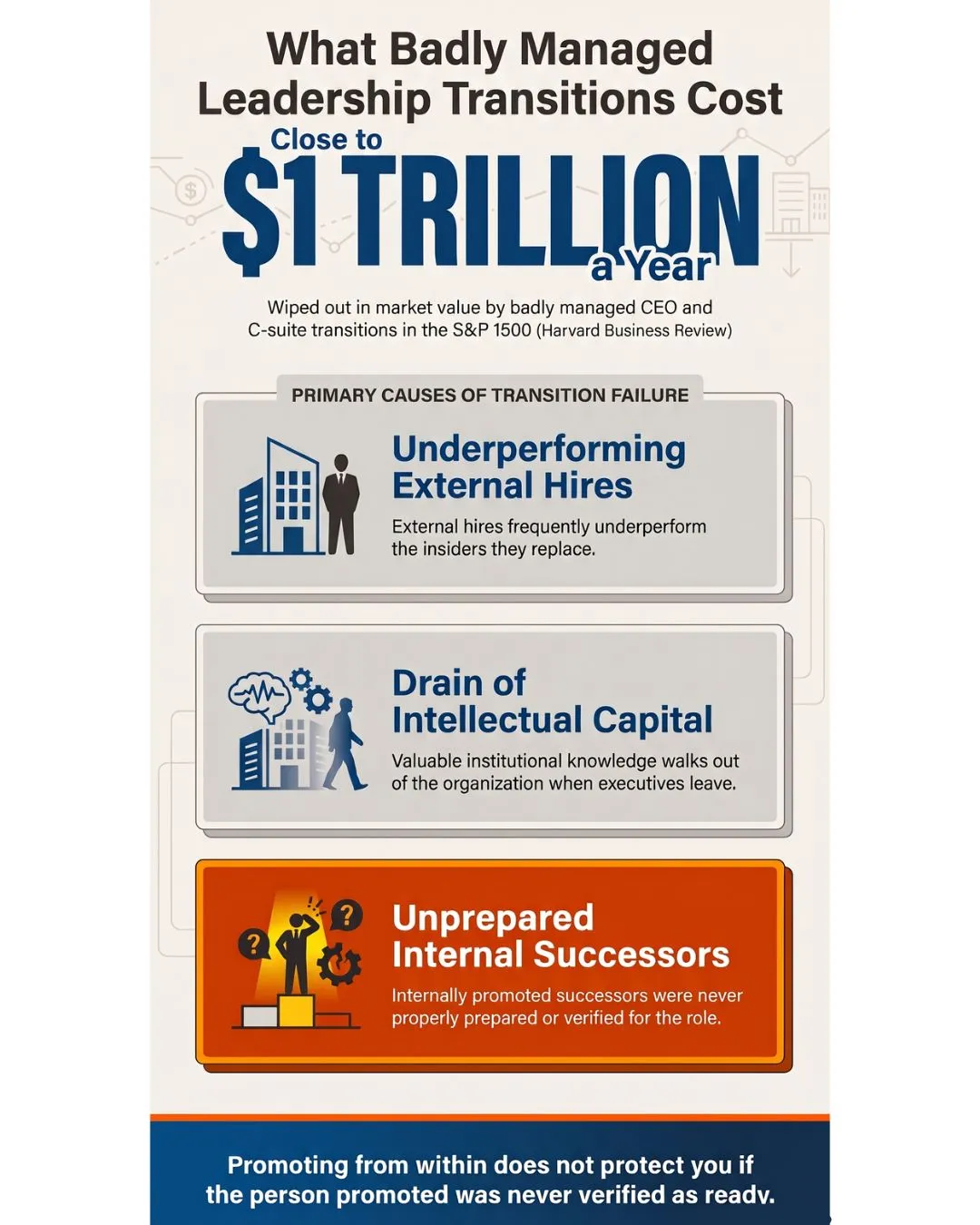
What Badly Managed Leadership Transitions Cost
There is a quieter cost as well. When high performers see leadership roles filled by whoever is available instead of whoever was prepared, the best of them start taking recruiter calls. Weak succession planning does not only leave a seat empty. It teaches the people you most want to keep that their growth is nobody’s job.
Boards are starting to feel the exposure. SHRM, reporting on a 2023 Gartner board survey, notes that only 51% of surveyed directors said their company had a written plan for the current CEO’s succession. A written plan is the minimum. Roughly half of those boards could not clear it.
The leadership layer is also running behind the work. At its 2026 HR Symposium in London, Gartner reported that 68% of CHROs agree their leaders are not ready for what’s next. That is a statement about the people who will be asked to carry strategy, and some of them are your named successors.
Succession risk is not only about the empty seat. It is about every decision that waits while the seat stays empty.
IV. From Naming Successors to Verifying Them
Most organizations have assessed their leaders at some point: a talent review last spring, a potential exercise before the last restructure, an annual calibration. Almost none can assure them. Assessment is a photograph. By the time anyone acts on it, the person has moved on, the role has changed and the strategy has shifted. Assurance works more like the way finance treats its numbers: continuously verified, always current, trusted enough to make decisions on.
That shift changes the question a succession plan answers. The old question is who could replace whom. The better question is who has demonstrated the capability this role needs, and how current that judgment is.
For a CEO, the practical effect is a different kind of confidence. A plan built on verified capability tells you which of your three candidates has actually demonstrated what the role requires, not just held a title near it. It also shows you where the bench is thin before a resignation shows you instead. That is a stronger position from which to make succession planning decisions, because the gaps arrive as information, not as surprises.
This is why readiness is so often a feeling, not evidence. In most plans, ready means a senior person believes it. Belief is a start, but it is rarely comparable across successors and almost never revisited. Judgment is unavoidable, and it should stay. What improves a plan is making that judgment structured: more than one perspective, anchored to a defined standard for the role, comparable across the people you are weighing, and revisited on a schedule instead of recalled under pressure.
Named successor + verified capability = succession you can defend.
A name gets you a conversation. Verified capability gets you a decision the board can sit behind.
V. How to Build a Succession Plan That Holds
The mechanics of succession planning are not complicated. What separates plans that hold from plans that collapse is how seriously each step is treated. Five steps do the work.
A. Start With the Roles Where a Vacancy Hurts Most
Do not begin with people. Begin with roles. Identify the positions whose vacancy would stall strategy, expose a client relationship or halt a critical process. Gartner’s guidance is to rank roles by business criticality and how hard they are to fill, not by their place on the org chart. A plant head or a lead architect can matter more than a vice president.
Ask which exits would hurt within the quarter. Then look for the critical role gaps first, because those are the roles where an empty bench is already a live risk.
B. Define What Ready Means for Each Role
For every critical role, write down what the job will demand over the next two to three years: the decisions it owns, the outcomes it is held to and the capabilities it needs. Write it for the role as it will be, not the role as it was when the current holder joined.
This is the step most plans skip, and it is why successor lists drift into popularity contests. Without a defined standard, there is nothing to compare candidates against except impressions. With one, two leaders can be weighed on the same terms.
C. Name More Than One Successor, and End Reviews in Decisions
In succession planning, one name per role is a bet. Build a pool of two or three credible candidates, including people from outside the obvious function. Gartner’s same analysis recommends broader, organization-wide talent pools for critical and recurring roles, precisely because a short list collapses when one person leaves.
Then fix the talent review. Most are long meetings that end with the same names on the same grid. The goal is to turn talent reviews into succession decisions: who moves, who is developed against which gap, and where the real risk sits. Every review should close with named actions and named owners.
D. Develop Against the Gap, Not the Title
In succession planning, potential is not readiness. Once a successor is named, compare them to the role standard, find the specific gap and give them work that closes it: a stretch assignment, a wider remit, exposure to board-level conversations, a mentor who has held the role. Generic leadership programs rarely do this.
Make a business leader, not HR, accountable for each development plan, and check progress at every review. The follow-through problem is a problem of ownership, so give it an owner.
E. Review on a Rhythm, and After Every Material Event
Succession planning is never finished. People leave, strategies shift and roles change. Review critical roles on a fixed rhythm, and again after any material event: a reorganization, an acquisition, a resignation. Update the role standard, recheck each successor against it, and retire names that no longer fit.
A plan reviewed once a year is out of date for most of the year.
VI. The Question the Board Will Ask
Sooner or later a director asks the question that tests everything else: who is ready now for this role, and how do we know?
The honest answers fall into two groups. Some organizations produce a name and a story. Others produce a name, a defined standard for the role, a view of how the successor compares with it, and a record of what has been done about the distance. Only the second is succession planning a CEO can stand behind.
At this level, succession planning is a governance question, not an HR one. Directors do not want a walkthrough of the process. They want to know that the capability behind each name has been checked, that the gaps are known and that someone owns closing them.
For a CEO or COO the practical test is simple. Pick your five most critical roles. For each one, can you say within an hour who would step in, how ready they are and what is being done about the gap? If the answer takes a week of phone calls, the plan is a list.
The organizations that answer the board in minutes did not get lucky. They verified readiness before anyone asked.
VII. How PeopleBlox Helps?
PeopleBlox is a Capability Assurance platform. Capability Assurance is the discipline of continuously verifying, not just assessing, that your organization has the capabilities its strategy requires.
For succession planning, that discipline is Leadership Capability Assurance: continuously verifying that the people expected to carry your strategy, including every named successor, can actually do it. It sits inside the wider discipline of Organizational Capability Assurance, the same verification applied to every critical role, not only the top of the house.
The frameworks behind PeopleBlox are built to a level of structure and detail most organizations never reach, and the platform is built around them. What that buys a leader is narrow and useful. When you ask whether someone is ready for a role, the answer comes back anchored to a defined standard and consistent across every person you are comparing, with judgment that is structured and multi-perspective instead of assembled from whoever happened to be in the room.
Where this lands for the talent review is the 16 Box Talent Matrix. Instead of a debate over names on a grid, leaders see where readiness sits and where the risk is, so the succession conversation starts from a current picture, not a reconstruction.
Book a demo and see your bench.
VIII. Readiness Is the Only Succession Answer That Counts
Every organization has a leader whose exit would be felt in revenue, in client calls and in the pace of every project they touch. That exit will come, on a date nobody chooses.
What the organization controls is what is true on that day. Whether the role is defined, whether more than one successor exists, whether each has been compared with the standard, and whether anyone has acted on the gap.
Succession planning earns its name when the answer to the board is specific. Names alone never will




read next

How to Use Technology to Streamline Leadership Succession Planning

Why You Are Missing Succession Ready Leaders in Your Company?