










Org Design is one of the few moves a CEO can make that changes execution speed almost immediately when it’s done right.
When it’s done wrong, it becomes a clean-looking org chart with messy outcomes: unclear ownership, slow decisions, duplicated work, and “shadow networks” that keep things running despite the structure.
The difference is rarely the boxes and lines. It’s whether the design is backed by talent architecture, the capability blueprint that makes the operating model real.
If you’re a Business Head, you feel this faster than anyone. You inherit the outcomes of the design, good or bad.
I. Why the CEO Must Personally Own the Blueprint
Structure is not neutral. It decides:
- where decisions sit
- what gets prioritized
- how work flows across teams
- which roles become critical failure points
That’s why this can’t be treated as a “re-org exercise” or fully delegated as an HR initiative. Only the CEO (or enterprise leadership) can align the design to strategy and operating model because the real question is: what must move faster, safer, and cleaner this year?
The urgency is growing. Employers globally expect 39% of workers’ core skills to change by 2030, which means capability needs will keep shifting even after you redraw reporting lines. (World Economic Forum)
Practical CEO test: if the new structure doesn’t change decision velocity or execution clarity, it isn’t a design, it’s a diagram.
II. The Most Common Failure Mode: Structure Without Capability
Most redesigns follow a predictable pattern:
- reporting lines change
- titles change
- a few new roles appear
- everything else stays the same
This is why transformations struggle to stick. McKinsey & Company notes that transformation success rates have remained low, around 30% over years of research.
What Business Heads experience downstream:
- “Who owns this now?” (accountability blur)
- “Why is this approval slower than before?” (decision drag)
- “We created the role but don’t have the capability.” (talent gap)
- “We still depend on the same 2–3 people.” (single points of failure)
The root cause is simple: design changes the ‘where’, but capability defines the ‘how’.
III. Talent Architecture, in CEO Language
Talent architecture isn’t HR jargon when you translate it into leadership terms. It’s the system that makes the design executable, the same discipline covered in PeopleBlox’s guide to talent architecture for role readiness, by answering:
- Which roles truly drive outcomes (not every role, only critical roles)
- What “good” looks like in those roles (competencies + proficiency)
- Where the bench is strong or thin (readiness)
- What breaks if someone leaves or underperforms (risk)
This becomes even more important when you look at how leaders are thinking about disruption. PwC reports 66% of India CEOs vs 42% globally are concerned about keeping pace with technology and AI.
So if your plan is “we’ll hire later,” that’s not a plan. That’s an assumption.
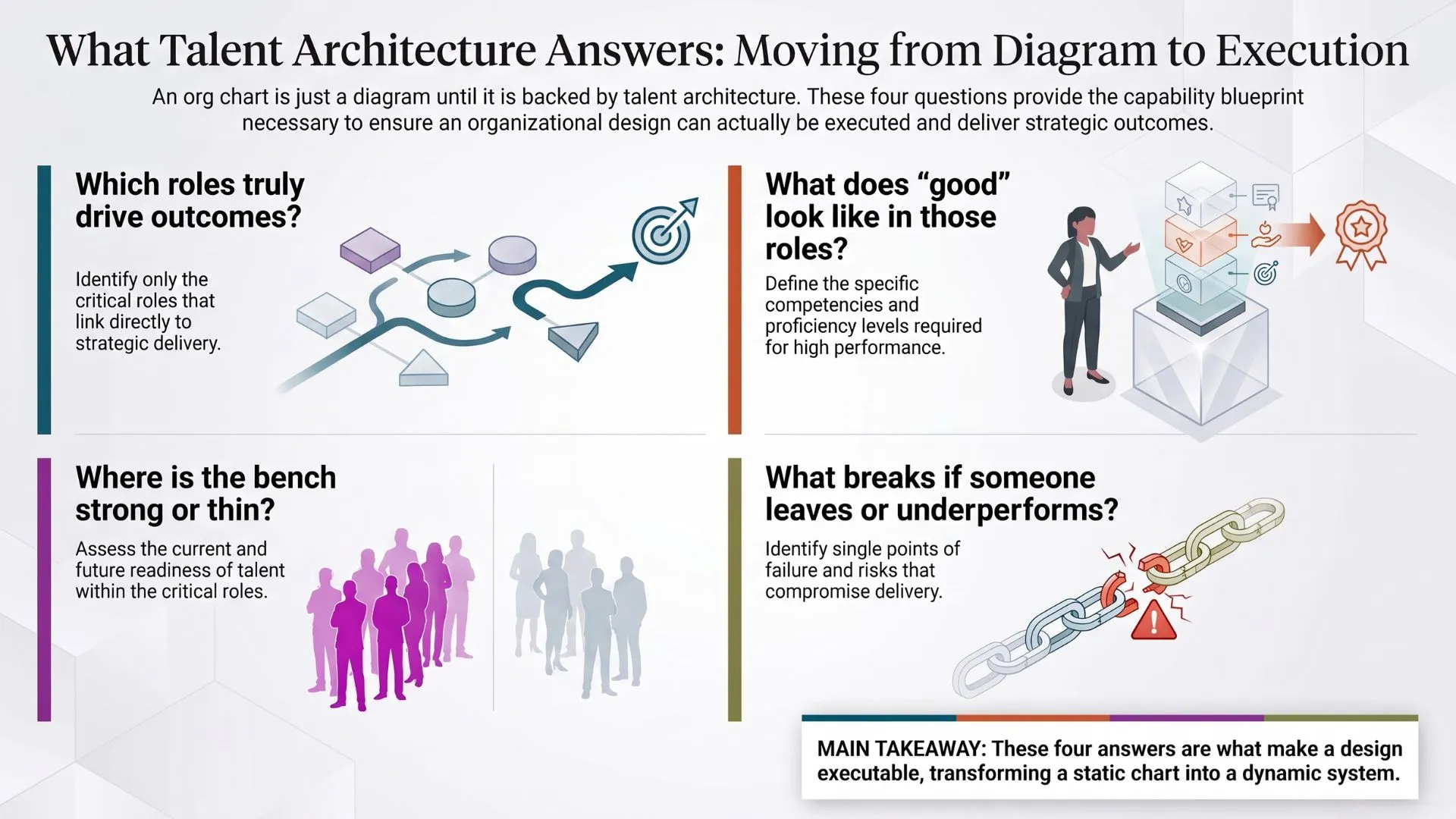
The four questions that turn an org chart into an executable design
IV. Five Decisions That Make the Design Actually Work
Even if you’re not the CEO, these are the decisions you should push to make explicit because they determine whether the org will run cleanly.
A. Decision Rights
Who decides? Who recommends? Who executes? If this isn’t clear, escalation becomes the default and speed collapses.
B. How Work Flows
The org chart is not the workflow. Map:
- handoffs
- dependencies
- approval loops
- escalation paths
C. Where Capabilities Should Live
Some capabilities should be centralized (scale + standards). Some should be embedded (context + speed). Many should be hybrid (center-led, business-executed).
D. Critical Roles (and Their Standards)
If leadership can’t name the critical roles, the design isn’t strategy-linked. Critical roles need clear competency expectations, not vague JDs.
E. Build / Buy / Borrow Plan
With skill disruption accelerating, this is no longer annual planning, it’s continuous.
V. Where PeopleBlox Fits in the Story
Most org design efforts stop at structure and reporting lines. PeopleBlox supports what usually gets missed: making the design measurable through role clarity, competencies, readiness, and risk.
This is the discipline PeopleBlox calls Capability Assurance: continuously verifying, not just assessing, that the organization has the capabilities its new structure now depends on.
What that looks like in practice:
Role clarity you can align on: Define roles as outcome engines (not just JD text).
Competency-backed standards: Create consistent expectations across units (including techno-functional + behavioral depth, not just “soft skills”).
Readiness visibility: See bench strength for critical roles, now and 6–12 months out.
Early risk signals: Spot thin succession, capability gaps, and over-dependence before delivery breaks.
This matters because execution failure is common even in well-funded initiatives. Gartner reported only 48% of digital initiatives meet or exceed business outcome targets, on average.
Org design without capability instrumentation increases the odds you fall into the “looks good, doesn’t land” category.
VI. A Simple Playbook Leaders Can Run
If you want the design to improve outcomes (not just reorganize teams), run it like a system:
- Start with the strategy stress points (where speed/quality is breaking)
- Lock the few enterprise decisions that must move faster
- Define critical roles and competency expectations
- Run a capability reality check (bench, gaps, readiness timelines)
- Commit to the build/buy/borrow plan tied to real dates
- Track readiness + risk signals continuously (not once a year)
The biggest mindset shift is this: Org design is not a one-time “re-org.” It’s ongoing architecture.
VII. The One CEO Question That Changes Everything
If you’re a Business Head, this is the question worth asking after any org discussion:
“Are we changing the chart or are we building the capability system to run the new model?”
Because structure alone won’t protect speed, delivery, or customer outcomes. Capability will.
If you want to make org design execution-ready through role clarity, competencies, readiness, and risk, request a demo of PeopleBlox.




read next

Talent readiness is no longer an HR metric, it is a business-critical leadership question.

Talent Risk in Filled Roles: The Hidden Risk Inside “Filled” Roles