










Most organisations run talent reviews every year, but very few turn them into leadership succession planning decisions that actually strengthen the bench. You’ve seen it: long meetings, nine-box debates, names moving across grids, yet when a leadership role opens, the room is unsure. Suddenly the “high-potential” tag doesn’t feel enough, and the organisation starts looking outward again.
The real issue isn’t the lack of data. It’s the lack of decision-ready insight.
This article breaks down how to shift talent reviews from a descriptive exercise (“Here is where people stand”) to a decision-driving engine for leadership succession planning (“Here is who can succeed, when, and with what risks”).
A talent review only adds value when it leads to a succession decision.
I. Why Talent Reviews Fall Short of Succession Decisions?
Even mature organisations often struggle to move from talent insight → leadership action. Common breakdowns include:
A. Ratings Without Readiness
A 9-box is not a measure of readiness. It’s a snapshot in time, not a projection of leadership capability.
B. Potential Labels Inflated by Perception
“High potential” is often a reward, not an assessment. Without role-specific criteria, potential becomes subjective.
C. Capabilities Not Linked to Actual Leadership Roles
Knowing someone is strong at execution or stakeholder management is good. Knowing whether they can run your P&L, your geography, or your transformation is better.
D. No Bridge from Talent Review to Leadership Succession Planning
Most organizations treat these as two separate processes. They shouldn’t be.
Data is collected but rarely interpreted in the context of future leadership seats. Talent reviews fail when they assess individuals but ignore roles.
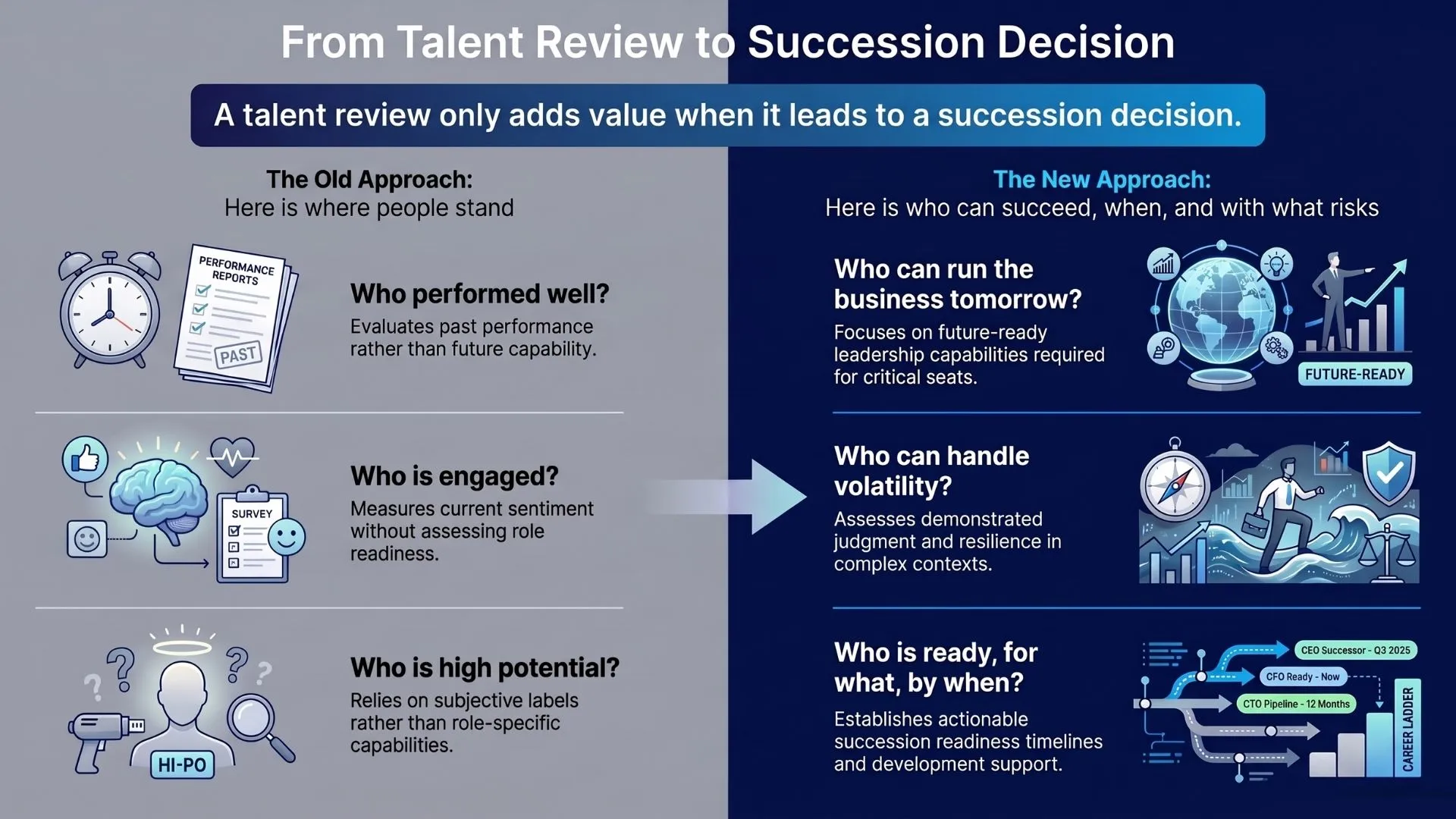
A talent review only adds value when it leads to a succession decision.
II. What Leadership Succession Planning Really Needs?
To turn talent reviews into decisions, succession planning must evolve from a list of names to a leadership capability model tied to real roles. It requires clarity on three things:
A. What the Role Demands (Future-Ready, Not Reference-Ready)
Leadership roles evolve every 12–18 months. Strategy shifts. Markets move. Customer expectations change. A successor must be evaluated on what the role will require tomorrow, not on what the current leader performs today.
B. What the Individual Can Deliver (in Real Contexts)
Potential is not the same as readiness. Readiness is not the same as promotability. This distinction matters.
C. What Risks the Organisation Carries if the Role Goes Vacant
Leadership risk is a business risk. Vacancy risk, capability gaps, concentration risk: all must be visible.
Strong pipelines result from clear decisions, not labels. Succession planning demands context: role, individual, and risk, together.
III. How to Turn Talent Reviews into Leadership Succession Planning Decisions
Below is a practical, leadership-ready framework that moves your organisation from rating individuals to deciding successors.
A. Step 1: Redefine Talent Reviews Around Leadership Succession Planning
A talent review should not be a generic performance-potential exercise. It should be structured directly around:
- Critical roles
- Time-to-cover expectations
- Role-specific capabilities
- Enterprise priorities
- Leadership risks
This reframing ensures the review meeting sets up the right conversation:
“Who is ready for which role, by when, and with what development?”
Make leadership roles, not people, the anchor of your talent review.
B. Step 2: Replace Guesswork with Capability-Based Evaluation
Leadership cannot be evaluated on behavioural labels alone. Organisations need:
i. Role-Specific Leadership Competencies
Not generic “collaboration” or “stakeholder management,” but precise capabilities such as:
- Running a P&L
- Leading multi-market operations
- Driving digital transformation
- Managing regulatory risk
- Scaling a function or business line
ii. Assessment Based on Demonstrated Evidence
Move from opinion to evidence:
- What decisions has this leader taken?
- What were the outcomes?
- What complexity have they handled?
- What judgment have they demonstrated in uncertainty?
iii. Potential Validated in Context
Context is everything. Someone may be high potential for Technology but not necessarily for Growth, Ops, or Finance. A successor is chosen based on capability in context, not generic potential.
C. Step 3: Convert Talent Insights into Succession Slates
This is where most organizations hesitate. But it is the exact moment where leadership succession planning begins. Every critical role should have:
- Ready Now (0–12 months)
- Ready Soon (12–24 months)
- Emerging (24–36 months)
- External benchmark required
This simple mapping forces clarity. It reveals bench strength, bench depth, coverage risk, and capability gaps in one view.
A slate converts talent into options. Without it, succession is luck.
For a closer look at keeping this view current, see how to use technology to streamline leadership succession planning.
D. Step 4: Attach Development to Decisions, Not Labels
Too many development plans float in isolation, unconnected to any future role. Development becomes meaningful only when it prepares someone for a specific leadership seat. Attach development to the succession slate:
- If someone is “Ready Soon,” specify what must change in 12 months.
- If someone is “Emerging,” define stretch exposures.
- If someone is “Ready Now,” outline transition support and risk mitigation.
This creates accountability and momentum. Leadership development must serve leadership succession, not run parallel to it.
E. Step 5: Track Leadership Risk Like a Business Risk
Succession planning is not an HR ritual. It is a risk-management exercise. Boards and CEOs want visibility into:
- Vacancy risk
- Over-reliance on single successors
- Capability concentration
- Successor fatigue
- Successor engagement
- Market optionality versus internal readiness
A Deloitte study shows that 86% of leaders believe leadership succession is urgent, yet only 14% feel their organization does it well. The problem is not awareness, it’s execution. Leadership risk must be monitored with the same discipline as financial risk.
IV. The Shift: From Talent Conversations to Leadership Decisions
A transformation happens when talent reviews stop being annual meetings and start becoming decision points:
Not “Who performed well?” But “Who can run the business tomorrow?”
Not “Who is engaged?” But “Who can handle volatility?”
Not “Who is high potential?” But “Who is ready, for what, by when?”
This is the difference between a company that hopes for future leaders and one that builds them by design.
V. The Power of Decision-Ready Talent Reviews
Turning talent reviews into succession decisions is not a process change, it is a mindset shift. It requires:
- Clear definitions of leadership capability
- Evidence-based evaluation
- Role-specific succession slates
- Development tied to decisions
- Continuous visibility into leadership risk
Organizations that do this well don’t scramble when a role opens. They transition leaders smoothly, confidently, and with strategic intent.
If you want to convert your talent reviews into leadership succession planning decisions with clarity, capability models, and decision-ready insights, PeopleBlox Succession Readiness can help. PeopleBlox approaches this through Leadership Capability Assurance, the discipline of continuously verifying, not just assessing, that your organization has the capabilities its strategy requires.
Experience how organizations today are building leadership depth by design.




read next

How to Use Technology to Streamline Leadership Succession Planning

Why You Are Missing Succession Ready Leaders in Your Company?