










Remote work does not fail because people are far apart. It fails when leaders cannot see who can do what without watching them, so they manage presence instead of capability. Gartner data shows the work model does not change how productive teams are rated, while the quality of management changes it sharply. This piece shows CHROs how to run remote work on verified capability, clear outcomes and deliberate connection.
I. Remote Work Did Not Break Your Team. Your View of It Did.
When the CEO asks whether your remote teams are performing, what do you point to?
Most HR heads point to attendance on calls, response times and a green status dot. None of those measure whether someone can do the job. They measure whether someone is visible.
Remote work removed the office as a proxy. Hallway conversations, shared lunches and a full desk used to stand in for evidence that work was happening and that people were capable of it. Without them, many leaders feel they are managing blind. The reaction is predictable: more check-ins, more monitoring, more status meetings. Activity rises. Clarity does not.
The data points elsewhere. In an October 2024 survey of more than 3,000 managers of knowledge workers, Gartner found that the same share of onsite and hybrid employees, 21%, were rated highly productive. Where people sit is not the variable. How they are managed is.
That is the real problem behind remote work, and it is a visibility problem. Most HR systems record attendance, ratings, learning completion and engagement scores. None of them show what a person can actually deliver. That gap between tracking people and understanding capability is the talent visibility gap, and remote work widens it every quarter.
The blind spot compounds. A leader who cannot see capability cannot defend a promotion, a restructure or a headcount request with evidence. Every decision becomes an argument about impressions, and the loudest voice in the room wins.
II. What Managing Remote Work by Presence Costs You
Presence-based management feels safe. It also carries costs that rarely reach the board report.
A. Quiet Disengagement You Cannot See
Leaders who answer distance with mandates often make the problem worse. Gartner’s analysis finds that return-to-office mandates increase the number of employees doing the bare minimum by up to 19%, and that intent to stay can fall by up to 10%, more so among high performers. The people most able to leave are the first to start looking.
None of this shows up in an attendance report. A disengaged employee can attend every call and still contribute a fraction of what the role needs.
B. Capability Gaps That Hide Behind Full Calendars
A remote employee with a busy calendar and fast replies looks productive. They may also lack the capability the role now demands. Busy and capable are different things, and presence-based management cannot tell them apart.
The gaps surface late: a missed customer commitment, a project that keeps extending, a transformation that never gains speed. This is how capability gaps work inside a business. Targets slip slowly, then all at once.
For a CHRO this is a credibility issue. When the CEO asks which teams are ready for next year’s plan, an answer built on responsiveness will not hold.
C. Oversight That Crowds Out Coaching
Managers who cannot see capability fill the gap with oversight. Calendars fill with status updates. Dashboards track activity. The time that should go into coaching someone through a real development need goes into checking that they are working. Over a year, that trade quietly changes what a manager is for. The team gets watched more and developed less, and the capability gap the manager could not see in the first place keeps growing.
III. Assessing Capability Is Not the Same as Assuring It
Most organizations have assessed capability at some point: a competency review two years ago, a skills audit before the last restructure. Almost none can assure it. Assessment is a photograph. By the time anyone acts on it, the team has changed, the work has moved and half the people sit on different projects. Assurance is closer to how finance treats its numbers: continuously verified, always current, trusted enough to base decisions on.
Remote work makes that gap expensive. When you cannot watch people work, a photograph taken once a year tells you very little about whether a team can deliver this quarter.
Consider a strong engineer promoted to lead a distributed team. In an office, a senior colleague would notice within weeks that the new manager struggles to give feedback, and would step in informally. In a remote team, nobody sees it. The first visible signal is a resignation or a missed quarter. The capability was never assured. It was assumed from the promotion letter.
Capability evidence + role clarity = remote work you can defend.
This is the shift in thinking. Stop asking whether people are online. Start asking whether the capability your strategy needs is present, current and visible. That is capability visibility, and it is what lets an HR head answer the CEO without guessing. Judgment still matters. The difference is that it becomes structured, comparable across people and revisited over time, instead of recalled under pressure in a review meeting.
IV. How Capable Organizations Run Remote Work
The practices below are familiar. What changes is that each one is anchored to a defined standard of what good looks like, so it can be checked rather than assumed.
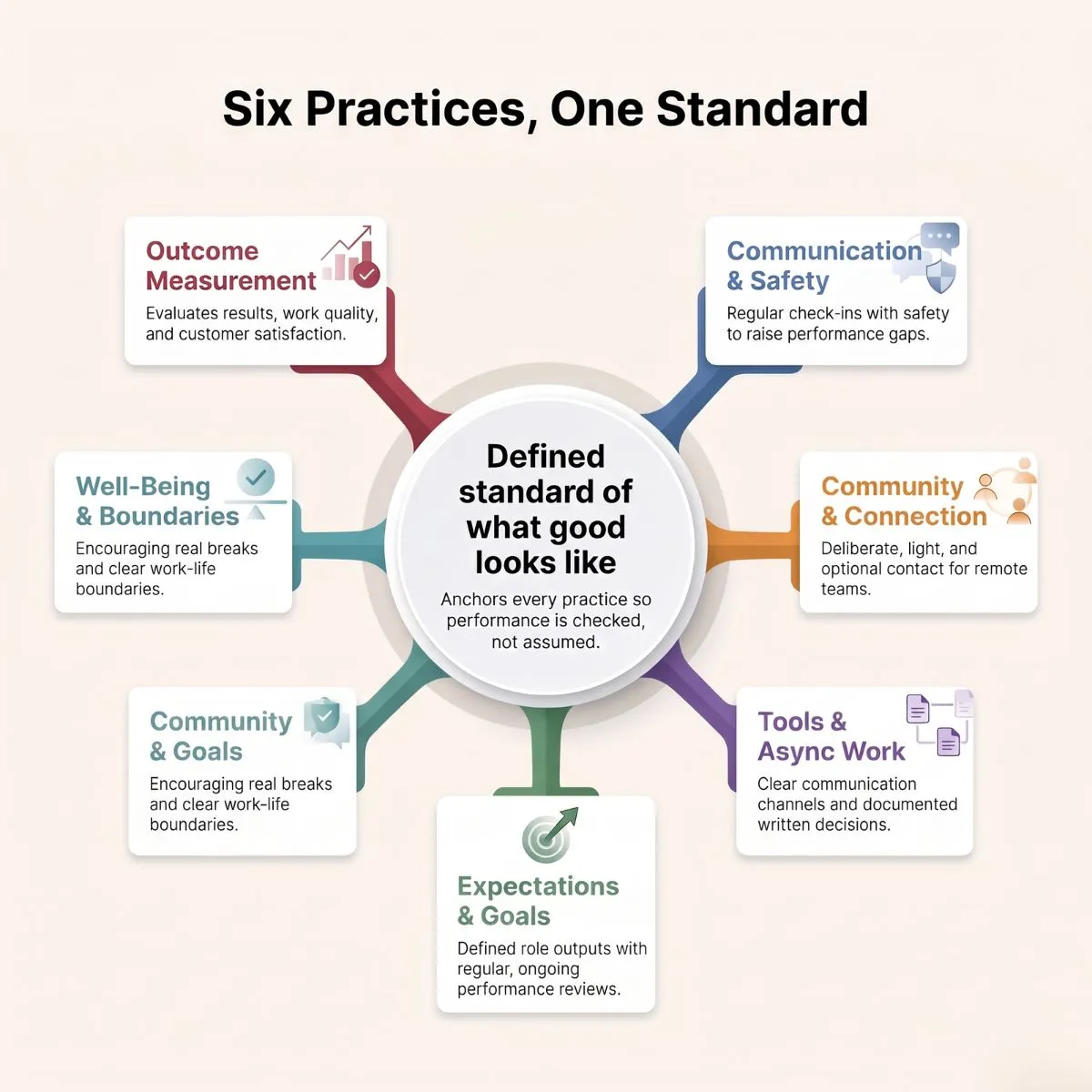
Remote work runs on familiar habits. A defined standard makes each one checkable.
A. Communication and Psychological Safety
Open communication is the cornerstone of any remote team, and it needs structure. Set a rhythm of one-to-one and team check-ins, use video where face-to-face signal matters, and make sure nobody wonders when they will next hear from their manager. A simple habit helps: open one-to-ones with what is blocking progress, not with status. It shows where the clarity and capability gaps sit before they turn into missed work.
Psychological safety matters most. In remote work, silence is ambiguous. It can mean agreement, confusion or disengagement. People need to feel able to raise a concern, share an idea or admit a skill gap without fear of judgment. SHRM, reporting Gartner’s hybrid work research, notes that 89% of HR leaders agree managers must lead with empathy, yet organizational investment to enable it falls short. A person who admits a gap early is worth more than one who hides it until it costs a deadline.
B. Community and Connection
Camaraderie does not appear on its own in remote work. Virtual team-building, shared goals, celebrating wins together and room for informal conversation all help. Keep them deliberate and light. Optional, regular, small-group contact tends to work better than mandatory fun.
The test of a good connection practice is simple. Do people know who to ask for help, and do they feel safe asking?
Onboarding deserves the same care. A new joiner in a remote team has no desk neighbors to learn from, so pair them with a named colleague and set early, small goals that build confidence.
C. Tools and Asynchronous Work
Project management software, shared documents and video conferencing are baseline. What separates strong teams is the set of rules around them: which channel is used for what, what response window is reasonable, and where decisions get recorded. Proficiency in the tools should be checked, not assumed.
Asynchronous communication lets people work at their own pace across locations and time zones. It also removes the pressure to be constantly available, which is a quiet driver of burnout. Written decisions leave a trail a manager can review without chasing anyone.
Agree a short written working agreement for each team: core overlap hours, response windows, and what needs a call versus a message. Teams that write it down argue less about it.
D. Clear Expectations and Goals
A clear roadmap matters more in remote work, because nobody can infer expectations by watching. Define what each role owns, what good output looks like and how progress gets reviewed.
Gartner’s research shows why this pays off. In its analysis of return-to-office transitions, when managers recognize contributions, practice evidence-based performance management and keep an ongoing dialogue about productivity, 70% of employees become highly productive, 3.2 times the average. Good performance management is not form-filling. It is the habit of anchoring every goal to the capability the role requires.
Review goals on a regular cycle, not once a year. A goal that made sense in January can describe a role that no longer exists by June. Each review should ask two questions: was the outcome met, and does the person have the capability the next stage requires?
E. Well-being and Boundaries
Remote work offers flexibility and burnout risk in equal measure. Without a commute, the workday has no edge. Encourage real breaks, agree boundaries between work and personal time, and make mental health support easy to reach.
Managers set the tone. A message from a leader at 10 pm is a policy, whatever the handbook says. A rested team delivers more consistently, which makes well-being a business argument, not a soft one.
Watch for the signs a remote manager cannot catch in a corridor: shorter replies, cameras that stay off, work drifting later into the evening. A direct, kind question in a one-to-one does more than any wellness program.
F. Measuring Outcomes
Office hours and physical presence are irrelevant measures in a remote setting. Measure outcomes, quality of work and customer satisfaction, and use KPIs to track progress and spot where to improve.
Then add one more layer. A missed outcome has two possible causes: the person lacked the capability, or the role was unclear. Outcome numbers alone cannot tell you which. Without that distinction, leaders respond to every miss with the same action, usually more oversight.
Review outcomes with the team, not about them. When people help define what counts as a good result, the numbers stop feeling like surveillance and start working as shared goals.
V. Where Remote Work Is Headed
Remote and hybrid arrangements are not a phase. Flexibility has become part of how many people judge an employer, and the tools will keep improving. What will not change is the leadership question underneath: can you see capability without watching people work?
Organizations that answer it well can hire from anywhere, move people into new roles with confidence and run distributed teams without adding layers of oversight. Those that cannot will keep buying more monitoring and getting less clarity.
Remote hiring raises the same question from day one. When a new joiner has never sat in your office, the usual informal signals of fit and ability are missing. Organizations that rely on impressions will struggle. Those with a clear standard for each role can judge readiness against something the whole team recognizes.
The organizations that run remote work well are not lucky. They made capability visible before they needed it.
VI. How PeopleBlox Helps?
The discipline this piece describes has a name. Organizational Capability Assurance is the discipline of continuously verifying, not just assessing, that your organization has the capabilities its strategy requires. For remote work, that means every team, in every location, checked against the same defined standard of what good looks like. Leadership Capability Assurance applies the same verification to the people expected to lead those teams, so the managers carrying remote work are themselves ready for it.
The frameworks behind PeopleBlox are built to a level of structure and detail most organizations never reach, and the platform is built around them. What that gives an HR head is narrow and useful. When you ask whether a team is ready for the work ahead, the answer comes back anchored to a defined standard and consistent across every person you are comparing, whether they sit in one city or across five time zones. Judgment stays human. It becomes structured, multi-perspective and revisited as the work changes.
It also changes the conversation with managers. Instead of asking whether they are keeping in touch with their teams, you can ask whether the capability those teams need is in place and current.
Where this lands for a CHRO is the Capability Command Center: one place where the capability of every critical role is visible at once, so the conversation with the CEO starts from a current picture instead of a reconstruction.
VII. The Questions Worth Asking Your Managers on Monday
Remote work does not need a better policy first. It needs better questions. Ask each manager three of them. What does this role own, and what does good output look like? Which capability will this team need next year that it does not visibly have today? And if I asked you to show me, without a meeting, how each person is performing against that standard, what would you open?
If the answers come from memory, the organization is running remote work on assumption. If they come from a current view you trust, it is running on capability. The difference shows up in the next leadership conversation, long before it shows up in attrition.




read next

Why Talent Management for BFSI Is Your Competitive Advantage?

7 Talent Management Stages Every Business Needs to Know