










Talent transformation is not a course catalogue. It is the visible, continuous investment in people’s growth that keeps them, and it starts with knowing which skills the business actually needs. Most organizations skip that second part, so development spending lands on guesses. This guide shows CHROs how to anchor talent transformation to verified capability, run it as an operating rhythm rather than a program, and answer the board with evidence instead of activity.
I. Why Talent Transformation Starts With a Retention Question
When your best analyst resigns, did anyone in the building know what she was ready to do next?
Most exit interviews arrive too late to answer that. The employee has already compared what she was building at your company with what another company offered to build, and the other offer won. LinkedIn’s Workplace Learning Report found that 94% of employees say they would stay at a company longer if it invested in their career development. The figure comes from the 2018 edition, and LinkedIn still cites it in its own guidance for employers.
Read the finding carefully. It says invested, not trained. Employees judge investment by what they can see: a real conversation about the next role, a stretch assignment, a path that names the skills required to reach it. A course library delivers none of those on its own.
That is the working definition of talent transformation for a CHRO. It is the movement of people from the capability they hold today to the capability the business needs next, done in a way both sides can see and believe. A transformation the business cannot see is a cost line. A transformation employees cannot see is a retention risk.
Most programs fail one of those two tests. Learning is bought in volume, completion rates are reported, and nobody can say whether the organization is more capable than it was a year ago. Talent transformation that works starts from a narrower question: which capabilities does our strategy require, and where do we stand against them today?
II. The Cost of Getting Talent Transformation Wrong
A. Skills Move Faster Than Programs
The World Economic Forum’s Future of Jobs Report 2025 draws on the views of more than 1,000 employers. Its headline finding is blunt: 63% of employers name skills gaps as a major barrier to business transformation over the 2025 to 2030 period. The same report expects just under 40% of workers’ core skills to change by 2030.
Put those two facts side by side. The skills a business needs are shifting quickly, and the organization’s own picture of the skills it holds is usually older than the shift. A learning plan built on last year’s competency review is aimed at a target that has already moved.
There is a second problem inside the first. Most leadership teams cannot say, with any confidence, which of the shifting skills their own people already hold. Without that baseline, a talent transformation budget is spread evenly across the organization, which means it is spread thinly over the roles that matter most.
This is why talent transformation cannot be a calendar of courses. Courses answer the question of how to teach. They do not answer the question of what to teach, to whom, and why that group first.
B. The Cost Shows Up in Business Terms
A CEO does not experience a skills gap as an HR metric. They experience it as a delayed product launch, a regional expansion staffed by outside hires, or a transformation program that stalls in month seven because the people expected to run it were never ready.
Three costs recur in organizations that treat talent transformation as an activity rather than a discipline.
First, external hiring to fill gaps that already exist inside the building, because nobody could see the internal candidate. Second, quiet attrition among high performers who concluded that growth was not on offer. Third, succession decisions made on tenure and impressions because the evidence did not exist when the question arrived.
None of these costs appears under a training budget line. All of them trace back to the same root: the organization invested in learning without verifying capability.
III. From Assessing Capability to Assuring It
Most organizations have assessed capability at some point: a competency review two years ago, a skills audit before the last restructure. Almost none can assure it. Assessment is a photograph. By the time anyone acts on it, the organization has moved. Assurance is closer to how finance treats its numbers: continuously verified, always current, trusted enough to make decisions on.
The gap matters for retention as much as for planning. An employee who completed an assessment eighteen months ago and heard nothing afterward does not feel invested in. They feel measured and then forgotten. The photograph went into a file, the organization moved on, and the growth conversation the employee expected never arrived.
The distinction changes what talent transformation is for. An assessed organization runs development as a response to the last photograph. An organization that assures capability runs development against a live picture of where its people stand relative to what the strategy asks of them.
Judgment stays human in both cases. Managers and employees still form views about readiness. What changes is that those views are structured, anchored to a common standard, comparable across people and roles, and revisited over time instead of recalled under pressure in a talent review meeting.
Verified capability + visible growth path = a transformation people stay for.
The formula carries two audiences. The business gets evidence that its investment is moving capability toward strategy. The employee gets proof that someone has looked at their potential and named the next step. Remove either half and the program drifts back to being a catalogue.
IV. Talent Transformation in Practice
A. Start From the Capabilities the Strategy Requires
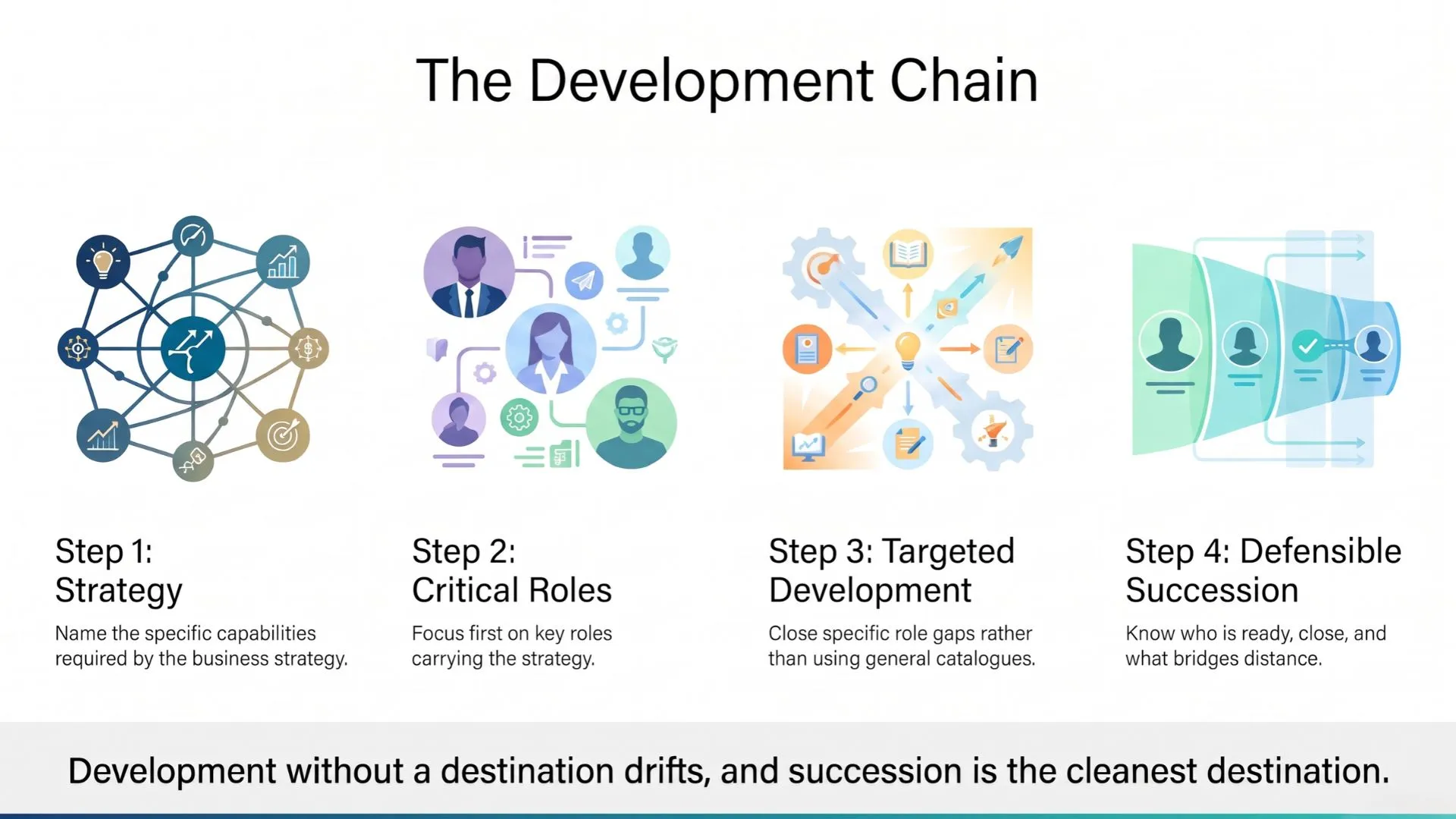
Begin with the strategy, not the learning library. If the plan calls for entering two new markets and automating a core process, ask which roles carry that work and which capabilities those roles need to carry it. The answer is usually a short list of critical roles, not the whole organization.
This focus is what separates a talent transformation effort from an enterprise-wide training rollout. Resources go first to the roles where a capability gap would hurt the strategy most. Everything else follows in sequence.
Consider a manufacturer planning to shift a third of its volume to a new product line. The roles that decide whether that shift works are a handful: the plant leads, the quality heads, the planning managers. A talent transformation plan that starts there reaches the people the strategy depends on within a quarter. One that starts with a company-wide learning launch reaches them in the same month as everyone else, with content written for no one in particular.
B. Match Development to the Role, Not the Catalogue
One-size-fits-all training produces disengagement because it ignores both the role and the person. A finance controller moving toward a CFO track and a plant manager moving toward a regional operations lead do not need the same year.
A workable approach asks three questions of every critical role. What does the role require now? What will it require in two years? Where does the current holder, or the likely successor, stand against both? Development then fills the specific distance between the answers.
The two-year question is the one most plans skip. Roles change shape before the people in them do, and a development plan written only against today’s job description produces someone ready for a role that no longer exists. Asking what the role will require next forces the conversation back to strategy, where it belongs.
Employees notice the difference immediately. A plan that names their role and their gap reads as investment. A plan that assigns the same module to everyone reads as compliance.
C. Make Managers the Delivery Channel
Employees do not experience talent transformation through company announcements. They experience it through their manager. If the manager holds a development conversation each quarter and follows it with a real assignment, the program is visible. If the manager is stretched thin, it is not.
Capacity is the quiet constraint. A manager absorbed in unresolved team conflict has little room left for a development conversation, which is why friction in the team and growth of the team belong in the same planning discussion. Give managers a clear standard to discuss, a short rhythm to follow, and a way to record what was agreed. Then ask whether those conversations are happening.
D. Connect Development to Succession
Development without a destination drifts. The cleanest destination for a critical role is the question of who could step into it. Linking talent transformation to succession planning gives each development plan a purpose the employee can see and the business can defend.
It also changes the conversation with the board. Instead of reporting hours of learning completed, a CHRO can report how many critical roles have a ready successor, how many have a successor within twelve months, and where no one is close. That is a statement about risk, which is the language a board already speaks.
Talent transformation works when development has a destination
V. Measuring Whether Talent Transformation Is Working
Activity metrics are easy to produce and easy to doubt. Completion rates, course hours, and satisfaction scores describe what the organization did. They say nothing about what the organization can now do.
Gartner’s research on talent management points at the gap. In a June 2024 survey of 190 HR leaders, fewer than one in five agreed that their organization can effectively move talent based on business need. Moving talent requires knowing who is ready for what. Where that knowledge is thin, the move does not happen, however many courses were completed.
Outcome measures answer a different question. A CHRO can ask four things each quarter.
How long does it take to answer which of our people could take on a critical role? What share of critical roles has at least one person who has demonstrated the required capability, rather than simply held a related title? Where did development close a gap that existed twelve months ago? And which high performers have had a real growth conversation in the last ninety days?
None of these questions requires a new survey. They require that capability be recorded in a form that can be compared across people and revisited, so that the answer in March can be set against the answer in December. Where capability lives only in the memory of a few senior leaders, every one of these questions turns into a research project.
Each of these can be answered with a number and a name. Each connects directly to the retention signal that started the conversation, since employees who see a path stay longer. The trend across quarters is the evidence of transformation. A single reading is only a photograph.
The leaders who can show their talent transformation is working did not guess at the start. They verified first.
VI. How PeopleBlox Helps?
Everything above describes a discipline: continuously verifying, not just assessing, that your organization has the capabilities its strategy requires. That discipline is Capability Assurance, and it is what PeopleBlox is built to run.
For a workforce and skills agenda like talent transformation, the starting point is Organizational Capability Assurance: the same verification applied to every critical role, so that development spending follows a current picture of where capability stands against what the strategy needs. It sits alongside Leadership Capability Assurance, which applies the same standard to the people expected to carry the strategy at the top, and which is what makes succession answers defensible.
The frameworks behind PeopleBlox are built to a level of structure and detail most organizations never reach, and the platform is built around them. What that buys a CHRO is narrow and useful. When you ask whether someone is ready for a role, the answer comes back anchored to a defined standard and consistent across every person you are comparing, instead of assembled from whoever happened to be in the room.
Where this lands for a leadership team is the Capability Command Center: one place where the readiness of critical roles is visible at once, so the talent transformation conversation starts from a current picture instead of a reconstruction. A CHRO can see where capability is strong, where gaps sit, and which roles carry the most exposure. Development decisions then follow what the leader can see, and employees see plans that name their role and their next step. For a leader accountable for talent transformation, the practical result is a shorter distance between a question from the CEO and an answer the CHRO is willing to put their name to.
VII. The Question to Take Into Your Next Planning Cycle
Talent transformation will be judged by one thing: whether the organization is measurably more capable of executing its strategy than it was twelve months ago, and whether its people can see why they should stay and grow with it.
Before the next planning cycle, ask your team a single question. For each critical role, can we name who is ready, who is close, and what specific step closes the distance? If the answer takes weeks to assemble, the investment is running ahead of the evidence. If the answer takes minutes, you have a transformation that people can see, and a business that can defend it.




read next

Why Talent Management for BFSI Is Your Competitive Advantage?

7 Talent Management Stages Every Business Needs to Know